
What Is an RFP in Project Management? A Complete Guide to the RFP Process
Project managers do not rely on guesswork when selecting vendors, contractors, or service providers. In complex projects such as IT, construction, engineering, or government work, decisions must be structured, traceable, and risk-aware. This is where an RFP becomes essential.
An RFP in project management is a structured procurement tool used to define requirements, invite competitive proposals, and evaluate vendors based on capability, cost, and alignment with project goals.
This guide explains what an RFP means in project management, how it fits into the project lifecycle, what it includes, and how organizations evaluate proposals to reduce risk and improve delivery outcomes.
Key Takeaways
- An RFP is a structured document used to source vendors in project management
- It is part of procurement planning and vendor selection
- It helps reduce risk and standardize decision making
- Common in IT, construction, government, consulting, and infrastructure projects
- RFPs evaluate both solution approach and pricing
- Strong RFPs improve project success by aligning scope, cost, and execution
What Is an RFP in Project Management?
An RFP, which stands for Request for Proposal, in project management is a formal document used during procurement to invite vendors or contractors to submit detailed proposals for completing part of a project.
Unlike a simple quotation request, an RFP requires vendors to explain:
- Their approach to solving the problem
- Methodology and execution plan
- Timeline and resource allocation
- Risks and assumptions
- Cost structure
It is used when work is complex, high-value, or requires specialized expertise.
Role of RFP in the Project Management Lifecycle
RFPs are part of the procurement management process in frameworks such as PMBOK. They typically appear during the planning phase but influence the entire project lifecycle.
Initiating Phase
- High-level needs are identified
- Make or buy decisions are evaluated
Planning Phase
- Detailed requirements are defined
- RFP is created and finalized
- Procurement strategy is approved
Execution Phase
- Vendor is selected and onboarded
- Contracted work begins
Monitoring and Controlling
- Vendor performance is tracked
- Deliverables are compared against the RFP scope
- Changes are managed through formal processes
Why RFPs Are Important in Project Management
RFPs bring structure and clarity into vendor selection.
They help project managers:
- Clearly define scope and deliverables
- Compare vendors objectively
- Reduce financial and operational risk
- Improve transparency in procurement decisions
- Align execution with project objectives
In complex industries such as construction and IT, RFPs reduce uncertainty before execution begins.
When Is an RFP Used in Project Management?
RFPs are used when internal teams cannot deliver a project alone or when external expertise is required.
Common use cases include:
IT Projects
- ERP implementation
- Cloud migration
- System integration
- Cybersecurity projects
Construction Projects
- Infrastructure development
- Commercial buildings
- Transportation systems
Consulting Projects
- Business transformation
- Operational restructuring
Government Projects
- Public infrastructure
- Compliance-driven procurement
Outsourcing Projects
- Managed services
- BPO operations
- IT support systems
Key Components of a Project Management RFP
A strong RFP includes structured and detailed project information.
Project Overview
Defines business goals and context.
Scope of Work
Specifies what is included and what is excluded.
Deliverables and Milestones
Breaks work into measurable outputs.
Technical Requirements
Defines tools, systems, and constraints.
Budget Constraints
Provides financial expectations or limits.
Timeline
Defines phases and deadlines.
Risk Requirements
Highlights known risks and mitigation expectations.
Compliance Requirements
Includes legal and regulatory obligations.
Evaluation Criteria
Explains how proposals will be scored.
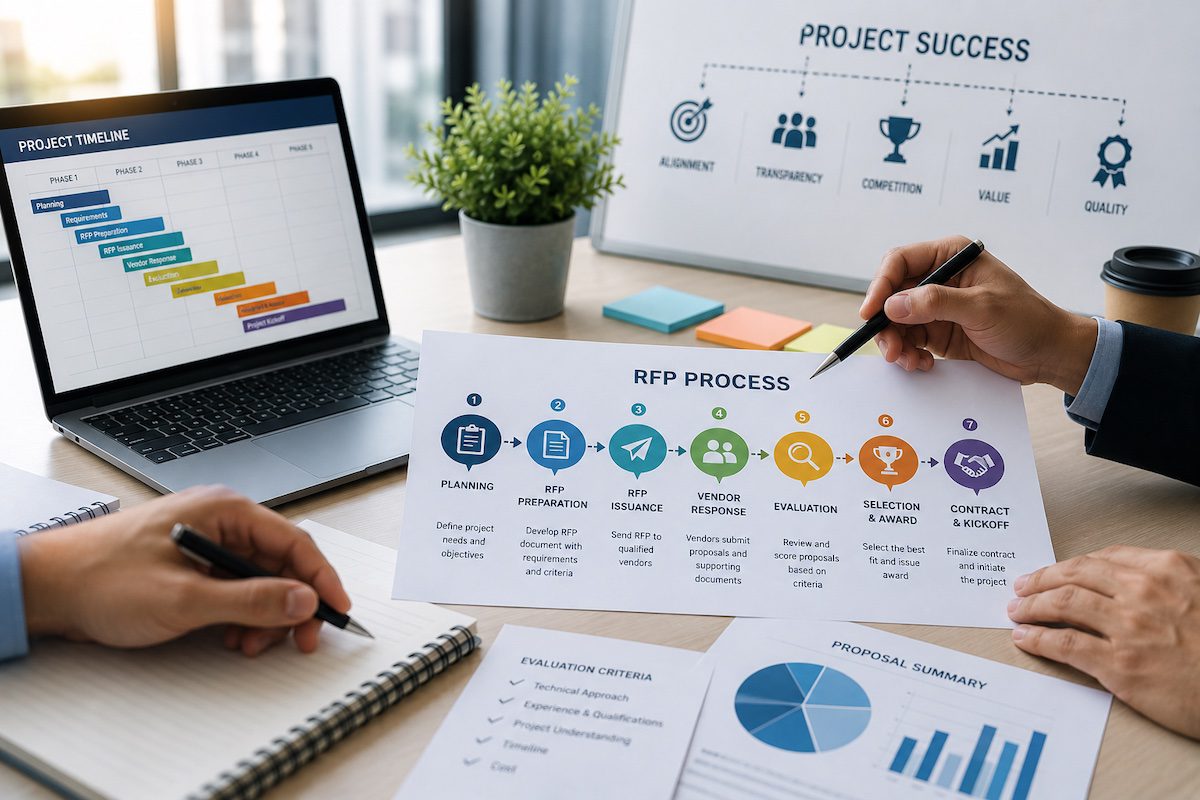
How the RFP Process Works in Project Management
Step 1: Define Project Requirements
Project needs, constraints, and outcomes are clearly defined.
Step 2: Draft the RFP Document
Procurement or project teams create the RFP with structured requirements.
Step 3: Invite Vendors
Qualified vendors are shortlisted and invited.
Step 4: Proposal Submission
Vendors submit technical and commercial proposals.
Step 5: Evaluation and Scoring
Proposals are evaluated using scoring models and comparison frameworks.
Step 6: Vendor Selection
The most suitable vendor is selected based on overall value.
Step 7: Contract Negotiation
Terms, pricing, and deliverables are finalized.
Step 8: Project Execution
Work begins, and performance is monitored.
Types of RFPs in Project Management
IT RFPs
Software development, cloud systems, and integration projects.
Construction RFPs
Infrastructure and building projects.
Consulting RFPs
Strategy and transformation initiatives.
Government RFPs
Public sector procurement with strict compliance rules.
Outsourcing RFPs
Long-term service delivery contracts.
RFP vs RFI vs RFQ
RFI (Request for Information)
Used to gather general information about vendors and capabilities.
RFQ (Request for Quote)
Used when requirements are clear, and pricing is the main factor.
RFP (Request for Proposal)
Used when both the solution approach and pricing must be evaluated.
How Project Managers Evaluate RFP Responses
Project managers evaluate proposals based on:
Technical Capability
Can the vendor deliver the required solution
Experience
Has the vendor handled similar projects
Execution Approach
Is the methodology realistic and effective
Cost Structure
Is pricing aligned with budget and value
Risk Management
Does the vendor identify and mitigate risks
Timeline Feasibility
Can deadlines be realistically met
Resource Allocation
Are qualified experts assigned
Compliance
Does the proposal meet legal requirements
Common Challenges in Project Management RFPs
Unclear Scope
Leads to misalignment between vendor and client
Weak Vendor Responses
Reduces the quality of the evaluation
Unrealistic Timelines
Creates execution pressure and delays
Budget Gaps
Leads to incomplete or failed delivery
Poor Evaluation Framework
Makes decisions subjectively
Best Practices for Strong RFPs
- Clearly define scope and deliverables
- Align stakeholders before issuing RFP
- Use measurable evaluation criteria
- Keep requirements realistic
- Apply structured scoring models
- Focus on risk management
- Ensure transparency across teams
Industries That Use RFPs in Project Management
- Information Technology
- Construction and infrastructure
- Government and public sector
- Healthcare systems
- Energy and utilities
- Engineering and manufacturing
- Consulting services
How AI Is Changing RFPs in Project Management
AI is increasingly used to:
- Draft RFP documents
- Analyze vendor responses
- Identify risks
- Compare proposals
- Automate scoring
However, human judgment is still required for:
- Final vendor selection
- Stakeholder alignment
- Risk interpretation
- Strategic decision making
Frequently Asked Questions (FAQs)
What is an RFP in project management?
An RFP in project management is a formal document used to invite vendors to submit proposals for completing part of a project, including methodology, cost, and timeline.
Why is an RFP important in project management?
It helps standardize vendor selection, reduce risk, define scope clearly, and improve decision making in complex projects.
Who prepares an RFP in project management?
Typically, project managers, procurement teams, and key stakeholders collaboratively prepare the RFP.
What is included in a project management RFP?
It includes the scope of work, deliverables, timeline, budget, technical requirements, and evaluation criteria.
What is the difference between RFP and RFQ in project management?
An RFP evaluates both solution approach and pricing, while an RFQ focuses mainly on cost for predefined requirements.
How are RFPs evaluated in project management?
They are evaluated using scoring models based on technical capability, experience, cost, risk management, and timeline feasibility.
What industries use RFPs the most?
IT, construction, government, consulting, healthcare, and infrastructure projects commonly use RFPs.
How long does an RFP process take?
Depending on complexity, it can take a few weeks to several months from drafting to vendor selection.
Final Thoughts
An RFP in project management is a critical tool that ensures structured, transparent, and risk-aware vendor selection. It directly influences project success by aligning scope, cost, timeline, and execution before work begins.
When done properly, it reduces ambiguity and improves delivery outcomes across complex projects.
At The Write Direction, we have seen how unclear or poorly structured RFPs often lead to misaligned vendors and project delays. Strong documentation and clear communication significantly improve project outcomes.
Our team helps organizations create precise, structured, and outcome-focused RFP documents that improve vendor alignment, reduce risk, and increase project success rates across industries.

Related posts


Recent Posts