
What Is an RFP in Construction? Process & Best Practices | The Write Direction
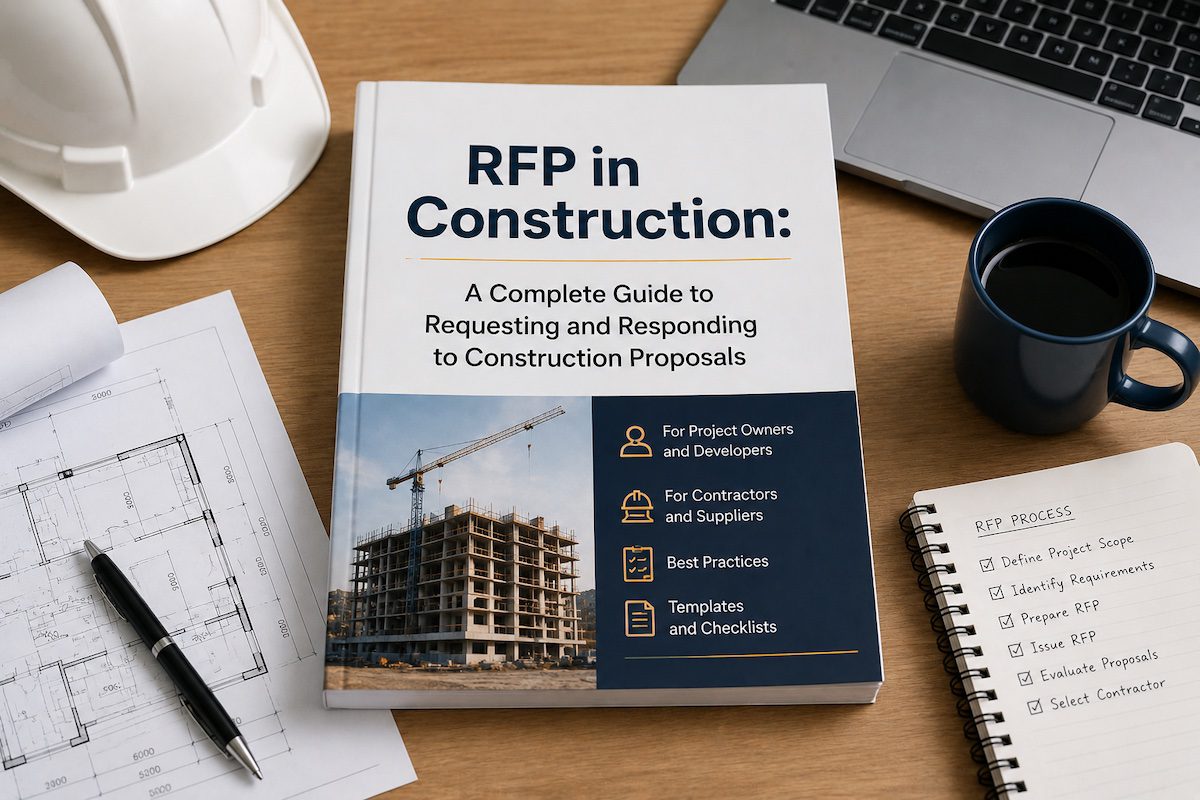
An RFP in construction is the document that determines who builds what, on what terms, and at what cost. It gives project owners a structured way to evaluate contractors on methodology, qualifications, schedule, safety, and price, not price alone. For contractors, it is the entry point to winning work. This guide covers what a construction RFP contains, how it differs from related procurement documents, and how the process unfolds for owners and bidders.
What Is an RFP in Construction?
An RFP in construction is a formal solicitation issued by a project owner, often working with the architect or engineer of record (A/E), inviting qualified contractors, construction managers, or design-build firms to submit proposals for a defined project. Unlike an Invitation to Bid (ITB), an RFP evaluates how a contractor will deliver the project, not only the price. Owners use RFPs when complexity demands more than a price comparison. Hospitals, schools, transit projects, and federal infrastructure require evaluation of safety records, technical approach, schedule discipline, and team experience.
RFP vs RFQ vs RFI vs ITB
Construction procurement uses several related documents.
RFI (Request for Information) is exploratory. Owners use it to gather information about market capabilities, technologies, or vendor offerings without commitment.
RFQ (Request for Qualifications) narrows the field by confirming credentials, past performance, and bonding capacity. Some firms also use RFQ to mean Request for Quote, a price-only document used when the scope is fully defined.
ITB (Invitation to Bid) is a price-driven solicitation against complete drawings and specifications, common on public design-bid-build projects.
RFP (Request for Proposal) is the most comprehensive of the four. It asks for a complete solution: methodology, schedule, key personnel, references, pricing, and contract terms. RFPs typically follow an RFQ on larger public projects.
The Five-Pillar Anatomy of an RFP in Construction
Construction RFPs share a structure that breaks into five functional pillars.
Pillar 1: Project Identity
Project background, scope of work, site conditions, owner objectives, and references to drawings and specifications, typically organized under the CSI MasterFormat with engineering content aligned to ASTM and ANSI standards.
Pillar 2: Submission Architecture
Format, page limits, file types, deadlines, single point of contact, addenda protocol, and rules for the pre-proposal conference, site walk, or mandatory prequalification.
Pillar 3: Technical Requirements
Project methodology, preliminary schedule, key personnel resumes, OSHA-aligned safety program, quality assurance plan, sustainability targets such as LEED certification, and references from comparable projects.
Pillar 4: Commercial Requirements
Pricing structure (lump sum, cost-plus, unit price, time and materials, or Guaranteed Maximum Price), payment terms, bonding requirements (bid bond, performance bond, and payment bond, all issued by approved sureties), insurance certificates including general liability, workers’ compensation, and builders risk, and the proposed contract form, often AIA A101 or A201, ConsensusDocs, EJCDC for engineering work, or DBIA documents for design-build.
Pillar 5: Evaluation Framework
Scoring criteria, weights, interview rounds, and any Best and Final Offer (BAFO) stage. Transparent criteria help responders prioritize effort and help owners defend the selection if challenged.
How Project Delivery Method Shapes the RFP
The project delivery method shapes the entire RFP. The same project produces a different document under each model.
Design-Bid-Build (DBB) is the traditional sequence. The owner hires a designer first, then issues an RFP to general contractors using completed drawings. These RFPs are highly prescriptive.
Design-Build (DB) combines design and construction under one contract. RFPs are performance-based and ask responders to propose a design solution along with construction.
Construction Manager at Risk (CMAR) brings the contractor in early for preconstruction services, then converts to a Guaranteed Maximum Price. The RFP focuses on preconstruction expertise and team chemistry.
Integrated Project Delivery (IPD) uses a multi-party agreement among owner, designer, and builder, with shared risk and reward.
Public-Private Partnership (P3) projects involve long-term financing, operations, and maintenance. RFPs are extensive and lifecycle-focused.
Job Order Contracting (JOC) uses a master contract with pre-negotiated unit price coefficients for recurring small-to-mid-size work, common on military bases, federal facilities, and school districts.
The Construction RFP Process: Eight Stages from Need to Award
Needs analysis and stakeholder alignment. The owner clarifies internal goals, budget ceilings, and non-negotiables.
- Scope, budget, and delivery method selection. These decisions determine what the RFP will look like.
- RFP drafting and internal review. Legal, procurement, and technical teams review before release.
- Distribution. Public sector RFPs are posted openly through SAM.gov for federal work or state procurement portals. Private owners may invite a shortlist.
- Pre-proposal conference and Q&A period. Questions are answered through formal addenda so all bidders see the same information.
- Proposal submission. Contractors submit by the stated deadline; late submissions are rejected.
- Evaluation, scoring, and BAFO. Evaluators apply weighted criteria that combine technical and cost scores.
- Award, negotiation, and contract execution. The selected contractor enters final negotiation, followed by a Notice of Award and a Notice to Proceed.
Owner-Side Best Practices
Owners who consistently attract strong responses define realistic scope, budget, and timeline before drafting; publish evaluation criteria and weights upfront; and allow enough response time for meaningful proposals. Many use a prequalification step to filter the bidder pool before issuing the full RFP.
Federal projects require compliance with the Davis-Bacon Act for prevailing wages, the Miller Act for bonding on contracts over $150,000, the Buy American Act for material sourcing, and the Federal Acquisition Regulation (FAR) for procurement procedures. State agencies follow their own statutes, and HUD, DOT, or FTA-funded work carries additional requirements. Diversity goals such as DBE (Disadvantaged Business Enterprise) or MWBE (Minority and Women-Owned Business Enterprise) participation are increasingly standard.
At The Write Direction, we help owners produce RFP documents that balance precision with readability, so qualified contractors can respond with confidence.
Contractor-Side Best Practices
Strong contractors make a clear bid or no-bid decision early, based on fit and capacity.
For teams that need support developing a compliant, persuasive response, our RFP writing services can help turn complex solicitation requirements into a clear, well-structured proposal.
They build win themes around the owner’s stated priorities, follow submission format strictly because non-compliance triggers disqualification on public projects, and tailor every section to the specific project rather than recycling boilerplate.
Pricing should align with the delivery method and reflect a realistic risk position. Contractors should also confirm bonding capacity with their surety before committing to a bid.
Common Mistakes That Sink Construction RFPs
Owners issue vague scopes, set unrealistic timelines, change requirements mid-process without proper addenda, or publish evaluation criteria that do not match stated priorities. Burdensome submission requirements drive away qualified firms.
Contractors submit template responses, ignore page limits, provide weak past-performance narratives, and ask clarification questions after the cutoff. They also underestimate the time required to assemble resumes, schedules, and methodology sections under deadline pressure.
Frequently Asked Questions
What is the difference between an RFP and a bid in construction?
A bid is a price submission against a fully defined scope, common in design-bid-build projects. An RFP in construction asks for a comprehensive solution including methodology, schedule, qualifications, and pricing. RFPs are used when the owner wants to evaluate value, not just cost.
How long does the construction RFP process take?
Simple commercial or renovation projects move from RFP release to contract signing in four to six weeks. Larger or design-build projects take three to six months. Public sector and federally funded projects often take longer because of mandatory review periods, protest windows, and approval steps.
Are RFPs in construction legally required?
Public sector projects almost always require an RFP in construction under state procurement statutes, the Federal Acquisition Regulation for federal work, or local ordinances. Private owners are not legally required to use one, but most do for projects above a certain dollar threshold to control risk and document the selection.
Who typically issues a construction RFP?
Federal agencies such as the U.S. Army Corps of Engineers, GSA, and the Department of Veterans Affairs are major issuers, along with state DOTs, school districts, hospital systems, universities, and municipal governments. Private developers, real estate firms, and corporate facility groups also issue RFPs for significant projects.
What should a winning construction RFP response include?
A strong response includes a tailored executive summary, methodology, realistic schedule, key personnel resumes, safety and quality plan, comparable project references, transparent pricing, and all required certifications and bonds. Every section should map directly to the owner’s stated evaluation criteria.
How are construction RFPs scored and evaluated?
Evaluators apply a weighted scoring matrix that distributes points across technical approach, qualifications, schedule, safety, references, and cost. Common weight distributions place 60 to 70 percent on qualitative factors and 30 to 40 percent on price. Some processes include interviews and a Best and Final Offer round.
Can a contractor negotiate after submitting an RFP response?
Yes. Most processes include a negotiation phase after selection, though it is usually limited to clarifying contract terms, refining the schedule, or adjusting specific scope details. Material changes to pricing or core scope are uncommon and can trigger protests on public projects.
Conclusion
At The Write Direction, we have spent years writing the documents that move construction procurement forward. From owner-side RFPs that attract qualified contractors, to winning RFP responses that turn shortlists into signed contracts, our team brings the structural clarity, technical accuracy, and persuasive narrative that complex construction projects demand. If your next RFP, proposal, or procurement document needs to perform under real evaluation pressure, we are ready to help you build it from the ground up. Talk to The Write Direction about your next construction writing project.

Related posts


Recent Posts