
The Government RFP Process: A Step-by-Step Guide for Contractors
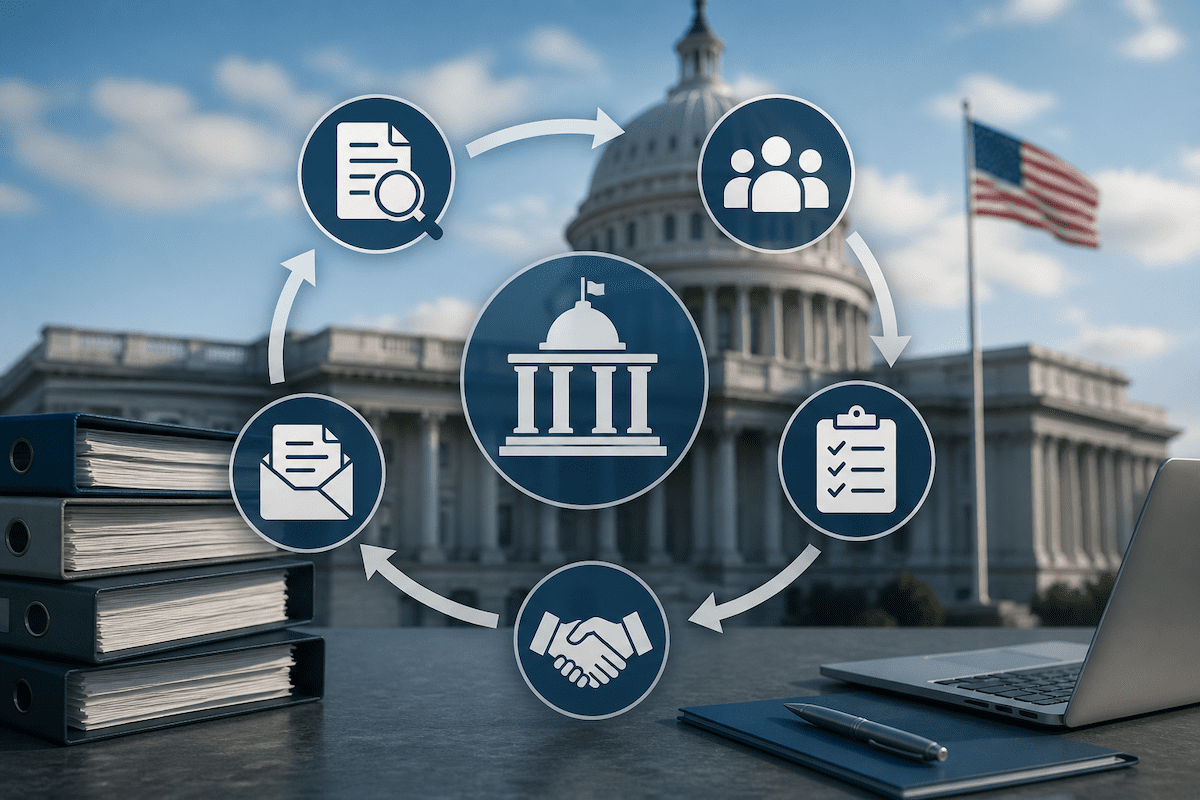
The federal government awards over $700 billion in contracts every year, and most of that work moves through one structured procedure: the request for proposal.
The government RFP process is how public agencies announce what they need, evaluate competing solutions, and award contracts. For contractors hoping to win that work, knowing how the process unfolds on both sides of the table is the difference between a serious pursuit and a wasted effort.
What Is the Government RFP Process?
A request for proposal is a formal solicitation a public agency issues when it needs goods or services from outside vendors. Agencies use RFPs to ensure transparency, fair competition, and best value for taxpayer dollars. Because procurement law governs the process, it is more rigid than commercial RFPs.
At the federal level, Federal Acquisition Regulation (FAR) Subpart 15.2 defines what a federal RFP must contain, how proposals are evaluated, and how revisions are handled. State and local governments operate under their own procurement codes, which vary by jurisdiction but follow the same principles.
For a deeper look at why agencies issue these solicitations in the first place, our breakdown of the purpose of an RFP walks through the strategic rationale.
RFP vs. RFI vs. RFQ vs. IFB
Before getting into the process, contractors should know which type of solicitation they are looking at:
- Request for Information (RFI): Used for agency market research. No contract award follows.
- Request for Quotation (RFQ): Pricing-focused, used when requirements are well-defined and price is the main factor.
- Request for Proposal (RFP): Used when the agency wants a complete solution, including technical approach and past performance.
- Invitation for Bid (IFB) or Sealed Bid: Awarded to the lowest responsive, responsible bidder on price alone.
Agencies often run an RFI first, then release an RFP once requirements firm up. Our guide on what an RFP bid is covers the basics in more depth.
The Six Phases of the Government RFP Process
Phase 1: Pre-Solicitation (Market Research and Acquisition Planning)
On the agency side, contracting officers identify needs, conduct market research, post sources sought notices, and circulate draft RFPs for industry feedback. On the contractor side, this is where capture planning happens: identifying upcoming opportunities, building relationships with program offices, and shaping requirements through RFI responses.
Most government contracts are effectively decided in this phase. Contractors who only show up after the RFP drops are competing for second place.
Phase 2: Solicitation Release and Q&A Period
The RFP gets posted on SAM.gov or an equivalent state platform. The agency may host a pre-proposal conference and accept written questions during a defined window. Once the question period closes, a “cone of silence” typically begins, restricting direct vendor-to-agency communication. Contractors use this window to make a bid/no-bid decision and build a compliance matrix.
Phase 3: Proposal Development
Most federal proposals are organized into four volumes: Technical, Management, Past Performance, and Cost/Price. Strong proposal teams run color team reviews: Pink Team (early draft), Red Team (full compliance and quality review), and Gold Team (final polish).
Three pillars define a winning proposal: compliance with every instruction, responsiveness to every evaluation factor, and persuasion through clear win themes. Our request for proposal writing tips cover how to balance all three.
Phase 4: Submission and Initial Compliance Review
Submission rules are strict. Format, page limits, font size, and electronic submission methods are all dictated by the RFP, and missing the deadline by even one minute means automatic disqualification. Once proposals arrive, the contracting officer screens them for compliance before evaluators ever see them.
Phase 5: Evaluation and Source Selection
This is where two scoring frameworks come into play:
- Best Value Tradeoff: Weighs technical merit, past performance, and price together. Agencies can pay more for stronger proposals.
- Lowest Price Technically Acceptable (LPTA): Awards to the cheapest proposal that meets minimum technical thresholds.
Section M of the RFP specifies which framework applies. Evaluators score each proposal, the agency may open discussions or request Final Proposal Revisions (FPRs), and the Source Selection Authority makes the final award decision.
Phase 6: Award and Post-Award
The agency posts the award notice on SAM.gov and notifies offerors. Unsuccessful bidders can request a debriefing, which reveals scoring rationale and proposal weaknesses. If procedural errors are suspected, contractors have ten days to file a protest with the Government Accountability Office or the agency. Once the protest window closes, the contract is executed and work begins.
Section L and Section M: The Hidden Framework
Every federal RFP contains two sections that determine everything about the response:
- Section L (Instructions to Offerors): Tells offerors how to submit, including format, content, and required volumes.
- Section M (Evaluation Factors for Award): Tells offerors how the proposal will be scored.
Strong proposal teams build a compliance matrix that cross-maps every requirement in Section L against every factor in Section M. Skip this step and you risk submitting a proposal that follows the instructions but fails to address what evaluators are actually scoring. The Harvard Kennedy School Government Performance Lab has published extensive guidance on how well-structured RFPs improve procurement outcomes, and the same principles apply in reverse to contractors writing responses.## How Federal, State, and Local RFPs Differ
- Federal: Governed by the FAR, posted on SAM.gov, with full cycles often running 6 to 12 months. Protest procedures are formal and well-defined.
- State (part of the SLED market): Governed by state procurement codes that vary widely. Cycles are usually 90 to 180 days.
- Local (city, county, school district): Smallest dollar values, fastest turnarounds, and the most accessible entry point for newer contractors.
Many contractors building a federal pipeline start with state and local work to establish past performance first.
What It Takes to Win
Winning consistently comes down to a few discipline points:
- Following every Section L instruction exactly
- Addressing every Section M evaluation factor explicitly, in order
- Citing past performance examples that match the scope and dollar value
- Building win themes around the agency’s mission, not your capabilities
- Pricing aligned with the technical narrative and the evaluation framework
Our proposal writing services cover full proposal development, past performance write-ups, and compliance matrices.
Frequently Asked Questions
How long does the government RFP process take?
Federal RFPs typically run 6 to 9 months from release to award, with the full pre-solicitation through post-award cycle stretching 12 months or longer. State and local cycles are shorter, usually 60 to 120 days. Complex defense or IT acquisitions can extend further depending on protests and funding cycles.
Who issues government RFPs?
Federal agencies such as the Department of Defense, GSA, and Health and Human Services issue them, alongside state agencies, county and city governments, school districts, and special-purpose authorities like transit and water districts. The Contracting Officer is the legal authority on the agency side.
What’s the difference between an RFP and a sealed bid?
An Invitation for Bid (IFB) awards the contract to the lowest responsive, responsible bidder on price alone. An RFP allows the agency to evaluate technical approach, past performance, and management plan alongside price. The highest-rated proposal wins, not necessarily the cheapest one.
Can small businesses compete in the government RFP process?
Yes, and many RFPs are set aside specifically for small businesses, including 8(a), HUBZone, WOSB (Women-Owned Small Business), and SDVOSB (Service-Disabled Veteran-Owned Small Business) categories. Set-aside contracts limit competition to certified firms, which dramatically improves win rates for qualifying companies.
What is FAR Subpart 15.2?
Federal Acquisition Regulation Subpart 15.2 governs the solicitation and receipt of proposals in negotiated federal acquisitions. It defines what an RFP must contain, how proposals are evaluated, and how discussions and revisions between agency and offeror are handled.
How are proposals scored in the government RFP process?
Most federal RFPs use one of two frameworks. Best Value Tradeoff weighs technical merit, past performance, and price together, allowing agencies to pay more for stronger proposals. LPTA awards to the cheapest proposal that meets minimum technical thresholds. Section M specifies which framework applies and the relative weight of each factor.
What happens if you lose a government RFP?
Unsuccessful offerors can request a debriefing within three days of award notification. The debrief reveals scoring rationale and proposal weaknesses, which is invaluable for future bids. If procedural errors are suspected, contractors have ten days to file a protest with the Government Accountability Office or with the agency directly.
Partner With The Write Direction on Your Next Government Bid
At The Write Direction, we work with government contractors, primes, and subcontractors to produce compliant, persuasive proposal narratives that map cleanly to Section L and Section M. Our team handles full proposal development, past performance write-ups, capture documents, and compliance matrices across federal, state, and local opportunities, with experience spanning IT, healthcare, defense, and professional services.
If you have an RFP on your desk and a deadline closing in, we can help. Book a consultation call or email us directly to discuss your next bid. Strong writing wins contracts, and we are ready to put ours behind yours.

Related posts

Recent Posts