
Types of Writing Formats: A Complete Guide to Choosing the Right One
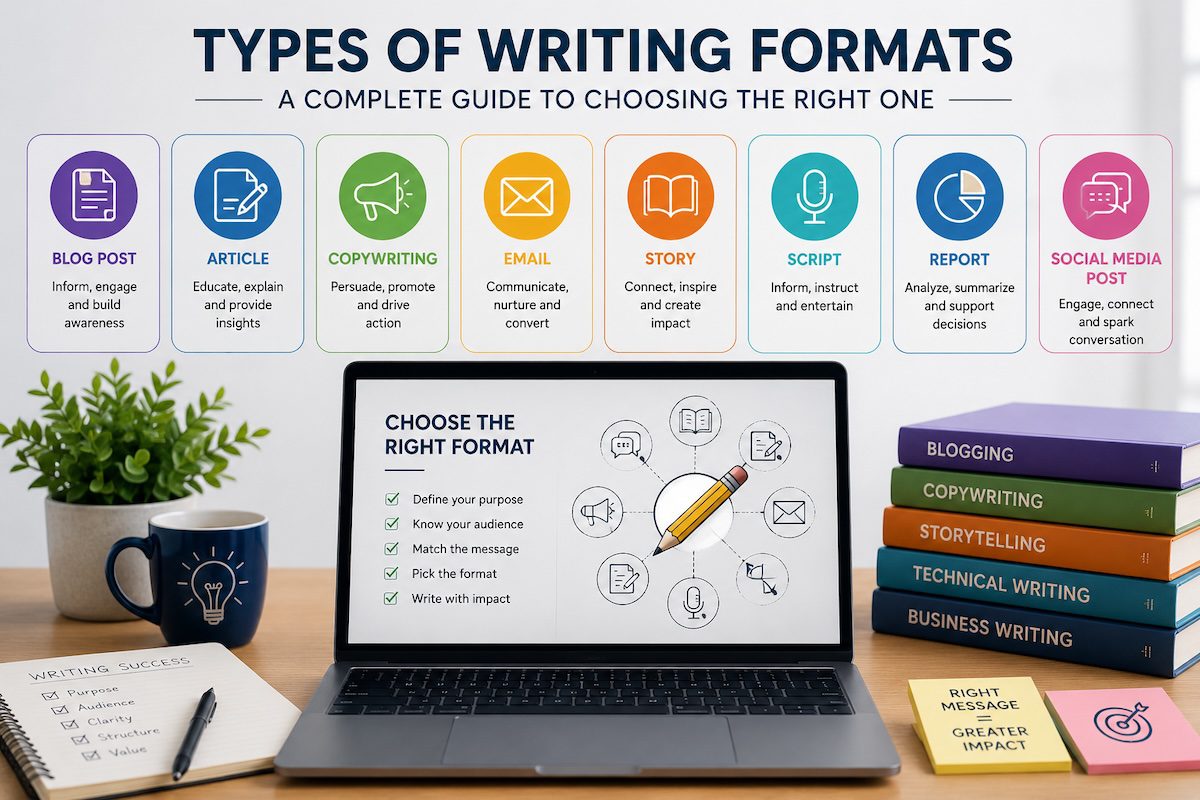
Quick answer: Writing formats fall into three groups. The first is the four core writing modes, which set your purpose: expository, descriptive, persuasive, and narrative. The second is document formats, which set the structure of the piece: an essay, a business report, a user manual, a short story, or a blog post. The third is citation standards, which set how sources and pages are presented: APA, MLA, Chicago, Harvard, or IEEE. Most writing tasks combine one choice from each group.
People use the word “format” in three different ways. Sometimes they mean the mode of writing, such as a persuasive piece versus a descriptive one. Sometimes they mean the type of document, such as a memo, a sonnet, or a landing page. And sometimes they mean a citation standard like APA or MLA.
This guide covers all three, with examples of each, and finishes with a simple method you can use to choose the right format for any task.
Key Takeaways
- Format, style, and genre are different things. Format is the structure, style is the voice, and genre is the category.
- There are four core writing modes: expository, descriptive, persuasive, and narrative. Creative writing is sometimes counted as a fifth.
- Document formats are best grouped by context: academic, business, technical, creative, and digital.
- Citation standards such as APA, MLA, and Chicago govern presentation, not content.
- The DRAFT method helps you pick the right format in five steps.
Format vs. Style vs. Genre: Clearing Up the Confusion
Format is the structure and presentation of a piece of writing. A business report, for example, has an executive summary, findings, and recommendations in a set order.
Style is the tone and voice: formal or conversational, plain or lyrical, first person or third.
Genre is the category a work belongs to, such as science fiction, memoir, or literary criticism.
An easy way to remember the difference: format is the container, style is the voice, and genre is the shelf the work sits on.
The Four Core Writing Modes (Rhetorical Modes)
Every piece of writing has a purpose, and the four rhetorical modes describe the most common ones. Most real documents blend modes, but one usually leads.
Expository Writing
Expository writing explains and informs. It relies on patterns such as cause and effect, compare and contrast, definition, and process analysis. Textbooks, how-to articles, news reports, and manuals are all expository. The goal is simple: the reader should understand something they did not understand before.
Descriptive Writing
Descriptive writing creates a picture in the reader’s mind. It uses sensory detail and figurative language, such as metaphor and simile, to show rather than tell. You will find it in fiction, poetry, travel writing, product descriptions, and character sketches.
Persuasive Writing
Persuasive writing aims to convince. It needs a clear position, credible evidence, an appeal to ethos, pathos, and logos, a response to counterarguments, and a call to action. Opinion columns, cover letters, marketing copy, and grant proposals all depend on it. Strong persuasive writing techniques work in business documents as well as essays.
Narrative Writing
Narrative writing tells a story. It is built from plot, character, setting, conflict, and point of view. Novels, memoirs, and short fiction are the obvious examples, but case studies and brand stories use narrative too.
Some teachers and style guides count creative writing as a fifth mode, since it often blends all four. Reading Rockets has a concise overview of the four purposes of writing if you want a classroom-friendly summary.
Writing Formats by Context
Modes define your purpose. Formats define the document. Each context has its own conventions, and importing them from one context into another, such as writing a business proposal like an academic essay, is one of the most common reasons good content fails. For a broader list of professional types of documents, see our companion guide.
Academic Formats
Academic formats include essays, term papers, theses, dissertations, literature reviews, abstracts, research papers, and lab reports. They share a formal tone, an objective stance, evidence drawn from credible sources, and a required citation standard. Work intended for publication also goes through peer review.
Business and Professional Formats
Business formats include reports, memos, proposals, white papers, press releases, meeting minutes, and emails. For job seekers, resumes, CVs, and cover letters are formats too, and each has its own conventions, which is why many people use a resume and cover letter writing service.
Business writing puts the conclusion first, keeps paragraphs short, and is built for readers who skim. The types of business reports guide breaks down the most common report formats.
Technical and Documentation Formats
Technical formats include user manuals, standard operating procedures (SOPs), quick reference guides, release notes, specifications, and API documentation. Precision matters more than style here: consistent terminology, plain language, numbered steps, and a logical sequence.
Good technical writing lets a reader complete a task without asking anyone for help. It is the core of what The Write Direction produces for clients, from user guides and instruction manuals to procedure manuals. If you are writing one yourself, our guide to what an SOP is is a good place to start.
Creative Formats
Creative writing has more formats than any other context, and they differ widely in structure. Some have strict rules, such as the 14 lines of a sonnet. Others, like free verse, deliberately break them. The format of creative writing depends on which of these forms you choose.
| Creative format | Typical structure | Typical length |
|---|---|---|
| Short story | Single plot arc, few characters, one central conflict | 1,000 to 7,500 words |
| Flash fiction | A complete story in one scene or moment | Under 1,000 words |
| Novel | Multiple plot threads and character arcs, organized in chapters | 50,000 words or more |
| Poetry | Lines and stanzas, either in a fixed form (sonnet, haiku, villanelle) or free verse | A few lines to several pages |
| Screenplay | Scene headings, action lines, and dialogue in a standard industry layout | About one page per minute of screen time |
| Stage play | Acts and scenes, with dialogue and stage directions | One act to full length |
| Creative nonfiction and memoir | True events told with narrative techniques such as scene, dialogue, and reflection | Essay to book length |
Whatever the form, most creative writing still draws on the same core elements: character, setting, plot or structure, point of view, and theme. If you have a book, memoir, or story you want to tell but no time to write it, our custom book writing services and ghostwriting services can help.
Digital and Web Formats
Web readers scan before they read, so digital formats rely on clear headings, short paragraphs, bulleted lists, and a strong first line.
Common web formats include blog posts, landing pages, microcopy, newsletters, listicles, ebooks, and social media posts. Effective blog writing also has to work for search engines and AI assistants, not just human readers.
| Format | Purpose | Typical length | Audience |
|---|---|---|---|
| Essay | Argue or explain a position | 1,000 to 5,000 words | Instructors, academic readers |
| Business report | Inform a decision | 5 to 50 pages | Managers, executives, boards |
| SOP | Standardize how a task is done | 1 to 10 pages | Staff who perform the task |
| Blog post | Inform, engage, and attract search traffic | 800 to 2,500 words | Customers and prospects |
| Short story | Entertain and explore an idea | 1,000 to 7,500 words | General readers |
Citation and Formatting Standards
The third meaning of “format” is the set of rules for citations, references, and page layout. You rarely get to choose. Your instructor, publisher, or journal will tell you which standard to follow.
| Standard | Common fields | Citation style |
|---|---|---|
| APA (7th edition) | Psychology, education, social sciences | Author-date |
| MLA (9th edition) | Literature, languages, humanities | Author-page |
| Chicago (18th edition) | History, publishing, some humanities | Notes-bibliography or author-date |
| Harvard | Many UK, Australian, and business programs | Author-date (no single official version) |
| IEEE | Engineering, computer science | Numbered |
Other standards you may meet include Turabian, AMA for medicine, Vancouver for health sciences, CSE for the sciences, and AP Style for journalism. For APA specifically, the official APA Style site is the most reliable reference. Remember that these standards govern how a document is presented, not what it says.
How to Choose the Right Writing Format: The DRAFT Method
When you are not sure which format to use, work through these five steps.
| Step | Question to ask |
|---|---|
| Define the purpose | Am I explaining, describing, persuading, or telling a story? |
| Read the audience | Who will read this, how much do they know, and how will they read it? |
| Arrange the structure | Which document format fits that purpose and audience? |
| Fit the standards | Is there a required citation style, template, or house style? |
| Tune the tone | How formal or conversational should the voice be? |
Two examples show how it works. An instructor asks you to argue a position on a social science topic: the purpose is persuasive, the audience is academic, so you write an argumentative essay in APA format. A manager asks you to help new staff learn a process: the purpose is expository, the audience is new employees who need to act on it, so the right format is an SOP or a quick reference guide.
Frequently Asked Questions
What are the main types of writing formats?
Writing formats fall into three groups: the four core writing modes (expository, descriptive, persuasive, and narrative), document formats (such as essays, reports, manuals, short stories, and blog posts), and citation standards (such as APA, MLA, and Chicago). Most writing tasks combine one choice from each group.
What are the 4 types of writing?
The four types of writing are expository, which explains; descriptive, which creates a picture; persuasive, which convinces; and narrative, which tells a story. Most documents blend more than one, but a single type usually leads.
What is the format of creative writing?
Creative writing has no single format. It depends on the form you choose. Short stories follow a single plot arc, poems are organized in lines and stanzas, screenplays use scene headings, action lines, and dialogue, and memoirs tell true events using narrative techniques. Most creative forms share the same elements: character, setting, plot, point of view, and theme.
What are the most common types of creative writing?
The most common types are fiction (short stories, flash fiction, and novels), poetry, drama (screenplays and stage plays), and creative nonfiction, which includes memoir and personal essays.
Is a writing format the same as a writing style?
No. Format covers structure and layout, such as headings, sections, and length. Style covers tone, voice, and word choice. The same format, such as a blog post, can be written in a formal style or a casual one.
What writing format should I use for business documents?
Choose the format that matches your goal. Use a report to inform a decision, a proposal to win work, a memo for internal updates, an executive summary for senior leaders, and a white paper to build authority on a topic.
How many writing formats are there?
There is no fixed number. Most guides describe four core writing modes and dozens of document formats. The count depends on how broadly you define “format” and how finely you split categories such as academic or creative writing.
Which citation format is most common?
APA and MLA are the citation styles most students meet first. APA is standard in psychology, education, and the social sciences, while MLA is standard in literature and the humanities. Your instructor, institution, or publisher decides which one applies.
What is the difference between a writing format and a genre?
Format is the structure of a piece of writing, such as a novel, a screenplay, or a report. Genre is its category or subject type, such as mystery, science fiction, or memoir. A mystery can be written as a novel, a short story, or a screenplay.
Putting the Right Format to Work
Choosing the right format comes down to three decisions: your purpose, your document, and your standards. Get those right and the writing has a structure readers recognize and trust.
When the format is unfamiliar, the stakes are high, or the deadline is close, The Write Direction can help with everything from technical documentation and business reports to blog content and books. Ready to start? Book a consultation or email us at [email protected].

Related posts


Recent Posts