
Business Resilience Plan vs Business Continuity Plan: Key Differences and Which One You Need
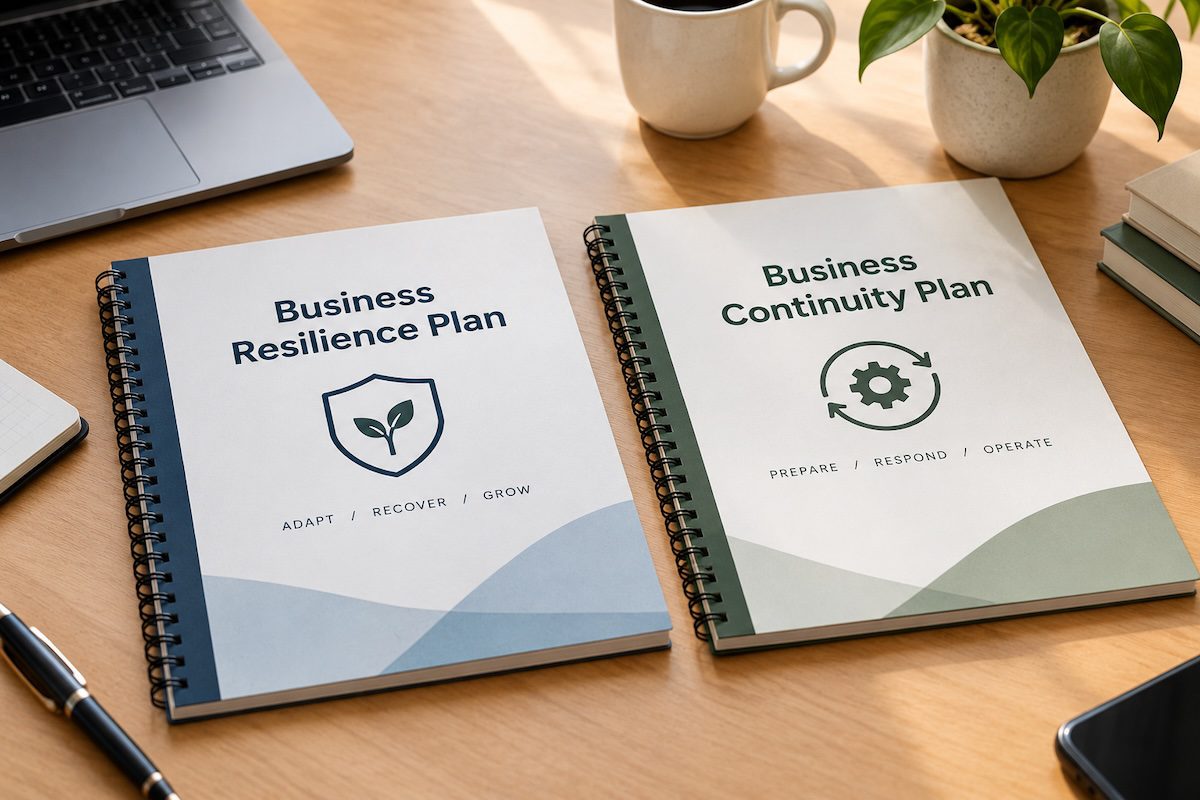
Most teams meet the business resilience plan vs business continuity question when a document request lands with a deadline attached. An RFP asks for “a current business continuity plan.”
Your insurer’s renewal form asks how you would keep operating after a fire or a cyberattack. Your board asks for a resilience strategy. You start to wonder if these are three names for the same document.
They are related documents with different jobs. A business continuity plan tells your team how to keep critical operations running during a disruption and how to restore them afterward.
A business resilience plan helps your company take shocks and adapt over months and years. Continuity handles the outage on Tuesday. Resilience prepares you for the next five years of supply chain, labour, and market change.
Key Takeaways
- Continuity is about response. A business continuity plan (BCP) restores critical processes within set recovery times after a specific disruption.
- Resilience is about capacity. A resilience plan makes the whole company better at taking hits and adapting.
- Continuity sits inside resilience. A resilience program includes your BCP, your disaster recovery plan, crisis communications, and supply chain planning.
- Start with the plan your reader asks for. RFPs, insurers, and lenders tend to ask for a BCP. Boards and financial regulators now ask for resilience as well.
What Is a Business Continuity Plan?
A business continuity plan is a written playbook for keeping your most important work going when something breaks. The break could be a flood, a power outage, a ransomware attack, a supplier failure, or the sudden loss of key staff.
A good BCP answers three practical questions:
- Which processes must keep running, and how fast must each one come back?
- Who does what when the plan activates?
- Which workarounds, backup sites, and resources will your team use?
ISO 22301, the international standard for business continuity management systems, treats continuity as a full cycle: protect, prepare, respond, and recover. Companies use it to keep serving customers at an acceptable level while a disruption lasts.
Core Parts of a Business Continuity Plan
- Business impact analysis (BIA): ranks your processes by how much damage an outage causes as the hours and days pass.
- Recovery time objective (RTO): the longest a process can stay down before the damage becomes unacceptable.
- Recovery point objective (RPO): the most data you can afford to lose, measured in time, such as four hours of transactions.
- Recovery strategies: manual workarounds, alternate sites, backup suppliers, and remote work setups.
- Activation and contacts: who declares a disruption, who gets called, and in what order.
A disaster recovery plan is the IT slice of continuity. It restores systems, networks, and data. If your main concern is getting servers and files back online, our disaster recovery planning service covers that ground in detail.
What Is a Business Resilience Plan?
A business resilience plan looks wider and further ahead. It asks how your company can keep hitting its goals as the world around it changes.
ISO 22316 gives guidance on organizational resilience. The Business Continuity Institute sums up the standard this way: resilient organizations “can absorb and adapt to the changing (business) environment” while they keep delivering on their objectives.
That scope covers slow pressures that fall outside a typical BCP. Think of tariffs that squeeze your margins, a labour shortage, the loss of your largest customer, climate risk to your buildings, or a new regulation that changes how you operate.
Core Parts of a Business Resilience Plan
- Leadership and governance: an executive owner, board reporting, and a clear risk appetite.
- Horizon scanning: a regular look at new risks, from cyber threats and AI failures to supply chain shifts.
- Dependency mapping: a map of the people, technology, suppliers, and facilities behind each critical service.
- Disruption tolerances: the most disruption each key service can take before customers or the business get hurt.
- Financial, supply chain, and people resilience: cash reserves, alternate suppliers, cross-training, and succession plans.
- Learning loops: lessons from real incidents and practice exercises flow back into the plan.
Business Resilience Plan vs Business Continuity: Key Differences
The table below sets the two plans side by side.
| Business Continuity Plan | Business Resilience Plan | |
| Purpose | Restore critical operations after a disruption | Strengthen the ability to absorb change and adapt |
| Time horizon | Hours, days, and weeks | Months and years |
| Trigger | A specific incident activates it | Runs all the time |
| Scope | Named critical processes and sites | The whole organization and its partners |
| Owner | Operations, IT, or a continuity manager | Executive team and board |
| Main standard | ISO 22301 | ISO 22316 |
| Key metrics | RTO, RPO, and time to recover | Disruption tolerances, maturity scores, and lessons applied |
| Review cycle | Once a year and after major changes | Ongoing, with a formal yearly review |
| Deliverable | A plan document with procedures | A program of strategy, policies, and several plans |
Scope
Your BCP covers named processes, such as payroll, order fulfilment, or patient intake. A resilience plan covers everything those processes depend on, including suppliers, finances, culture, and leadership decisions.
Time Horizon
Continuity deals with sudden events. A fire closes your warehouse, and the plan shows your team how to ship from a second site within 48 hours. Resilience deals with long pressure, such as a two-year slump in your biggest market.
Ownership
An operations manager can own a BCP. A resilience plan needs an executive owner, because it shapes budgets, supplier choices, and strategy.
Measurement
You measure continuity by recovery. Did payroll run within its 24-hour RTO? You measure resilience by capability over time. Are your disruption tolerances holding, and did your team close the gaps from the last exercise?
How Continuity Fits Inside a Resilience Program
Picture resilience as the house and continuity as one of its rooms. A full resilience program tends to include:
- A business continuity plan
- A disaster recovery plan
- An incident response plan, including cyber incidents
- A crisis communications plan
- Supply chain and vendor risk plans
- Succession and key-person plans
Gaps open up when a team treats the two terms as one. The team writes a BCP, files it, and calls the company resilient. The plan covers the server room but ignores the single supplier behind your main product. Nobody tests it, so nobody learns from it.
What Goes Into Each Document
The contents show the gap better than any definition.
Typical Business Continuity Plan Sections
- Purpose, scope, and assumptions
- Roles, responsibilities, and the continuity team
- Business impact analysis summary
- Recovery objectives (RTO and RPO) for each process
- Activation criteria and escalation steps
- Recovery procedures for each critical process
- Contact lists and call trees
- Alternate site and remote work arrangements
- Testing schedule and maintenance log
Typical Business Resilience Plan Sections
- Resilience policy and executive sponsor
- Risk appetite and governance structure
- Critical services and their dependency maps
- Disruption tolerances for each critical service
- Horizon scan of emerging risks
- Links to the BCP, disaster recovery, and crisis communications plans
- Exercise program and lessons-learned process
- Metrics and board reporting
Both documents depend on clear procedures. Your recovery steps belong in tested procedure manuals that staff can follow under stress. Both also need owners, version numbers, and review dates, which a sound document control procedure keeps in order. The Write Direction writes the full set, from the BCP itself to the procedures your team will follow on a bad day.
Which Plan Does Your Business Need?
Start with your reader. The person asking for the document tells you which one to write first.
- You run a small or single-site business. Start with a business continuity plan. Keep it short, test it once a year, and expand it as you grow.
- An RFP, contract, insurer, or lender asks for a plan. They almost always mean a business continuity plan, so write that first. Public buyers often score it as a mandatory requirement, so check it against your RFP compliance checklist before you submit.
- You run a federally regulated financial institution in Canada. OSFI Guideline E-21 covers both business continuity and operational resilience, and OSFI expects full adherence by September 1, 2026.
- You operate across several sites or rely on a few key suppliers. Build a resilience program and keep your BCP inside it.
Free government resources can help you begin. Ready.gov explains business impact analysis and risk assessment for US businesses, and the Government of Canada’s business continuity planning page points to federal continuity guidance.
If you already have an operational plan, use it as your starting list. It names the processes, resources, and owners your BCP needs to protect.
Building Both With the BRIDGE Framework
BRIDGE gives you six steps. The first two build your continuity plan, and the last four turn it into a resilience program.
B: Business Impact Analysis
List your processes and estimate the cost of an outage at one hour, one day, and one week. Count lost revenue, contract penalties, safety risks, and damage to your reputation. The processes with the steepest costs become your critical list.
R: Recovery Targets
Set an RTO and an RPO for each critical process. A clinic might give patient scheduling an RTO of four hours. An online store might set an RPO of 15 minutes for order data.
I: Interdependency Mapping
Trace each critical process back to the people, systems, suppliers, and buildings it needs. Mark any single point of failure, such as one supplier, one server, or one employee who knows the system.
D: Disruption Tolerances
Decide how much disruption each key service can take before customers get hurt. Tolerances push you past recovery times to a bigger question: can the business survive a long event?
G: Governance and Ownership
Name an owner for every plan and an executive sponsor for the program. Set a review date for each document and report results to leadership at least once a year.
E: Exercise and Evolve
Run a tabletop exercise at least once a year. Walk your team through a realistic scenario, record what failed, and fix it. Feed lessons from real incidents back into the plans the same way.
Common Mistakes When Planning for Disruption
- No named owner. A plan without an owner goes stale within a year.
- No testing. Your team will find the gaps during a real crisis instead of during a drill.
- IT-only scope. Restoring servers does little if your staff, premises, or suppliers are the ones out of action.
- No review cycle. Phone numbers change, staff leave, and suppliers close. An old plan sends people in the wrong direction.
- A copied template. Auditors and RFP evaluators spot generic plans fast, and a template seldom matches how your business runs.
Most of these gaps surface during an audit or a contract review. The Write Direction’s governance, risk, and compliance documentation service builds owners, review dates, and evidence trails into every plan from the start.
Choose the Plan, Then Build the Program
A business continuity plan gets you through the next disruption. A business resilience plan keeps you strong through the years of change that follow. Most companies need both, and most should start with continuity because their customers, insurers, and lenders ask for it first.
At The Write Direction, we write business continuity plans, resilience frameworks, and the procedures behind them, so your documents hold up in an audit, an RFP evaluation, or a real outage. Book a consultation through our business consulting services page, or email us at [email protected] to talk through your plan.
Frequently Asked Questions
Is business continuity part of business resilience?
Yes. Business continuity is one discipline inside a wider resilience program. Your continuity plan restores critical operations after a disruption, while resilience also covers governance, supply chain risk, finances, and long-term adaptation.
If you compare a business resilience plan vs business continuity, the clearest answer is that resilience contains continuity.
What is the difference between a business continuity plan and a disaster recovery plan?
A business continuity plan keeps the whole business running, including people, premises, suppliers, and processes. A disaster recovery plan focuses on IT: restoring systems, networks, and data within set recovery times.
Most companies treat the disaster recovery plan as one part of the wider business continuity plan. If your servers fail but your staff can still work, the disaster recovery plan leads. If your building floods, the continuity plan takes over.
Does a small business need a business resilience plan?
Most small businesses should start with a short business continuity plan, because customers, insurers, and lenders ask for it first.
As the business grows, opens new sites, or comes to rely on a few key suppliers, a business resilience plan becomes worth the effort. You can build it in stages on top of your continuity plan.
How often should you update a business continuity plan?
Review your business continuity plan at least once a year. Update it sooner after a major change, such as a new site, a new core system, a switch in key suppliers, or a real incident. Test it with a tabletop exercise at least once a year and record what your team learned.
What are the 4 Ps of business continuity?
The 4 Ps are people, processes, premises, and providers. Your business continuity plan should explain how you protect and replace each one: staff and key roles, critical workflows, buildings and equipment, and the suppliers you depend on. Some frameworks swap providers for partners or products, but the idea stays the same.

Related posts


Recent Posts