
How to Improve Your RFP Process: 6 Proven Steps to Faster, Smarter Sourcing
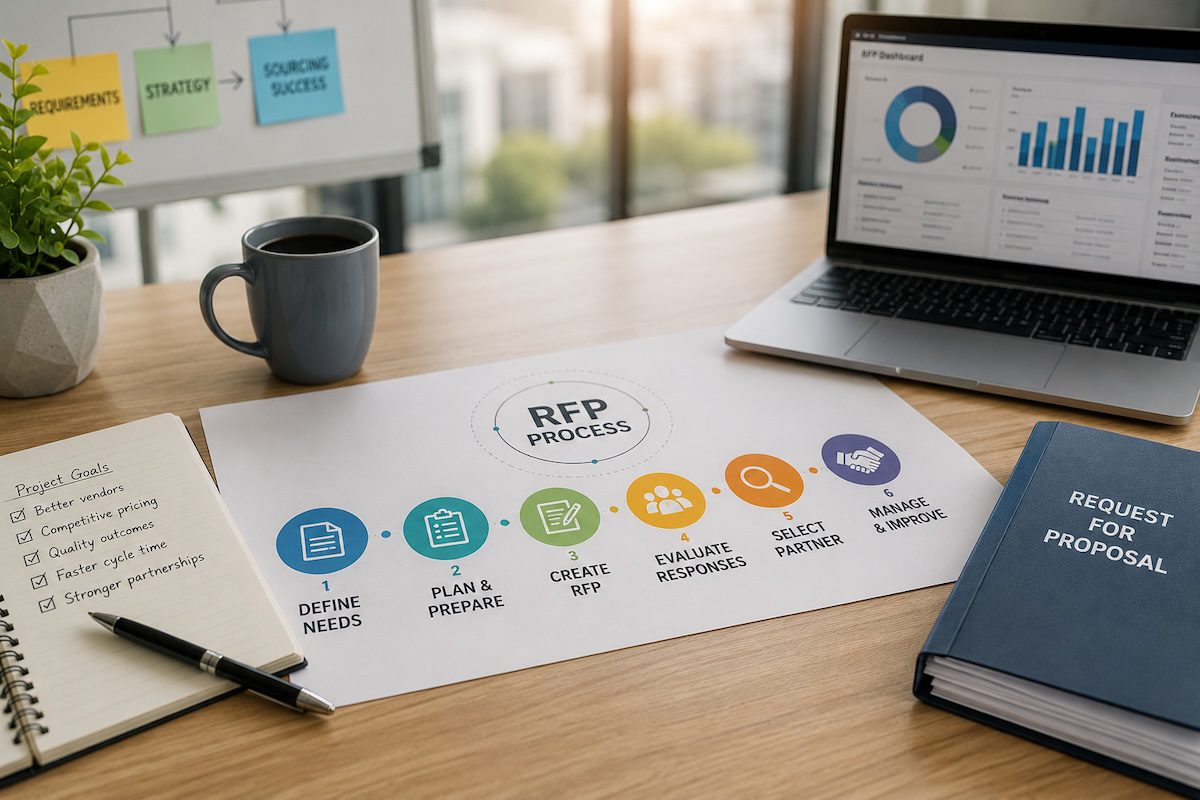
If you want to improve your RFP process, start with an uncomfortable truth: the proposals you receive are only as strong as the request you send.
A vague or bloated request for proposal produces off-target responses, and cleaning up the mess costs your team weeks. Strong procurement teams treat the RFP as a communication tool, not a formality, because a clear request attracts better vendors, speeds up evaluation, and leads to a decision that delivers real value.
Most organizations run their RFP process on habit, using templates inherited years ago. The result is a slow cycle, inconsistent scoring, and buyer’s remorse when the chosen vendor underdelivers. You can fix this without expensive software or outside consultants. You need a repeatable method.
This guide walks through the REFINE Method, a six-step framework for improving your RFP process from first draft to final contract award.
Each step removes a common point of friction, so your next strategic sourcing event runs faster, scores more fairly, and ends in a stronger vendor partnership.
Key Takeaways
- RFP quality drives response quality. A clear, well-scoped request attracts stronger vendors and produces proposals you can compare apples to apples.
- The REFINE Method gives you a repeatable system: Requirements clarity, Evaluation criteria, Format standardization, Involve stakeholders, Narrow the field, and Evaluate and iterate.
- Build your weighted scoring rubric before you issue the RFP, not after responses arrive, to keep evaluation objective and defensible.
- Standardized templates and a reusable content library cut cycle time and remove the chaos of starting from a blank page.
- A post-award review closes the loop, turning each sourcing event into data that sharpens the next one.
What Improving the RFP Process Actually Means
The request for proposal process, also called a tender in many sectors, is the structured method organizations use to invite, compare, and select vendors for a defined project or service.
Improving it means tightening every stage of vendor selection, from defining what you need to debriefing the vendors who lost, so the full cycle produces better decisions, lower risk, and stronger value for money.
The Two Sides of the RFP Process
Every RFP has two roles. The issuer (the buyer or procurement team) writes and sends the request, then evaluates the responses. The responder (the vendor or supplier) answers the request to win the work.
Both sides talk about improving the RFP process, but they mean different things. This guide focuses on the issuer side, where small changes to how you write and manage the request create the biggest gains. The principles still help responders understand what strong buyers expect.
Signs Your RFP Process Needs an Overhaul
A few symptoms signal trouble. Qualified vendors decline to bid or submit thin responses. Each RFP takes weeks longer than it should. Evaluators score the same proposal in very different ways.
Stakeholders disagree on the winner after the decision is made. The selected vendor struggles to deliver what you assumed they understood. If two or more sound familiar, the problem is the process, not the people.
Why RFP Quality Determines Response Quality
A request for proposal is a writing project, and the quality of that writing shapes everything that follows. Ambiguous scope invites guesswork. Missing evaluation criteria invite irrelevant pitches. A wall of disorganized requirements buries the questions that actually matter.
At The Write Direction, our team has built RFPs and proposals across government and private-sector procurement for years, and the pattern holds: clear documentation in, strong responses out. Treating the RFP as a polished piece of professional and technical writing, rather than a form to fill in, is the highest-leverage change most teams can make.
The REFINE Method: A Framework to Improve Your RFP Process
The REFINE Method organizes RFP improvement into six steps, each targeting a specific point of friction. You do not need to adopt all six at once. Start with the step that matches your biggest pain point, then layer in the rest.
| Common RFP problem | REFINE lever | Outcome |
| Vendors misread what you need | R: Requirements clarity | Accurate, on-target proposals |
| Scoring feels subjective or inconsistent | E: Evaluation criteria | Fair, defensible decisions |
| Every RFP starts from scratch | F: Format standardization | Faster drafting, consistent quality |
| Stakeholders weigh in too late | I: Involve stakeholders | Fewer reversals and surprises |
| Too many low-fit bidders to review | N: Narrow the field | Less wasted evaluation time |
| The same mistakes repeat each cycle | E: Evaluate and iterate | Continuous improvement |
Step 1: Define Requirements Before You Write (R)
The most common RFP mistake happens before anyone writes a word: teams draft questions before they agree on what they actually need. Reverse that order.
Begin with a needs analysis. Gather input from every group the purchase affects, including end users, IT, finance, legal, and executive sponsors. Document the business problem you are solving, not just the product features you want. Then translate that into clear, measurable requirements: functional needs, technical specifications, integration and security expectations, data and compliance requirements, a budget range, and a realistic timeline.
Separate your must-haves from your nice-to-haves so vendors know which requirements are deal-breakers and which are preferences. When your scope of work and success criteria are specific, vendors propose real solutions instead of guessing. Clarity here prevents the biggest source of wasted effort later.
Step 2: Build Evaluation Criteria Upfront (E)
Decide how you will score proposals before you send the RFP, not after the responses land. Building your evaluation criteria upfront keeps scoring objective and stops you from anchoring on the flashiest pitch or the lowest sticker price.
Create a weighted scoring rubric that reflects your priorities. Common categories include solution fit, total cost of ownership (TCO), vendor experience and references, implementation approach, and long-term scalability. Set minimum pass/fail requirements, assign each category a weight, and define what a strong answer looks like in advance.
Share the general criteria with vendors in the RFP itself. When bidders understand how you will judge their response, they focus on what counts, and you receive proposals you can compare apples to apples. This step turns subjective debate into a structured, side-by-side evaluation.
Step 3: Standardize Your Format and Templates (F)
If every RFP starts from a blank page, you pay for the same work over and over. Standardize the format so your team builds on a proven structure instead of reinventing one each time.
Create a master RFP template with consistent sections: project background, scope of work, requirements, submission instructions and format, timeline, evaluation criteria, and a named point of contact. Maintain a reusable content library of boilerplate language, standard questions, and approved legal and contract terms. Use version control so everyone works from one current document.
A centralized playbook does more than save time. It enforces consistency, so quality no longer depends on who runs the RFP that week.
As your sourcing volume grows, ad hoc methods break down, and a standardized process keeps you scalable. This is where many teams bring in professional writing support to build templates that are clear, compliant, and genuinely reusable.
This is where many teams use professional RFP writing services to build templates that are clear, compliant, and genuinely reusable.
Step 4: Involve the Right Stakeholders (I)
An RFP run by one person in a silo produces blind spots. Involve the right people early, and assign clear roles so collaboration does not turn into chaos.
Build a cross-functional evaluation committee that includes the stakeholders who defined the requirements.
A simple RACI chart, mapping who is Responsible, Accountable, Consulted, and Informed, prevents the confusion of everyone editing everything. Bring in subject matter experts to write and score technical sections, where qualitative requirements need expert judgment.
Name a single point of contact and run a structured Q&A period so every vendor receives the same information. Consistent communication keeps the process fair, protects the level playing field, and reduces the risk of a disputed award or a perceived conflict of interest.
Step 5: Narrow the Field Strategically (N)
More proposals are not better. Reviewing a dozen low-fit responses drains your team and slows the decision. Narrow the field on purpose.
For complex or high-value purchases, run a two-step process. Send a request for information (RFI) first to cast a wide net and prequalify suppliers, then invite only the strongest candidates to the full RFP. This screens the market quickly without the heavy work of evaluating detailed proposals from everyone. When you weigh procurement documents, remember that an RFI gathers general information, while an RFP requests detailed solutions and pricing.
Limit your RFP invitations to vendors with a genuine chance of winning. After responses arrive, shortlist two or three finalists for demos, presentations, and reference checks, then run due diligence on financial stability and delivery capacity. These conversations reveal capabilities and cultural fit a written proposal cannot. Use clarification and negotiation rounds with the finalists to refine scope, pricing, and terms before you award the contract.
Step 6: Evaluate and Iterate to Close the Loop (E)
The RFP process does not end when you sign the contract. The best teams treat every sourcing event as a chance to improve the next one.
Run a short retrospective, or lessons-learned review, after each award. Ask what slowed you down, where evaluators disagreed, and which parts of the RFP caused confusion. Track a few metrics over time: total cycle time, vendor participation rate, the number of qualified responses, and whether the selected vendor delivers the expected ROI.
Debrief the vendors too. Give unsuccessful bidders honest feedback so strong vendors keep bidding on your future requests, and plan a clean contract handover so the new vendor relationship starts well.
Finally, document your scoring results and rationale. A clear audit trail supports compliance, satisfies governance requirements, and makes your next RFP cycle faster because the reasoning is already on paper.
Common RFP Process Mistakes to Avoid
Avoid these recurring traps:
- Vague scope. If vendors cannot tell exactly what you need, their proposals miss the mark.
- No point of contact. Without a clear contact, vendors guess and flood you with duplicate questions.
- Unrealistic timelines. Too little time pushes good vendors to opt out, so include the release date, question deadline, submission date, and award date.
- Too many bidders. Inviting everyone multiplies evaluation workload without improving the outcome.
- No scoring rubric. Without weighted criteria set in advance, evaluation slides into personal preference.
- Skipping the debrief. Teams that never review the process repeat the same mistakes on every RFP.
Tools and Templates to Support an Improved RFP Process
Software can help, but it does not replace a sound process. RFP management platforms, e-sourcing tools, and AI-assisted proposal software centralize documents, store reusable answers, and speed up collaboration.
They earn their keep for teams handling high volumes of RFPs. If you adopt one, decide what you want it to do first, so you choose a tool that fits your workflow.
The highest-impact upgrade is usually the writing itself. A well-structured template, a clear scope of work, and precise evaluation criteria do more for your outcomes than any platform. This is exactly the work we handle at The Write Direction.
Our diverse team of experts builds tailored RFP templates, scope documents, and evaluation frameworks that are clear, compliant, and built to reuse. Through our partnership with sister company Web Sharx, we extend that into end-to-end content and digital solutions when you need them. Strong tools and strong documentation together give you a process that scales.
Frequently Asked Questions
What is the RFP process in simple terms?
The RFP process is the structured way an organization invites vendors to propose solutions for a specific project, then compares those proposals and selects the best fit.
A typical request for proposal, sometimes called a tender, includes the project scope, requirements, submission instructions, a timeline, and the evaluation criteria. It creates a fair, transparent path from defining a need to negotiating and awarding a contract.
How long does an RFP process take?
Most RFP processes take four to eight weeks from planning to a signed contract, though complex purchases run longer.
The biggest delays are organizational, not technical: slow stakeholder sign-off, unclear requirements, drawn-out negotiation, or too many bidders to review. Standardized templates and an evaluation team ready in advance shorten the cycle.
How can I make my RFP process faster without sacrificing quality?
To improve your RFP process speed without cutting corners, standardize your templates, build your weighted scoring rubric before issuing the request, and limit invitations to vendors with a real chance of winning.
Reusable content libraries remove repetitive drafting, and an evaluation committee that is ready before responses arrive keeps scoring moving. Speed comes from structure, not shortcuts.
What is the difference between an RFP, RFQ, and RFI?
These procurement documents serve different goals. An RFI (request for information) gathers background to learn what the market offers. An RFP (request for proposal) asks vendors to propose detailed solutions and suits projects where the approach matters, not just price.
An RFQ (request for quotation) focuses on price for clearly defined goods or services. Many buyers use an RFI to shortlist, then issue an RFP.
Do I need RFP software to improve my RFP process?
No. Software helps high-volume teams by centralizing documents and reusable answers, but it cannot fix an unclear request. The fundamentals of how to improve your RFP process are clarity, fair evaluation criteria, the right stakeholders, and a post-award review. Many teams gain more from sharper writing and better templates than from any platform.
Turn Your RFP Process Into a Competitive Advantage
A better RFP process is not about working harder on every bid. It is a repeatable system: clear requirements, evaluation criteria set in advance, standardized templates, the right people involved, a focused shortlist, and an honest post-award review. Follow the REFINE Method, and your sourcing gets faster, your decisions get easier to defend, and your vendor partnerships deliver more value.
At The Write Direction, we have spent years helping procurement teams and businesses across North America turn dense, confusing requests into clear, compelling documentation.
As a professional and technical writing company with deep RFP and proposal expertise, we know the difference between a good outcome and a great one often comes down to how well the request is written.
We work closely with you to build RFP templates, scope documents, and evaluation frameworks tailored to your goals, whether you are issuing your first RFP or refining a process you have run for years.
Ready to improve your RFP process? Book a free consultation to talk through your sourcing challenges, or email us directly at [email protected]. Let’s build documentation that wins.

Related posts

Recent Posts