
RFI vs RFP: Key Differences, When to Use Each (With Examples)
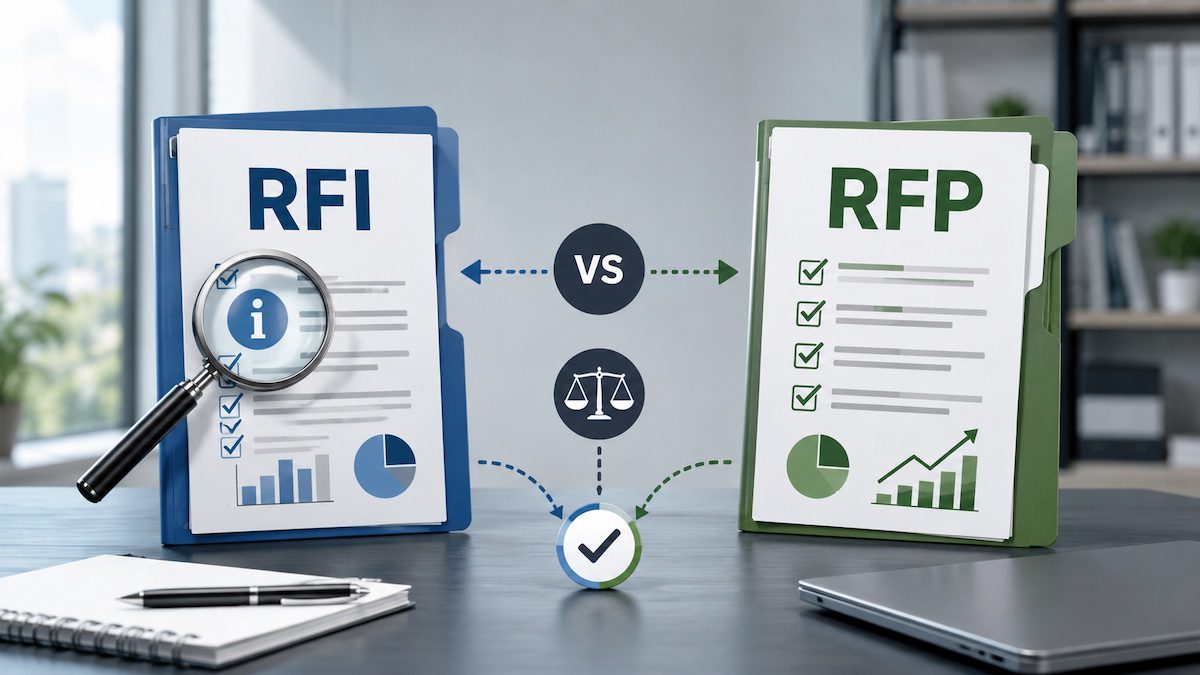
You’re ready to engage outside vendors, but two draft documents sit on your desk: an RFI and an RFP. Which one should you send? The difference between an RFI vs RFP comes down to intent. A Request for Information (RFI) explores the market when requirements aren’t yet defined.
A Request for Proposal (RFP) evaluates shortlisted vendors against defined requirements. Both are RFx documents within the source-to-contract lifecycle, but they sit at different stages. Picking the wrong one costs weeks of evaluation time, frustrates capable suppliers, and produces responses you can’t compare. This guide covers how each document works, how they’re structured, when to combine or skip them, and the five-question test that tells you which one your situation calls for.
Key Takeaways
- An RFI gathers market intelligence early in the sourcing lifecycle; an RFP evaluates shortlisted vendors against defined requirements.
- RFIs typically go to 10 to 20 suppliers with a 1 to 2 week response window; RFPs go to 3 to 5 vendors with a 4 to 6 week window.
- RFIs are non-binding and informal; RFPs signal serious purchase intent and create the audit trail required for defensible vendor selection.
- Use an RFI when requirements, budget, or the vendor landscape are still unclear. Use an RFP when scope is defined and you can commit to a full evaluation.
- A Request for Quotation (RFQ) focuses purely on pricing for a clearly specified product or service.
- Public sector procurement under the Federal Acquisition Regulation (FAR) and equivalent frameworks almost always requires an RFP.
What Is a Request for Information (RFI)?
A Request for Information is a non-binding RFx document used early in the procurement process to gather market intelligence. Buyers issue an RFI when they have a business problem but don’t yet know what solutions exist, who provides them, or what they typically cost.
The goal is exploration, not selection. Procurement teams use RFIs at the pre-qualification stage of the source-to-contract lifecycle to map the supplier landscape, refine internal requirements, and decide which vendors are worth taking into a competitive evaluation. RFIs are also used to manage tail spend, qualify new entrants for strategic sourcing categories, and collect capability statements before a formal solicitation.
Typical use cases include first-time category purchases, emerging technology evaluations (such as AI tooling or new GRC platforms), and large enterprise software selections like ERP, CRM, or SaaS rollouts where stakeholders are still aligning on requirements. RFIs are usually short, open-ended, and sent to 10 to 20 suppliers with a one to two week response window. Because they’re informal, RFIs rarely lead directly to a purchase. Their value is in clarifying the market scan so the next step (an RFP or RFQ) is more focused.
What Is a Request for Proposal (RFP)?
A Request for Proposal is a formal solicitation document that asks qualified vendors to submit detailed proposals for a defined project. Where the RFI explores, the RFP evaluates.
Buyers issue an RFP when they know what they need, have stakeholder alignment on requirements, and are ready to compare how shortlisted vendors will deliver. An RFP includes a statement of work (SOW), functional and technical requirements, evaluation criteria with weighted scoring, pricing structure, contract terms, and submission instructions. RFPs are the standard for complex services, strategic software purchases, consulting engagements, and most public sector contracts where a documented, auditable selection process is mandated.
RFPs are typically sent to three to five shortlisted suppliers after an RFI or pre-qualification questionnaire (PQQ) has narrowed the field. Response windows run four to six weeks because vendors need time to build pricing models, calculate total cost of ownership (TCO), prepare compliance documentation (SOC 2 reports, ISO 9001 certifications, HIPAA attestations, insurance certificates), and route the response through their own legal and finance teams. Many RFPs include a bidder’s conference and a structured Q&A period before submissions close, and some end with a Best and Final Offer (BAFO) round before contract award.
Internally, buyers should expect 60 to 80 hours of evaluation time, often using a scoring matrix to keep the decision defensible. An RFP signals serious buying intent. Sending one without genuine intent to purchase damages a buyer’s reputation with the suppliers they’ll need on future projects.
RFI vs RFP: Side-by-Side Comparison
Compare them across the dimensions that actually shape sourcing work:
| Dimension | RFI | RFP |
| Primary purpose | Gather market information | Evaluate detailed solutions |
| Stage in lifecycle | Pre-qualification, early discovery | Shortlist evaluation, pre-award |
| Level of detail | High-level, exploratory | Comprehensive, prescriptive |
| Pricing included | Rarely, or directional only | Always required |
| Vendors invited | 10 to 20 | 3 to 5 |
| Typical response window | 1 to 2 weeks | 4 to 6 weeks |
| Internal time investment | 20 to 30 hours | 60 to 80 hours |
| Binding intent | Non-binding, informal | Signals serious purchase intent |
| Tone | Open-ended, exploratory | Formal, structured |
| Common next step | RFP, RFQ, vendor demos, PQQ | Contract negotiation, MSA, award |
The underlying difference is intent. An RFI asks, “What’s possible?” An RFP asks, “How will you deliver?” That single shift drives everything else, including how vendors respond and how much time both sides invest.
The RFI to RFP Decision Framework
Here’s a five-question diagnostic that tells you which document fits your situation.
1. Do you have defined requirements?
If your team can list specific functional, technical, and commercial requirements, you’re ready for an RFP. If stakeholders are still debating what the solution should do, you need an RFI first.
2. Do you have an approved budget?
RFPs ask vendors to commit to pricing. Without a budget range you can defend internally, you’ll get proposals you can’t act on. No budget? Issue an RFI.
3. Have you already identified qualified vendors?
If you can name three to five viable suppliers, move straight to an RFP. If you can’t, an RFI helps you map the market first.
4. Are you prepared to evaluate detailed proposals?
A serious RFP evaluation absorbs 60 to 80 hours of cross-functional team time across procurement, finance, legal, IT, and the business owner. If your stakeholders aren’t resourced for that, an RFI provides a lighter filter first.
5. Do you intend to buy within the next 3 to 6 months?
RFPs signal real buying intent. Vendors invest significant time responding, and issuing one without follow-through hurts your reputation across the supplier market.
Rule of thumb: if you answered “no” to two or more, start with an RFI.
How RFI and RFP Documents Are Structured
The structure of each document reflects its intent. RFIs are short and open-ended. RFPs are detailed and prescriptive.
Typical RFI Sections
- Company background and project context
- Statement of the business challenge (the problem, not a predetermined solution)
- Open-ended capability questions
- Supplier qualification questions (years in business, relevant client base, certifications, compliance posture)
- Optional directional pricing or market rate questions
- Response format, NDA requirements, and submission deadline
Typical RFP Sections
- Executive summary and project background
- Detailed statement of work and deliverables
- Functional and technical requirements
- Vendor qualifications and case study requirements
- Pricing structure, payment terms, and TCO breakdown
- Evaluation criteria and weighted scoring rubric
- Implementation timeline, milestones, and acceptance criteria
- Compliance requirements (SOC 2, ISO 9001, HIPAA, data residency, insurance)
- Submission instructions, contract terms, and proposed Master Services Agreement (MSA)
At The Write Direction, our team has built procurement documents across healthcare, financial services, and technology, and the section buyers most often underbuild is the evaluation criteria. When scoring weights are vague, every proposal looks viable and the decision drags on. A clear scoring matrix in the RFP is the single biggest predictor of a fast, defensible award.
When to Combine an RFI and RFP (Or Skip One Entirely)
Some procurement events don’t fit a single document.
For complex enterprise software (CRM, ERP, GRC platforms), the strongest sequence is three stages: an RFI to map the market, vendor demos to validate fit, then a focused RFP to the top three. The demos refine requirements by showing buyers how products actually work, which dramatically improves RFP quality.
Skip the RFI when you’re a repeat buyer in a familiar category, when the vendor landscape is small and well-mapped, or when timeline pressure makes a discovery phase impractical. Skip the RFP when you’re buying a commodity with a clearly defined specification: a Request for Quotation (RFQ) is faster and cleaner. RFQs focus purely on pricing, delivery terms, and contractual conditions for standardized off-the-shelf purchases.
A related document, the Request for Tender (RFT) or Invitation to Tender (ITT), is common in public sector and Commonwealth procurement frameworks and functions similarly to a sealed-bid RFP.
Match the document to where you actually are in the buying journey, not to what your template library has on file.
Common Mistakes That Signal You Picked the Wrong Document
Vendors keep asking clarifying questions
Your RFP went out before requirements were defined. An RFI would have surfaced those gaps before formal solicitation.
Responses look nearly identical
Generic questions produce generic answers. An RFI asking “Tell us about your company,” or an RFP that copy-pastes a boilerplate template, signals you don’t know what differentiation looks like.
You’re surprised by the pricing
You skipped the RFI and lack baseline market intelligence. Establish market rates before issuing an RFP, not after.
Evaluation drags on for months
You invited too many vendors to the RFP stage. Three to five is the right number for a manageable, comparable evaluation.
Top vendors decline to bid
Your RFP is too long, too vague about success criteria, or signals a low-intent buyer. Strong suppliers self-select out of unwinnable or unclear opportunities.
Why Well-Written RFIs and RFPs Outperform Templates
The buyer’s writing quality directly shapes the quality of vendor responses. Template-driven RFPs attract template-driven proposals. A tailored RFI surfaces real differences between suppliers. Procurement documents are content, and content quality compounds across the entire selection process.
At The Write Direction, we write RFPs, RFIs, RFQs, and complete procurement document suites for organizations across regulated industries including healthcare, financial services, education, and professional services. We sit down with your internal stakeholders, translate fragmented requirements into clear evaluation criteria, and structure the document so the vendors you actually want to hear from will take the time to respond well. If you’re preparing for a procurement event and want a document that attracts substantive proposals instead of boilerplate, get in touch with our team. We’ll help you scope it, structure it, and write it so the work it produces is worth the investment.
Frequently Asked Questions
Does an RFI always come before an RFP?
Not always. Many procurement events skip the RFI, especially when the buying organization knows the vendor landscape, is repurchasing in a familiar category, or has clearly defined requirements. For complex, strategic, or first-time purchases, an RFI almost always saves time downstream. For routine categories, going straight to an RFP is faster and equally valid.
Can an RFP include pricing requirements?
Yes. Pricing is a core component of almost every RFP, including itemized costs, payment terms, total cost of ownership, and any assumptions that affect pricing. This is one of the clearest differences from an RFI, where pricing is optional or directional. If you need pricing without a full solution proposal, an RFQ is the right document.
Is responding to an RFI worth a vendor’s time?
Yes. RFI responses often shape the requirements that appear in the eventual RFP. A strong RFI response positions a vendor as a credible candidate and lets them influence how the buyer frames the problem. Skipping RFIs means entering RFPs cold, with less context and less influence on evaluation criteria.
How long should an RFI or RFP be?
RFIs are typically three to eight pages with a small number of high-value questions. RFPs run five to fifteen pages for the core document, plus appendices for technical specifications, contract terms, and submission templates. Longer isn’t better. Overlong documents produce stock answers and discourage top vendors from bidding.
What’s the difference between an RFP, RFI, and RFQ?
An RFI gathers market information when requirements aren’t yet defined. An RFP evaluates how shortlisted vendors will deliver a defined solution, including pricing, approach, and timeline. An RFQ confirms pricing and commercial terms for a clearly defined product or service. Simplest framing: RFI explores, RFP evaluates, RFQ prices.
Do government agencies require an RFP?
In most public sector contexts, yes. Federal, state, provincial, and municipal agencies typically require RFPs for any significant procurement because the process creates the audit trail needed for fair, competitive selection. In U.S. federal contracting, RFPs follow Federal Acquisition Regulation (FAR) rules and are often issued through the General Services Administration (GSA). Most non-U.S. public sector frameworks (UK Procurement Act, EU public procurement directives, Canadian CFTA) have equivalent requirements.

Related posts


Recent Posts