
Tender vs Bid: Key Differences in Procurement Explained
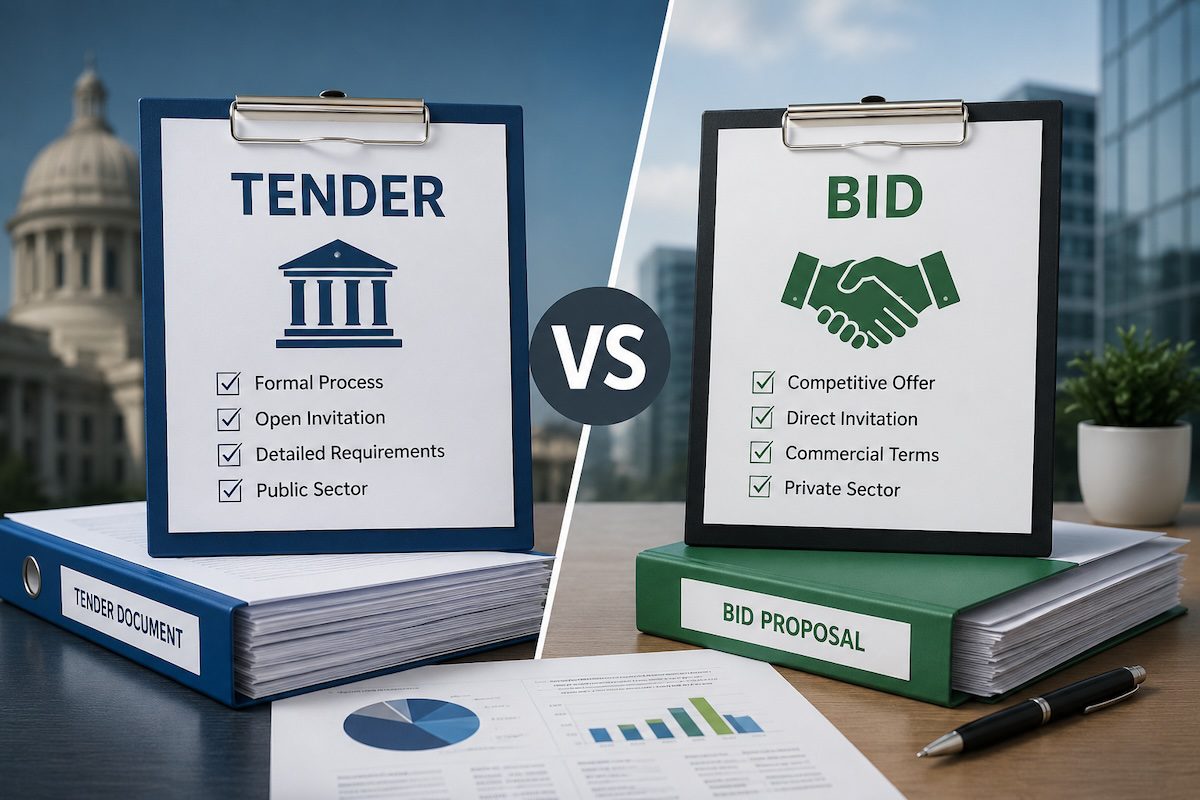
The terms tender vs bid get used as if they mean the same thing, but they sit on opposite sides of the same transaction.
A tender is the formal invitation a buyer puts out to the market. A bid is the offer a supplier sends back.
Confuse the two and you can misread a contract opportunity, mislabel your own documents, or submit the wrong thing entirely. Knowing which is which protects your compliance and improves your win rate.
Key Takeaways
- A tender is an invitation, and a bid is a response. The buyer issues the tender, and the supplier submits the bid in reply.
- They describe different stages, not competing ideas. Tendering is the process of inviting offers, while bidding is the act of making one.
- The terminology is regional. “Tender” dominates in the UK, the EU, India, and Australia, while “bid” and “solicitation” are standard in the United States.
- A bid is usually a binding offer. Once it is submitted and accepted, it can form a legally enforceable contract, so accuracy matters.
- Strong documents win contracts. Clear tenders attract better suppliers, and compliant, well-written bids stand out during evaluation.
What Is a Tender?
A tender is a formal invitation issued by a buyer, such as a client, project owner, or contracting authority, asking suppliers to submit offers for goods, services, or works.
The buyer defines exactly what it needs and then opens the opportunity to the market. In public procurement, tendering exists to keep vendor selection fair, transparent, and accountable.
A complete tender document, sometimes called an Invitation to Tender (ITT) or Request for Tender (RFT), sets out the project specifications, scope of work, terms and conditions, evaluation criteria, and submission deadline. The clearer these details are, the easier it becomes for suppliers to respond accurately and for the buyer to compare offers on equal footing.
Common Types of Tenders
Buyers choose a tender method to match the size, complexity, and risk of the project:
- Open tender: Also called competitive tendering, this is advertised publicly and accepts offers from any qualified supplier. It maximizes competition and transparency.
- Selective (restricted) tender: Only pre-qualified suppliers are invited, which raises the quality of responses and suits specialized or high-value work.
- Negotiated tender: The buyer holds direct discussions with one or a few suppliers, often for complex projects or contract renewals.
- Single-stage and two-stage tenders: A single-stage tender asks for technical and financial proposals at once. A two-stage tender collects technical proposals first, then invites shortlisted suppliers to submit detailed pricing.
- Framework agreement: The buyer pre-approves several suppliers for a set period and then calls off specific work as needs arise.
What Is a Bid?
A bid is the offer that a supplier, contractor, or vendor submits in response to a tender. It states the price, the proposed approach, the timeline, and the evidence that the supplier can deliver.
Bidding is competitive by nature because several suppliers usually respond to the same tender, and the buyer scores them against the published criteria before awarding the contract.
A strong bid does more than quote a number. It answers every requirement in the tender, demonstrates relevant experience, and shows the buyer why this bidder is the capable, low-risk choice.
Many tenders also ask for bid security, sometimes called a bid bond or earnest money deposit, as a guarantee that the bidder will honor the offer. In sealed-bid processes, suppliers submit their offers confidentially so that no one can adjust pricing after seeing a competitor’s.
Common Types of Bids
- Open and sealed bids: Open bids may be visible during the process, while sealed bids stay confidential until a set opening date to protect fairness.
- Pricing structures: A bid can be a fixed-price or lump-sum offer for the whole job, or a unit-rate offer priced per item or measure, depending on what the tender requests.
Tender vs Bid: The Core Difference
The clearest way to separate tender vs bid is direction. A tender flows outward, from the buyer to the market. A bid flows back, from the supplier to the buyer. One invites, and the other responds.
The confusion usually comes from loose language. People use “bid” as both a noun (the document you submit) and a verb (the act of competing for work). “Tender” behaves the same way: you can issue a tender or tender for a contract. The two are not rivals fighting over one meaning. They name two connected stages of a single procurement cycle, where the buyer tenders the opportunity and suppliers bid for it.
At The Write Direction, we see this mix-up constantly in client documents, where a bid is labelled a tender or evaluation criteria from one are pasted into the other. Getting the labels right is the first step toward documents that do their job.
| Aspect | Tender | Bid |
| Who issues it | The buyer, client, or contracting authority | The supplier, contractor, or vendor |
| Direction | From buyer to market | From supplier to buyer |
| Purpose | To invite offers and define requirements | To make an offer and win the contract |
| Typical contents | Specifications, terms, evaluation criteria, deadline | Price, methodology, timeline, qualifications |
| Legal standing | Sets the rules of the process | Usually a binding offer once accepted |
| When it happens | At the start of the procurement cycle | In response to the tender |
The FLOW Test: A Quick Way to Tell Them Apart
When a document lands on your desk and the label is unclear, run it through the FLOW Test. It checks the four things that separate a tender from a bid:
- F, From: Who is it from? If it comes from the buyer, it is a tender. If it comes from the supplier, it is a bid.
- L, Looking for: What does it want? A tender is looking for offers. A bid is looking to win the contract.
- O, Obligation: What does it commit to? A tender sets the rules and conditions of the process. A bid is the offer itself, usually binding once accepted.
- W, Winner: Who decides the outcome? With a tender, the issuer selects. With a bid, the submitter competes to be selected.
If three or four answers point the same way, you have your answer. The FLOW Test also works as a drafting check. If you are writing a tender but the document reads like an offer, something has drifted.
Tender vs Bid Around the World: Regional Terminology
A lot of the confusion is geographic, because the same process carries different names in different markets.
In the United Kingdom, Ireland, Australia, India, and across the European Union, “tender” is the dominant term, and suppliers bid or tender for the work.
Public buyers follow strict rules, such as the UK’s Procurement Act 2023 and the EU Procurement Directives, that govern how tenders must be advertised and awarded. Most opportunities are now posted on e-procurement portals such as the UK Find a Tender service and the EU’s Tenders Electronic Daily (TED).
In the United States, the language leans toward “bid,” “solicitation,” and “Request for Proposal.” Federal purchasing follows the Federal Acquisition Regulation (FAR), agencies post opportunities on SAM.gov, and a public buyer usually issues an Invitation for Bid or a solicitation rather than a tender.
The underlying logic is identical: a buyer defines a need and invites competitive offers. Only the vocabulary shifts. A document called a tender in London and a solicitation in Washington can describe the very same step.
How Tenders and Bids Relate to RFP, RFQ, RFI, and IFB
Tenders and bids do not exist on their own. They sit within a wider family of procurement documents, each with a specific job:
- Request for Information (RFI): An early, informal query to learn what the market can offer, before any formal tender.
- Request for Quotation (RFQ): A request for pricing on clearly defined, often straightforward, goods or services.
- Request for Proposal (RFP): A request for detailed solutions when the buyer understands the problem but not the exact answer.
- Invitation for Bid (IFB), Invitation to Tender (ITT), or Request for Tender (RFT): A formal call for competitive, usually price-led, offers against fixed specifications.
- Expression of Interest (EOI): A preliminary signal from suppliers who want to be considered for an upcoming opportunity.
A Statement of Work (SOW) often sits alongside these, defining the exact deliverables and milestones once a contract is awarded.
In practice, a tender can take the shape of an RFP, an RFQ, or an IFB, and the supplier’s response is the bid. Knowing which document you are dealing with tells you how much detail to expect and how the buyer will choose the winner.
How to Write a Strong Tender or a Winning Bid
On either side, the writing shapes the outcome. A vague tender invites vague, hard-to-compare offers, and a disorganized bid loses on points it should have won. Helping clients get both right is the work we do every day at The Write Direction.
Writing an Effective Tender (Buyer Side)
A good tender removes guesswork. State the full scope and specifications, set out measurable evaluation criteria, and say upfront whether you will award on lowest price, best value, or the most economically advantageous tender (MEAT).
Add realistic deadlines. Transparent, complete tenders attract stronger suppliers and reduce disputes later. The most common fix we recommend is simple: replace assumptions with specifics.
Related Reading – How Tenders and Bids Relate to RFP, RFQ, RFI, and IFB
Crafting a Winning Bid (Supplier Side)
A winning bid starts with compliance. Answer every requirement in the order the tender presents it, because evaluators score section by section and reject any bid that is not responsive.
Support claims with evidence rather than adjectives, keep pricing clear and complete, and never leave a mandatory question blank, which is one of the most common reasons capable suppliers get disqualified. Read the tender twice before you write a single line.
Frequently Asked Questions
Is a tender the same as a bid?
No. In the tender vs bid relationship, the tender is the buyer’s formal invitation to suppliers, while the bid is the offer a supplier submits in response. They belong to the same procurement process but describe different stages, which makes them related rather than interchangeable.
What is the difference between tendering and bidding?
Tendering is the buyer’s process of inviting and managing offers for a contract. Bidding is the supplier’s act of preparing and submitting an offer in reply. The buyer tenders the opportunity, and suppliers bid for it, so the words describe two sides of the same exchange.
Is a submitted bid legally binding?
In most cases, yes. A bid is usually treated as a firm offer, so once the buyer accepts it within the stated validity period, it can form a legally enforceable contract. This is why accuracy in your pricing and commitments matters so much before you submit.
What are the main types of tenders?
The main types are open, selective, and negotiated tenders, along with single-stage and two-stage formats and framework agreements.
Open tenders invite any qualified supplier, selective tenders restrict entry to pre-qualified firms, and negotiated tenders involve direct discussion with one or a few chosen suppliers.
Are “tender” and “bid” used differently in the US and UK?
Yes. The tender vs bid terminology is regional. The UK, the EU, India, and Australia favor “tender,” while the United States favors “bid,” “solicitation,” and “Request for Proposal.” The process is essentially the same in each market, and only the vocabulary and governing regulations differ.
Turn Procurement Documents Into Contract Wins
At The Write Direction, we spend our days untangling this exact confusion and turning rough drafts into documents that win. The difference between a tender and a bid is not just terminology.
It shapes how clearly you communicate, how fairly you evaluate, and whether you win. Whether you are a buyer building a tender that attracts the right suppliers or a supplier writing a bid that survives a demanding evaluation, the document has to do the work.
If you want procurement documents that are clear, compliant, and built to win, our team is ready to help. Book a consultation with us to talk through your next tender or bid, or email us directly at [email protected]. Let us give your procurement writing the right direction.

Related posts


Recent Posts