
RFP Examples: Real Templates, Annotated Samples, and What Makes Them Win Better Bids
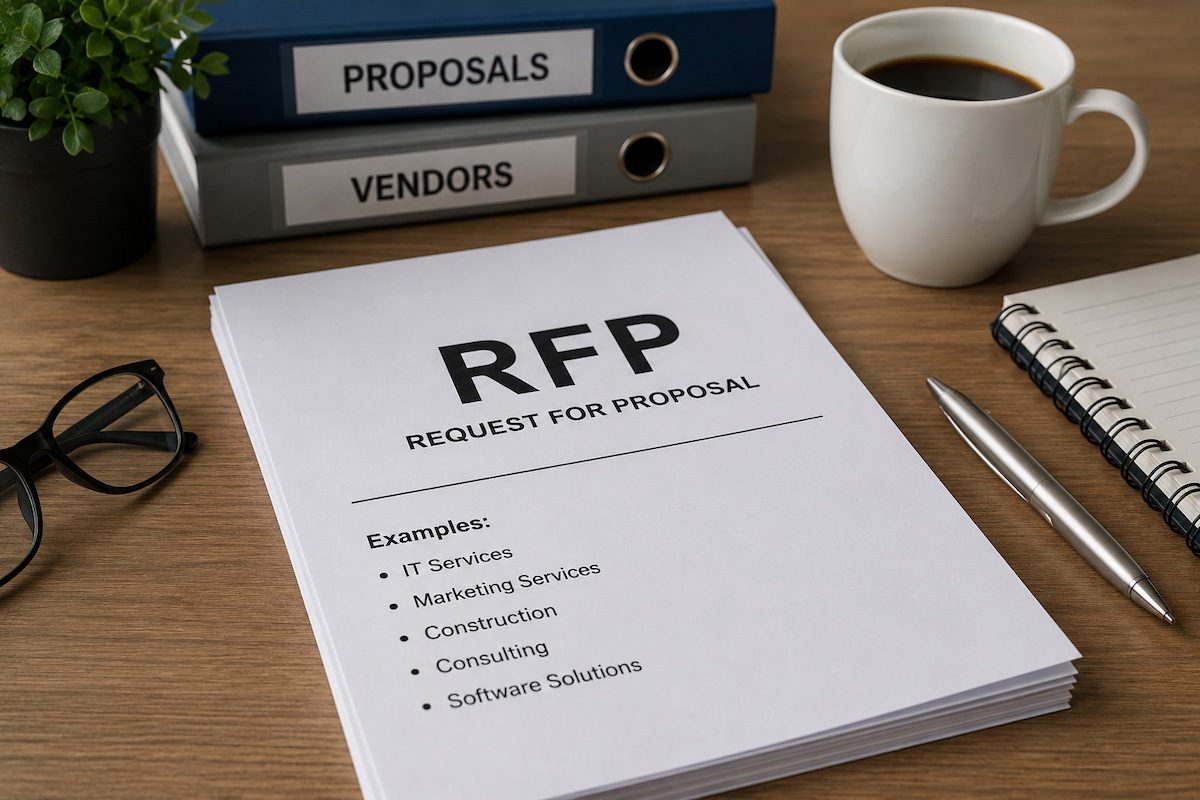
Quick answer: An RFP (request for proposal) example is a sample procurement document that shows how an organization asks vendors to propose a solution to a defined need. A strong RFP example includes project background, a statement of need, scope of work, requirements, submission guidelines, weighted evaluation criteria, a timeline, a budget signal, and terms and conditions.
The best RFP examples teach you what good writing looks like when real money is on the line. A clear request for proposal attracts thoughtful, tailored bids. A sloppy one attracts boilerplate, and vendors who pad their pricing to cover the ambiguity.
This guide covers the anatomy of a strong RFP, a template you can copy, examples by industry, an annotated walkthrough, the red flags that tank vendor responses, and the writing habits that separate average documents from winning ones.
What an RFP Example Should Actually Show You
Most people open a sample looking for a structure to copy. Structure is the easy part. The harder lessons live in the wording: how scope is defined, how evaluation criteria connect to goals, and how the tone treats vendors as partners rather than supplicants.
Use samples in two ways. Model your structure on one when you are starting fresh. Pressure-test a finished draft against one when you want a rigorous check before publishing.
The Anatomy of a Strong RFP
Almost every effective RFP contains the same nine sections, regardless of industry:
- Organizational background and project context. Who you are, and why this project matters now.
- Statement of need. The problem in plain language, plus the impact of solving it.
- Statement of Work (SOW) and deliverables. The specific outputs the vendor will produce.
- Technical and functional requirements. Separated into must-have and nice-to-have.
- Submission guidelines. Page limits, file formats, response order, and NDA expectations.
- Evaluation criteria and weighted scoring. What you will judge proposals on, and how much each factor counts.
- Timeline and key dates. Issue date, Q&A deadline, submission deadline, decision date, and contract start.
- Budget range or budget signal. Even a ballpark or total cost of ownership (TCO) target helps vendors propose realistically.
- Terms, conditions, and compliance. Master Service Agreement (MSA) expectations, regulatory requirements, data handling, indemnification, and IP ownership.
The order can vary. The completeness should not. Section 9 is often where drafts are weakest, so it helps to have governance, risk, and compliance documentation in place before you write it.
RFP Template You Can Copy
Use this outline as a starting point. Replace every bracketed prompt with project-specific detail rather than leaving generic wording in place.
| Section | What to write |
|---|---|
| 1. Background | [Who your organization is, who you serve, and what triggered this project] |
| 2. Statement of need | [The problem, who it affects, and what success looks like in measurable terms] |
| 3. Scope of work | [Each deliverable as its own line, with quantity, format, and frequency] |
| 4. Requirements | [Must-haves that disqualify a vendor if missing, then nice-to-haves] |
| 5. Submission guidelines | [Page limit, file format, response order, contact person, and how to submit] |
| 6. Evaluation criteria | [Each criterion with its percentage weight, adding up to 100] |
| 7. Timeline | [Issue date, questions deadline, proposal due date, decision date, contract start] |
| 8. Budget | [A range, a ceiling, or a TCO target] |
| 9. Terms and compliance | [Contract type, insurance, data handling, regulatory requirements, IP ownership] |
RFP Examples by Industry (with Language Cues)
Different sectors expect different vocabulary. Using the right terms signals that you understand the work.
| Industry | Typical RFP example | Language strong examples use |
|---|---|---|
| Marketing and advertising | Content or campaign agency engagement | CAC, LTV, MQL-to-SQL, incremental lift |
| Information technology | SaaS platform or managed IT services | SOC 2, ISO 27001, SSO, SLAs, uptime |
| Healthcare | EHR vendor or patient transport services | HIPAA, PHI, HL7, FHIR, BAAs |
| Construction | General contracting or design-build | CSI MasterFormat, bid bonds, CMAR |
| Financial services | Payment systems or core banking software | GLBA, SOX, KYC/AML, PCI DSS |
| Government | Professional services or infrastructure | FAR, Section 508, NAICS, set-asides |
| Nonprofit and grants | Program evaluation or grant-funded services | Logic model, outcomes, indirect costs |
| Professional services | Consulting, legal, or accounting | Fixed-fee vs T&M, named team, acceptance criteria |
Marketing and Advertising
Strong examples lead with measurable campaign objectives, audience segments, and attribution expectations. They reference KPIs like CAC, LTV, MQL-to-SQL conversion, and incremental lift rather than vague “engagement” goals.
They also specify the MarTech stack (HubSpot, Marketo, Salesforce Marketing Cloud), brand voice guidelines, and content velocity expectations.
Information Technology
Tech RFPs lean heavily on security and integration language: SOC 2 Type II, ISO 27001, NIST 800-171, NIST CSF, GDPR, CCPA, PCI DSS, FedRAMP for federal cloud, CMMC for defense contractors, data residency, SSO, SAML, OAuth, MFA, RBAC, API specifications, SLAs, and uptime guarantees.
The best samples ask for architecture diagrams, penetration test results, and reference customers in similar environments. Many teams draft these requirements as standalone technical specifications and attach them to the RFP.
Healthcare
Healthcare procurement is regulation-heavy.
Expect HIPAA, HITECH, PHI handling, 21 CFR Part 11 for clinical systems, HL7 and FHIR interoperability standards, EHR integration requirements, Business Associate Agreements (BAAs), CMS reporting alignment, Joint Commission considerations, and FDA clearance where medical devices are involved.
Strong samples define the clinical workflows the solution must support, and buyers often lean on healthcare compliance writing to get the regulatory language right.
Construction
Good construction RFPs reference CSI MasterFormat divisions, Davis-Bacon prevailing wage requirements, the Miller Act for federal projects, AIA contract documents, ConsensusDocs, OSHA safety standards, bid bonds, performance bonds, payment bonds, BAFO procedures, and the project delivery method (Design-Bid-Build, Design-Build, CMAR, IPD, P3).
They specify whether the request is for general contracting, design services, or both.
Financial Services and Banking
Finance RFPs carry their own compliance load: GLBA, SOX controls, KYC and AML procedures, FINRA and OCC alignment, PCI DSS for payment systems, encryption at rest and in transit, and audit-ready logging.
They often require SSAE 18 SOC 1 reports alongside SOC 2, business continuity plans, and disaster recovery RTO and RPO targets. Because the documentation load is heavy, many institutions bring in banking technical writing support.
Government and Public Sector
Public sector RFPs include FAR clauses, Section 508 and WCAG 2.1 accessibility requirements, NAICS codes, SAM.gov registration, UEI numbers, GSA Schedule eligibility, set-aside designations for SBA, MBE, WBE, and DBE-certified businesses, and detailed protest procedures. Canadian federal solicitations follow their own rules, including pre-qualified supply arrangements. Tone is formal, and compliance language is non-negotiable.
Nonprofit and Grants
Nonprofit RFPs and grant solicitations care about logic models, theory of change, outcomes versus outputs, in-kind match, NICRA indirect cost rates, IRS 501(c)(3) status, and Form 990 transparency. Federal grants from NIH, NSF, or HRSA add their own application formats and reporting cycles. The same habits that make a strong RFP response carry over to grant writing.
Professional Services
Strong professional services RFPs (consulting, legal, accounting) emphasize the engagement model (fixed-fee versus time and materials), named-team commitments to prevent bait-and-switch staffing, deliverable acceptance criteria, conflict-of-interest disclosures, and how the vendor handles knowledge transfer at the end of the engagement.
An Annotated Mini-RFP Walkthrough
Reading about RFP structure is one thing. Seeing it on the page is another. Here is a short, realistic example for a B2B SaaS company sourcing a content marketing agency, with notes after each section.
Project Title: Content Marketing Agency Engagement, FY27
Issued by: [Company Name], a Series C B2B workflow software company
Background. [Company Name] serves operations teams at mid-market manufacturers. We currently publish two blog posts a month and one quarterly report. We need a partner who can scale output to four pieces a week while raising the editorial bar.
Why this works: it tells the vendor where the company is, where it wants to go, and why the gap matters.
Scope of Work.
- Monthly content calendar aligned with Q1 to Q4 themes
- 16 long-form articles per month (1,500 to 2,500 words)
- Editorial review of internally drafted thought leadership
- Quarterly performance review with recommendations
Why this works: each line is a deliverable a vendor can quote on. There are no vague “support” or “assistance” placeholders.
Must-Have Requirements.
- Three or more clients in B2B SaaS, ideally serving operations or manufacturing audiences
- In-house writers (no offshore aggregator models)
- Demonstrable SEO results, with case studies
- HubSpot CMS familiarity
Why this works: must-haves are filters. They keep unqualified vendors from spending time on a proposal that cannot win.
Evaluation Criteria.
- Relevant experience: 30 percent
- Sample work quality: 30 percent
- Pricing and value: 20 percent
- Cultural fit and communication: 20 percent
Why this works: scoring weights are visible. Vendors prioritize what matters, and the buyer can defend the decision later.
Budget. $15,000 to $20,000 per month, billed monthly.
Why this works: a range lets vendors scope realistically instead of guessing, and it filters out firms that are far outside your budget.
Submission Guidelines.
- Maximum 12 pages, PDF only
- Respond in the same order as this RFP
- Send questions to one named contact by the questions deadline
Why this works: every proposal arrives in the same shape, which makes side-by-side scoring fast and fair.
Timeline.
- RFP issued: March 1
- Questions deadline: March 8
- Proposals due: March 22
- Decision: April 5
- Contract start: May 1
Why this works: every milestone is a date, not a vague placeholder.
This kind of inline clarity is what we focus on through our RFP writing services, helping clients develop and refine clear, structured procurement documents.
Short vs Long RFPs: When Each One Wins
Effective RFPs range from a handful of pages to fifty or more. Length is not a quality signal. Fit is.
Short RFPs (four to ten pages) suit bounded scope and similar-profile vendors: a defined consulting engagement, a specific marketing project, or a narrow software replacement.
Long RFPs (twenty-plus pages) suit high stakes, varied vendor pools, non-negotiable compliance, or business-reshaping initiatives: enterprise software replacements, public infrastructure, and healthcare systems integrations.
The rule of thumb: if project failure would barely register on next year’s strategy, keep it short. If failure would headline a board meeting, write the long version.
Red Flags: Common RFP Mistakes That Tank Responses
Vague scope masquerading as flexibility. “We are open to all suggestions” reads as “we have not done our homework.” Vendors price uncertainty by adding a margin.
Hidden or undefined evaluation criteria. If vendors cannot tell what you will judge them on, they hedge across every dimension. Proposals get longer, and decisions get harder.
Unrealistic timelines. A two-week window for a complex enterprise RFP filters out the most thoughtful vendors. The ones who remain are the ones with the most boilerplate ready.
Laundry-list requirements with no prioritization. A 200-row matrix with no must-have versus nice-to-have distinction tells vendors nothing.
Conflicting stakeholder voices. When the IT section contradicts the business section, vendors notice. Reconcile internal disagreements before publishing.
Asking for a free strategy. Detailed strategic recommendations belong in a paid engagement, not a sales document.
Writing and Clarity: What Separates a Good RFP from a Great One
Most RFP advice stops at structure. The best documents go further.
Write for scanners, not readers. Procurement teams skim. Use headings, bullet lists, and white space.
Calibrate tone. Public sector and regulated industries call for formal language. Marketing and creative engagements can be more conversational.
One requirement per sentence. Compound requirements such as “the system must integrate with Salesforce, support SSO, and meet SOC 2” are harder to score. Split them.
Specify, do not hedge. “Within 30 days of contract execution” beats “promptly.”
Default to active voice. “The vendor will deliver a status report each Friday” reads cleaner than “Status reports will be delivered weekly.”
The Vendor’s Perspective: What Bidders Wish You Included
Flipping the lens reveals what makes a sample worth modeling. Vendors consistently ask for:
- Visible decision-makers. Who signs off, and what they care about
- Honest budget signals. Even a range cuts wasted effort on both sides
- Realistic timelines. Enough time to write a good proposal, not just a fast one
- Reasonable page limits. Constraints force vendors to lead with what matters
- A named point of contact. One person to email with clarifying questions
Responding to an RFP? How to Use These Examples From the Bidder’s Side
RFP examples are just as useful when you are on the other side of the table. Reading a strong RFP shows you exactly how evaluators think, so you can mirror their structure, answer every must-have, and write to the scoring weights.
A few habits that consistently lift responses:
- Build a compliance matrix first. List every requirement and where your response addresses it.
- Answer in the buyer’s order. Make each section easy to find and score.
- Lead with proof. Relevant case studies and sample work carry more weight than claims.
- Tailor every section. Reused boilerplate is easy for evaluators to spot.
If your team needs support writing proposals or bid responses, The Write Direction is a pre-qualified ProServices supplier with the Government of Canada and has supported bids across Canadian federal and US public sector procurement.
AI-Era RFPs: New Sections Worth Adding
AI tools now sit inside most vendor stacks. Modern RFPs reflect this with clauses borrowed from older security and compliance logic:
- Data handling and training-data clauses. Will vendor AI tools train on your data? Reference the EU AI Act, NIST AI RMF, and applicable SOC 2 controls.
- Model evaluation questions. Accuracy benchmarks, hallucination rates, source attribution, and bias testing protocols.
- Human-in-the-loop requirements. Where review is mandatory before output reaches customers or regulators.
- Audit and explainability provisions. Can the vendor produce a decision trail when challenged?
These clauses work best when they line up with your own internal AI policy, so vendors are held to the same standard as your team.
Pre-RFP Prep Checklist
Before writing the first word, lock down:
- Stakeholder alignment on goals, scope, and budget
- A brief internal scoping document or business case
- Vendor landscape research and a target bidder list
- The evaluation panel and scoring rubric
- Distribution channels (SAM.gov, CanadaBuys, vendor portals, direct outreach)
Skipping this step is one of the most common reasons RFPs end up being reissued.
How to Customize Any RFP Example to Your Project
Treat samples as starting points, not templates to fill in blindly.
- Audit against project complexity. A sample built for a $50K engagement will not stretch to a $5M one.
- Replace assumptions, do not just fill in blanks. Every example carries hidden context from its original use case.
- Reweight evaluation criteria. What mattered to the original buyer may not matter to you.
- Localize compliance references. A US-based example may need GDPR or CCPA language for cross-border vendors, or Canadian privacy requirements for Canadian buyers.
- Test for scannability. Read the final draft on a phone. If you cannot find the timeline in ten seconds, neither can a vendor.
Strengthen Your RFPs (and Every Other Document) with The Write Direction
At The Write Direction, we work with procurement teams, proposal managers, and content leaders who know that clarity at the document level changes outcomes at the deal level. A vague RFP costs you the right vendors. A muddled response costs you the contract. A flat blog post costs you the lead.
Our team has helped clients across healthcare, technology, financial services, professional services, and the public sector turn dense procurement language into documents vendors actually want to respond to. We bring an editorial eye to every section, from the SOW to the evaluation criteria, and we write in your voice rather than ours.
If your team is sitting on an RFP draft that does not feel sharp yet, or you are building a library of templates and want them to read like they were written by people who care about words, we would love to help. Get in touch with The Write Direction today.
Frequently Asked Questions
What is an example of an RFP?
A typical RFP example might be a B2B SaaS company sourcing a content marketing agency, a hospital sourcing an EHR vendor, or a city government procuring infrastructure services.
Each contains the same building blocks: background, scope of work, requirements, evaluation criteria, timeline, and budget. The difference is the language and the priorities each industry brings to the document.
What should an RFP template include?
A complete RFP template includes nine sections: background, statement of need, scope of work, requirements, submission guidelines, weighted evaluation criteria, timeline, budget, and terms and compliance. The template gives you the structure, but the project-specific detail you add is what attracts strong bids.
What is the difference between an RFP and a proposal?
An RFP is the document a buyer issues to describe a need and invite bids. A proposal is the vendor’s response to that RFP, explaining how they will meet the need, who will do the work, and what it will cost.
Who writes an RFP?
RFPs are usually written by a procurement lead or project owner, with input from the stakeholders who will use or fund the solution, such as finance, IT, legal, and operations.
Many organizations also bring in professional writers to make sure the scope, requirements, and evaluation criteria are clear before the RFP goes out.
What are the 7 stages of an RFP?
The seven stages are needs assessment, internal scoping and stakeholder alignment, drafting the RFP, distribution to potential vendors, vendor Q&A and clarifications, proposal evaluation against scoring criteria, and vendor selection, followed by contract negotiation. Some teams add an eighth stage for post-award debriefs with unsuccessful vendors, which strengthens future RFPs.
How long should an RFP be?
There is no universal answer.
Strong RFP examples range from four pages for tightly scoped projects to fifty pages or more for enterprise software, public infrastructure, or healthcare systems. Length should match complexity, regulatory load, and how varied the vendor field is. Short and clear beats long and padded every time.
What is the difference between an RFP, RFI, and RFQ?
An RFI (request for information) is exploratory, used early to learn what is possible. An RFQ (request for quote) asks for pricing on a clearly defined item or service. An RFP (request for proposal) asks vendors to propose a full solution to a defined problem, with pricing as one component among many.
How are RFP responses evaluated?
Most buyers use a weighted scoring matrix.
An evaluation panel scores each proposal against published criteria such as experience, approach, sample work, and price, then multiplies each score by its weight. Shortlisted vendors may be invited to present or submit a best and final offer (BAFO) before the award.
Can I use a free RFP template?
Yes, a free RFP template is a useful starting point for structure. Treat it as an outline rather than finished copy: replace every generic line with your own background, deliverables, requirements, scoring weights, and dates, and remove sections that do not apply to your project.
What should I look for when reviewing RFP examples?
Look beyond formatting. Examine how the scope is defined, whether evaluation criteria connect to stated goals, and how specific the timeline and deliverables are. Strong RFP samples use plain language, prioritize must-have requirements, and treat vendors as partners. Weak ones rely on vague phrasing and unprioritized requirement lists.
How is AI changing the way RFPs are written and evaluated?
AI tools now help draft requirements, score responses, and surface inconsistencies between sections.
Modern RFPs increasingly include AI-specific clauses on data handling, model accuracy, hallucination rates, and human-in-the-loop requirements, often referencing the EU AI Act and NIST AI RMF. The best new RFP examples hold AI vendors to the same rigor older documents applied to security and compliance.

Related posts


Recent Posts