
Policy vs Procedure: Key Differences, Examples, and How to Use Both Effectively
Walk into any HR meeting, IT review, or compliance audit, and you will hear the words “policy” and “procedure” used interchangeably. They are not the same thing.
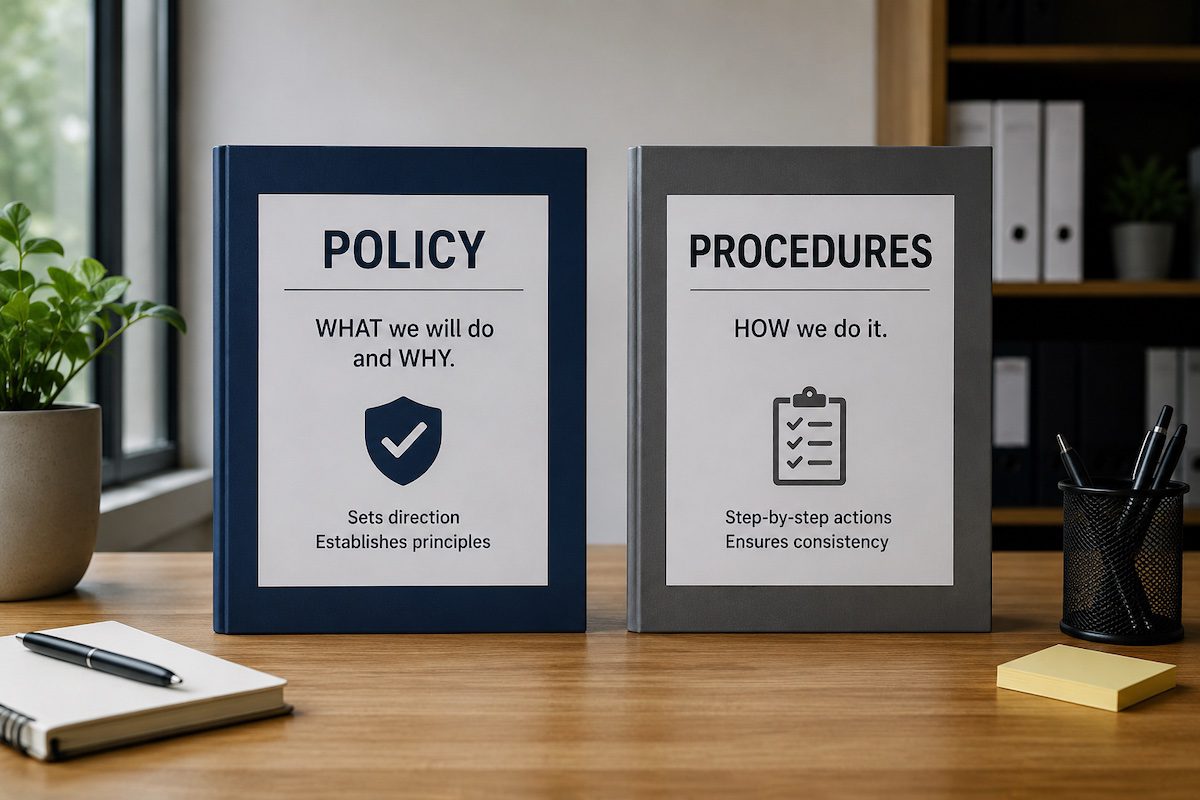
Understanding the difference between policy and procedure is one of the most important distinctions a growing organization can make, because confusing the two leads to vague rulebooks, orphaned instructions, and audit findings that cost time and money to fix. A policy explains what your organization stands for and why. A procedure explains exactly how a task gets done. Both work together, but each plays a distinct role in governance, compliance, and daily operations.
This guide breaks down the difference using a five-dimensional comparison framework, places both documents within the broader governance hierarchy, and walks through real examples across healthcare, IT, HR, manufacturing, finance, and education. You will also get a clean decision rule for choosing between the two, the structural anatomy of each document, and the most common mistakes organizations make when drafting them.
Key Takeaways
- A policy is the “why.” It is a high-level, mandatory statement of management intent approved by leadership and applied across the organization.
- A procedure is the “how.” It is a step-by-step set of instructions, owned by department managers or process owners, that operationalizes a policy.
- They differ along five dimensions: purpose, scope, authority, audience, and lifecycle.
- They sit inside a layered hierarchy: principles, policies, standards, procedures, guidelines, and work instructions, which map directly to ISO 9001, ISO 27001, NIST, PCI-DSS, HIPAA, SOX, and similar frameworks.
- Policies stay stable for years; procedures evolve continuously as tools, technologies, and regulatory requirements change.
- Mixing the two into one document is the most common drafting mistake and a frequent source of audit findings, employee confusion, and inconsistent operations.
What Is a Policy?
A policy is a high-level statement of management intent. It is a formal, principle-based document that establishes what an organization expects, why those expectations exist, and what behavior or outcome is required. Policies communicate values, philosophy, and culture, and they reduce institutional risk by giving every employee a shared frame of reference.
The defining characteristics of a policy include:
- Mandatory. Compliance is non-negotiable for the intended audience.
- Broad. It addresses an issue at a strategic level, not the steps to resolve it.
- Stable. Policies change infrequently because they reflect long-term organizational direction.
- Principle-based. The focus is on intent and accountability, not execution detail.
- Strategic. Policies tie back to business objectives, regulatory obligations, or risk tolerance.
Policies typically originate at the executive level. The board of directors, C-suite leaders, or a dedicated policy committee drafts and approves them. Human resources, legal, and compliance officers usually contribute during review. A typical policy runs one to three pages.
Here is what real policy language looks like. A Data Protection Policy might state: “The organization will protect all personal and customer data in accordance with applicable privacy laws, including HIPAA and GDPR. All third-party data sharing agreements must be reviewed and approved by Legal Services before execution.” Notice that the statement defines the principle and the expectation, but says nothing about how the review is conducted, who routes the document, or what tools are used. Those details belong in a procedure.
What Is a Procedure?
A procedure is a sequential set of instructions that operationalizes a policy. Where a policy says “what” and “why,” a procedure says “how,” “when,” “where,” and “by whom.” Procedures translate principles into concrete, repeatable actions.
The defining characteristics of a procedure include:
- Sequential. Steps follow a logical order, often numbered or written as a checklist.
- Role-specific. Procedures target the people who actually perform the task.
- Evolving. Procedures change as tools, technologies, and processes evolve.
- Operational. They live in the day-to-day work environment.
- Detailed. Ambiguity is the enemy of a good procedure.
Procedures are sometimes called Standard Operating Procedures (SOPs), work instructions, or simply “practices.” In regulated environments, they map directly to specific controls within a compliance framework. Department managers, process owners, and subject matter experts typically write and maintain them, with input from the teams who actually carry out the work.
A Data Protection Procedure that supports the policy above might read:
- Receive the third-party agreement from the vendor or business owner.
- Forward the agreement to the Legal Services intake queue within 24 hours of receipt.
- Tag the request with an internal tracking ID and assign a Legal reviewer.
- Document the review outcome in the contract management system.
- Notify the business owner of approval, conditional approval, or rejection within 10 business days.
The procedure is precise, role-specific, and measurable. It can be audited against, trained on, and updated when the contract management system changes.
Policy vs Procedure: The Five-Dimension Comparison Framework
Most articles compare policies and procedures with a flat two-column table. That oversimplifies the relationship. A more useful approach is to examine five distinct dimensions across which the two documents diverge.
Purpose: Strategic Intent vs Operational Execution
Policies set strategic intent. They define the desired outcome and the boundaries within which decisions are made. Procedures handle operational execution. They explain the precise actions required to achieve the policy’s intent. A privacy policy says the organization will protect customer data; the breach response procedure tells the security team exactly what to do at minute zero of an incident.
Scope: Organization-Wide vs Task-Specific
A policy generally applies to everyone in the organization, or at least everyone within a defined audience such as all employees, all contractors, or all vendors. A procedure narrows the focus to a specific task, role, or situation. One policy can spawn dozens of procedures, each addressing a different operational scenario.
Authority: Approved by Leadership vs Owned by Departments
Policies require approval by executive leadership, the board, or a senior governing body. Procedures are usually owned and approved at the department or process-owner level. This is why amending a policy is a formal exercise that may take weeks, while updating a procedure is routine and can happen in days.
Audience: All Personnel vs Role-Based
Policies are written in language that any employee, auditor, or external stakeholder should be able to follow. Procedures speak directly to the person performing the task, often in technical or role-specific language. A nurse, a network administrator, and an accounts payable clerk each rely on procedures written for their specific role.
Lifecycle: Stable Over Years vs Updated as Needed
Policies are reviewed annually or when significant regulatory or strategic shifts occur. Procedures may be updated quarterly, monthly, or whenever a new tool, system, or method is introduced. The lifecycle difference is one of the strongest practical reasons to keep the two documents physically separate.
Together, these five dimensions give you a clear lens for examining any document in your organization and asking: is this principle-driven (policy) or action-driven (procedure)?
Where Policies and Procedures Fit in the Document Hierarchy
Policies and procedures rarely exist in isolation. They sit inside a broader document hierarchy that governs how decisions get made and operations run:
- Principles are the foundational values that drive everything else.
- Policies translate principles into mandatory organizational rules.
- Standards specify the mandatory technical or measurable requirements that support a policy.
- Procedures describe the step-by-step actions required to meet standards and policies.
- Guidelines offer voluntary recommendations and best practices.
- Work instructions break procedures down to the most granular task level.
Standards differ from policies in that they are far more specific and measurable. “All passwords must be at least fourteen characters long, contain mixed case, and rotate every 90 days” is a standard. “The organization will protect access to information systems” is a policy. Guidelines differ from procedures in that they are voluntary. “Use a passphrase made of four unrelated words” is a guideline; “Configure the password manager according to the steps below” is a procedure.
This hierarchy aligns directly with the major compliance frameworks organizations are expected to follow. ISO 9001 (quality management) and ISO 27001 (information security) require documented policies and supporting procedures with clear ownership. The NIST Cybersecurity Framework (NIST CSF) and NIST SP 800-53 use policies, standards, and procedures as separate but interconnected layers. PCI-DSS, COBIT, CMMC, and SOC 2 follow the same structural logic. Treating these layers as one big document creates audit risk and operational confusion.
Policy vs Procedure Examples Across Industries
The clearest way to see the difference between a policy and a procedure is to look at how they manifest across sectors.
Healthcare
A patient privacy policy establishes the organization’s commitment to protect health information under the HIPAA Privacy Rule (45 CFR Part 164). The corresponding procedures cover medication administration, infection control, breach notification within the HIPAA-mandated 60-day window, and accreditation survey readiness for The Joint Commission. Each procedure operationalizes the privacy and safety principles the policy establishes.
Information Technology and Cybersecurity
An Acceptable Use Policy (AUP) sets the rules for how employees may use company systems. A Bring Your Own Device (BYOD) policy defines whether personal devices are allowed and under what conditions. The procedures that support these policies cover password creation, multi-factor authentication setup, incident response, and patch management. These procedures map to controls in NIST CSF, NIST SP 800-53, and ISO 27001 Annex A.
Human Resources
A PTO policy explains how much paid leave employees receive and when they are eligible to take it. The PTO procedure walks through how to submit a request, who approves it, and how priority is decided when multiple requests overlap. Code of conduct, anti-harassment, and equal employment policies must align with Title VII of the Civil Rights Act, the ADA, and state employment laws, with supporting procedures for hiring, onboarding, performance evaluation, and disciplinary action.
Manufacturing and Operations
A workplace safety policy commits the organization to comply with OSHA standards under 29 CFR 1910 and protect employee well-being. The procedures that support it cover machine lockout/tagout under 29 CFR 1910.147, personal protective equipment use, emergency evacuation, and quality control under ISO 9001. Together, they form the operational backbone of regulated production environments.
Finance and Accounting
An expense approval policy establishes spending limits, authorization tiers, and documentation requirements. The supporting procedures detail how to submit expense reports, how reimbursements are processed, and how internal audit reviews them. Public companies must align these documents with Sarbanes-Oxley (SOX) Section 404 internal controls and Generally Accepted Accounting Principles (GAAP). Financial institutions add procedures supporting anti-money laundering rules under the Bank Secrecy Act.
Education and Government
A student records policy establishes how the institution complies with FERPA. Procurement policies in government settings define rules for vendor selection, while the supporting procedures detail bid submission, evaluation, and award workflows. Ethics policies are accompanied by procedures for disclosing conflicts of interest and reporting potential violations to the appropriate oversight body.
Anatomy of a Well-Written Policy
Strong policies share a consistent structure. Most include the following sections:
- Title and policy number for easy reference and version tracking.
- Purpose explaining why the policy exists and what risk it addresses.
- Scope defining who and what the policy covers.
- Policy statement outlining the principles and rules.
- Definitions clarifying any specialized terms.
- Roles and responsibilities identifying ownership and accountability.
- Enforcement describing consequences for non-compliance.
- Review cadence specifying how often the policy is revisited.
- References linking to related laws, standards, and procedures.
The tone is formal, principle-based, and free of step-by-step instructions. The approval workflow typically moves from drafting to policy committee review to executive sign-off, followed by publication and employee acknowledgment in a learning management system or policy portal.
Anatomy of a Well-Written Procedure
Procedures follow a different structure built around action:
- Title matching the linked policy.
- Objective stating the goal of the procedure.
- Prerequisites listing tools, access, or approvals required before starting.
- Numbered steps walking through the workflow in sequence.
- Roles clarifying who performs each step.
- Decision points for branching logic or conditional actions.
- Exceptions covering edge cases and escalations.
- Linked policy showing the parent document and authority.
- Version history tracking updates, owners, and approval dates.
Procedures use the imperative voice, with phrases such as “click submit” or “verify the request,” because they are designed to be followed, not interpreted. Flowcharts, checklists, and screenshots often accompany the text and significantly improve adoption.
How to Decide: Should This Be a Policy or a Procedure?
When drafting a new document, four quick questions resolve almost every “policy or procedure?” debate:
- Is this about why we do something, or how we do it? “Why” goes in a policy. “How” goes in a procedure.
- Does it apply across the whole organization, or to a specific role or task? Broad scope points to a policy.
- Is it expected to remain stable for years, or to change with operations? Stable content belongs in a policy.
- Does it require executive approval, or can a department head sign off? Executive approval signals a policy.
Some policies stand alone without a paired procedure. A “no alcohol at work” rule, for instance, does not need a step-by-step procedure for abstaining. Other policies require multiple supporting procedures to cover different scenarios. Either way, every procedure should reference the policy it implements, and every policy that requires action should reference the procedure that operationalizes it.
Common Mistakes Organizations Make
Even experienced teams trip over the same few errors when writing policies and procedures:
- Combining them into one document. Mixing principles with steps creates a long, hard-to-maintain document that confuses readers and slows audits.
- Writing policies that are too vague. A policy needs to set clear direction, even though it is not prescriptive. Vague policies fail audit reviews.
- Creating orphan procedures. A procedure with no parent policy lacks the authority that justifies its requirements and is difficult to defend during compliance reviews.
- Failing to assign ownership. Without a named owner, policies and procedures fall out of date quickly, and accountability becomes diffuse.
- Treating documents as static. Both need scheduled reviews, especially as regulations change. Outdated documents are a leading cause of compliance failures.
- Ignoring framework alignment. Documents that do not map to ISO 9001, ISO 27001, NIST, PCI-DSS, HIPAA, GDPR, or SOX requirements create audit risk and remediation cost.
- Inconsistent terminology. Using “policy,” “procedure,” and “guideline” interchangeably across departments undermines governance and weakens enforcement.
The cost of these mistakes is not theoretical. Organizations regularly face audit findings, regulatory fines, failed certifications, and litigation exposure when their policy and procedure documentation is unclear or inconsistent.
Why Professional Policy and Procedure Writing Matters
Writing policies and procedures sounds straightforward until you sit down to do it. The challenge is balance: principles need to be firm without becoming rigid, steps need to be detailed without becoming bloated, and every document must align with applicable laws, standards, and frameworks. That is where The Write Direction’s policy manual writing services and procedure manual writing services come in, helping organizations turn complex governance requirements into clear, compliant, and usable documents.
Frequently Asked Questions
Can a policy exist without a procedure?
Yes. Some policies are self-contained statements of principle that do not require step-by-step instructions to comply with. A workplace dress code or a no-alcohol policy is a good example. Most policies that govern recurring tasks, however, such as data handling, expense approvals, or incident response, are paired with one or more procedures to ensure consistent execution.
Is a procedure the same as a process?
Not quite. A process is the broad sequence of activities required to achieve an outcome, often spanning multiple departments. A procedure is a detailed set of instructions for completing a specific task or step within that process. Hiring is a process. Conducting a structured interview is a procedure within that process.
Who is responsible for writing policies and procedures?
Policies are typically drafted under the direction of executive leadership, with input from legal, compliance, and HR. Procedures are usually written by department managers, process owners, and subject matter experts who know the work in detail. Many organizations also engage professional writers to ensure clarity, consistency, and regulatory alignment across both.
How often should policies and procedures be reviewed?
Most policies are reviewed annually, or whenever a major regulatory, strategic, or organizational change takes place. Procedures should be reviewed more frequently, often quarterly, because they evolve with tools, systems, and operational practices. A near-year-end review is a smart habit for both, since many regulations take effect at the start of the calendar year.
What is the difference between a policy, procedure, standard, and guideline?
A policy is a high-level mandatory rule. A standard is a mandatory specific requirement that supports a policy, such as a password length minimum. A procedure is the step-by-step instructions for implementing standards and policies. A guideline is a voluntary recommendation or best practice. Together, they form a layered governance hierarchy.
Are workplace policies and procedures legally binding?
Workplace policies are generally enforceable by the employer once they have been formally adopted, communicated, and acknowledged by employees. They can carry legal weight in disputes related to discrimination, termination, or compliance violations. Procedures supporting policies inherit that enforceability when followed consistently. Specific legal status varies by jurisdiction, so legal review is recommended.
Final Thoughts From The Write Direction
At The Write Direction, we have helped hundreds of organizations across healthcare, IT, finance, manufacturing, and education translate complex regulatory requirements into clear, compliant policy and procedure documentation. We know firsthand that the difference between a strong policy framework and a weak one usually is not the writer’s intent.
It is the discipline of separating the “why” from the “how” and aligning every document with the right governance layer. Whether your team is working through a policy refresh, building a procedure library from scratch, or preparing documentation for an audit, our writers can help you get it right the first time. Reach out to The Write Direction and let us build documentation your organization can actually rely on.

Related posts


Recent Posts