
Procedure Writing: A Complete Guide to Documenting How Work Gets Done
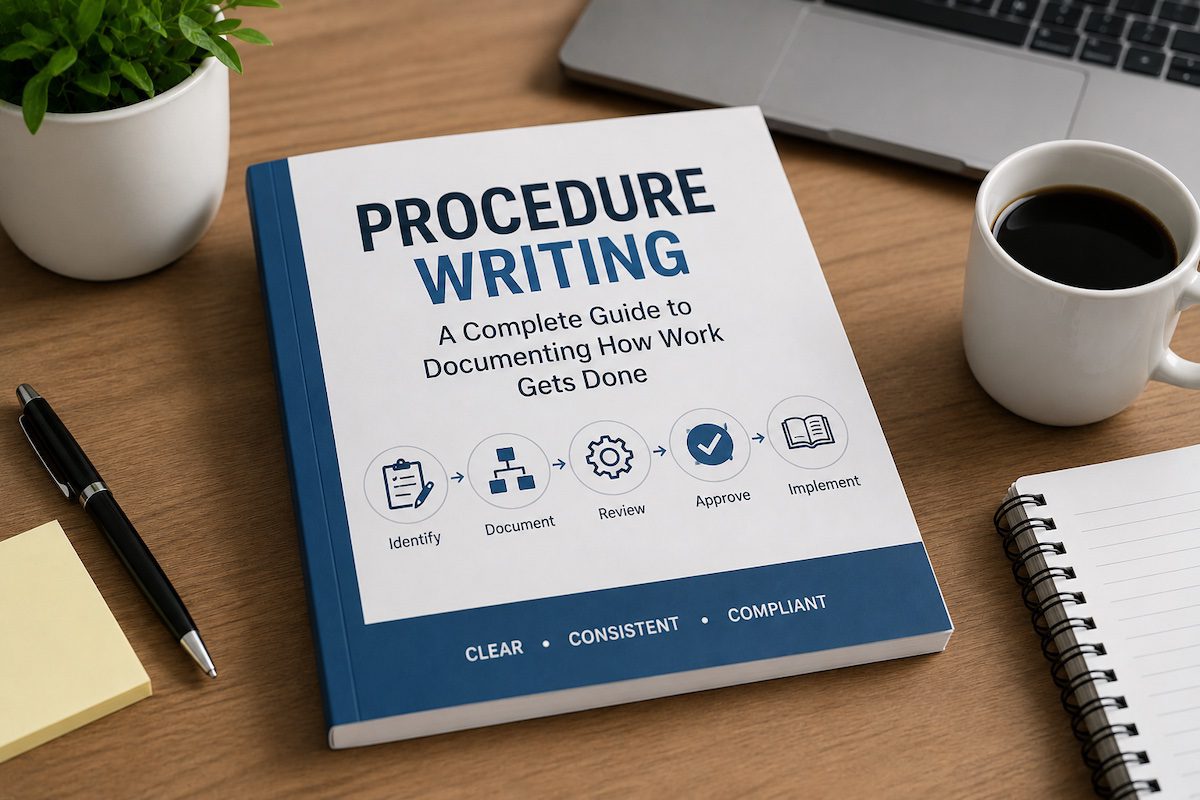
Inconsistent work produces inconsistent results: more errors, longer training, and harder audits. Procedure writing fixes this by capturing exactly how a task is performed, in what order, by whom, and with what controls. The output is documentation that any qualified employee can pick up and follow.
What Is Procedure Writing?
Procedure writing is the practice of documenting a step-by-step set of instructions for carrying out a specific task or process. ISO 9001:2015 defines a procedure as a “specified way to carry out an activity or a process.” A well-written procedure is clear, repeatable, and verifiable.
Place it correctly in the documentation hierarchy:
- Policy answers why and sets the rule.
- Process answers what high-level steps move work from start to finish.
- Procedure answers how each step is executed.
- Work Instruction (WI) zooms in on a single task within a procedure.
- Guidelines offer recommendations rather than mandatory steps.
Procedures sit one level below processes and translate policy into action. Treating them interchangeably is the most common documentation mistake in any Quality Management System (QMS).
Why Procedure Writing Matters
Consistency. Documented procedures eliminate variation across shifts, sites, and individuals. This underpins continuous improvement methodologies such as Lean, Six Sigma, and DMAIC.
Compliance. Regulated industries depend on documented procedures to satisfy requirements set by frameworks including HIPAA, OSHA, ISO 9001, ISO 13485, ISO 27001, SOX, GDPR, FDA 21 CFR Part 11, Good Manufacturing Practice (GMP), NIST, PCI-DSS, and ITIL. Auditors look for evidence that staff follow the rules, not just that the rules exist.
Risk reduction. Clear procedures reduce human error in safety-critical work, from clinical handovers and Lockout/Tagout (LOTO) to Job Safety Analysis (JSA) tasks.
Onboarding speed. New hires reach productivity faster when work is documented rather than demonstrated.
Scalability. Procedures let organisations expand without losing operational fidelity.
The Five Types of Procedural Documentation
Format depends on three variables: task frequency, complexity, and consequence of failure.
- Full step-by-step procedures. For infrequent, complex, high-consequence tasks such as decommissioning equipment or responding to a data breach.
- Standard Operating Procedures (SOPs). Detailed documentation for recurring operational tasks. Common in healthcare, pharmaceuticals, food production, and laboratory environments governed by GMP.
- Work instructions. Narrow in on a specific task within a larger SOP, such as calibrating an instrument or running a single test.
- Job aids and quick reference cards. Strip out the background and present only critical points for trained employees.
- Checklists and flowcharts. Best when sequence and decision points matter most. Pre-flight checks, clinical triage, and ITIL incident response are classic examples.
Choosing the wrong format is how critical instructions get buried inside hundreds of routine steps.
The 9 Anchor Sections Every Procedure Needs
Regardless of format, well-structured procedures share the same skeleton:
- Title and document ID for retrieval and document control
- Purpose: stating why the procedure exists
- Scope defining where it applies and where it does not
- Audience identifying who should follow it
- Roles and responsibilities aligned to a RACI chart
- Materials, tools, and prerequisites, including software, PPE, and access permissions
- Step-by-step instructions in sequential order
- Verification and quality checks confirming that the work was done correctly
- Review history and version control showing approvals, effective dates, and revision logs as part of the audit trail
Skipping any of these is the fastest way to fail an audit.
How to Write a Procedure: An 8-Step Process
- Define the goal and audience. Write one sentence stating what the reader should be able to do after following the procedure.
- Apply the Five Ws and One H. Answer Who, What, Where, When, Why, and How before drafting to surface gaps early.
- Interview Subject Matter Experts (SMEs). Sit beside the operator, observe, and capture the real sequence rather than the idealised one.
- Map the process visually. A flowchart, swim-lane diagram, or BPMN diagram reveals decision points and parallel paths that prose hides.
- Draft with imperative mood and one action per step. Write “Open the valve,” not “The valve should be opened.”
- Add warnings, conditional logic, and verification steps. Flag hazards before the action that triggers them.
- Peer-review with actual operators. A draft should always be tested by someone who has never seen it before.
- Publish under document control. Schedule reviews, log every revision through change management, and retire outdated versions formally.
Style Rules That Improve Comprehension
- Use active voice and the imperative mood: “Press Save,” not “Save should be pressed.”
- Write in the present tense and address the reader as “you” when appropriate.
- Keep steps short, numbered, and parallel in grammatical structure.
- Replace jargon with plain language aligned to standards such as those from the Plain Language Action and Information Network (PLAIN).
- Use visuals: flowcharts, annotated screenshots, swim-lane diagrams, and labelled illustrations.
- Maintain consistent terminology across related procedures so readers do not translate between documents.
Common Procedure Writing Mistakes to Avoid
- Writing for the wrong audience or assuming too much expertise
- Bloating documents so critical steps get buried
- Skipping peer review with actual operators
- Ignoring document control, leaving teams on outdated versions
- Mixing policy content (the why) with procedure content (the how)
- Inconsistent terminology across related documents
When to Bring in a Professional Procedure Writer
Subject matter experts know the work but rarely have the time or writing experience to produce documents that hold up under audit. That is where The Write Direction comes in. Our team produces procedure manuals, policy and procedure documentation, and Standard Operating Procedures that employees use and auditors accept.
Frequently Asked Questions
What is procedure writing in simple terms?
Procedure writing documents how a specific task is performed, step by step, so anyone qualified can follow the instructions and reach the same outcome. It captures the actions, sequence, roles, and verification checks needed for consistent execution.
What is the difference between a procedure and a policy?
A policy states a rule and the reason for it. A procedure explains how to follow that rule. A workplace safety policy might require monthly fire drills; the procedure spells out evacuation routes, assembly points, and roll-call steps. Policies set direction; procedures provide the map.
What is the difference between a procedure and an SOP?
A Standard Operating Procedure (SOP) is a specific kind of procedure, usually narrower in scope and tied to a recurring operational task. All SOPs are procedures, but not all procedures are SOPs. SOPs typically carry stricter formatting, document control, and approval requirements because they often support GMP, ISO 9001, ISO 13485, or FDA compliance.
How long should a procedure document be?
As long as needed, and no longer. A checklist may run a single page; a complex equipment procedure may fill twenty. The test is whether a trained reader can complete the task correctly the first time. Cut steps that do not affect accuracy or compliance.
What format is best for a procedure?
It depends on the task. Step-by-step prose suits complex sequences, checklists suit routine parallel tasks, and flowcharts suit branching decisions. Many organisations combine formats within a single document.
Who should write procedures in an organisation?
The people closest to the work draft the content; a trained writer or technical communicator structures and edits it. Department heads or team leads usually own procedures because they understand operational reality. Many organisations also engage outside writing specialists to ensure consistency, audit-readiness, and regulatory alignment.
Conclusion
At The Write Direction, we have been writing procedure manuals, SOPs, and policy documentation for North American businesses for over a decade. Our team blends academic researchers, industry SMEs, and seasoned technical writers who translate complex operations into clear, compliant, audit-ready documentation. Whether you need a single procedure rewritten for clarity or a full manual built around frameworks such as ISO 9001, HIPAA, OSHA, GMP, or ITIL, our writers deliver work that holds up in front of employees and auditors alike. Visit our procedure manual writing services page to see how we can help your team document how work gets done.

Related posts

Recent Posts