
RFP Grants: How to Find, Evaluate, and Win Them
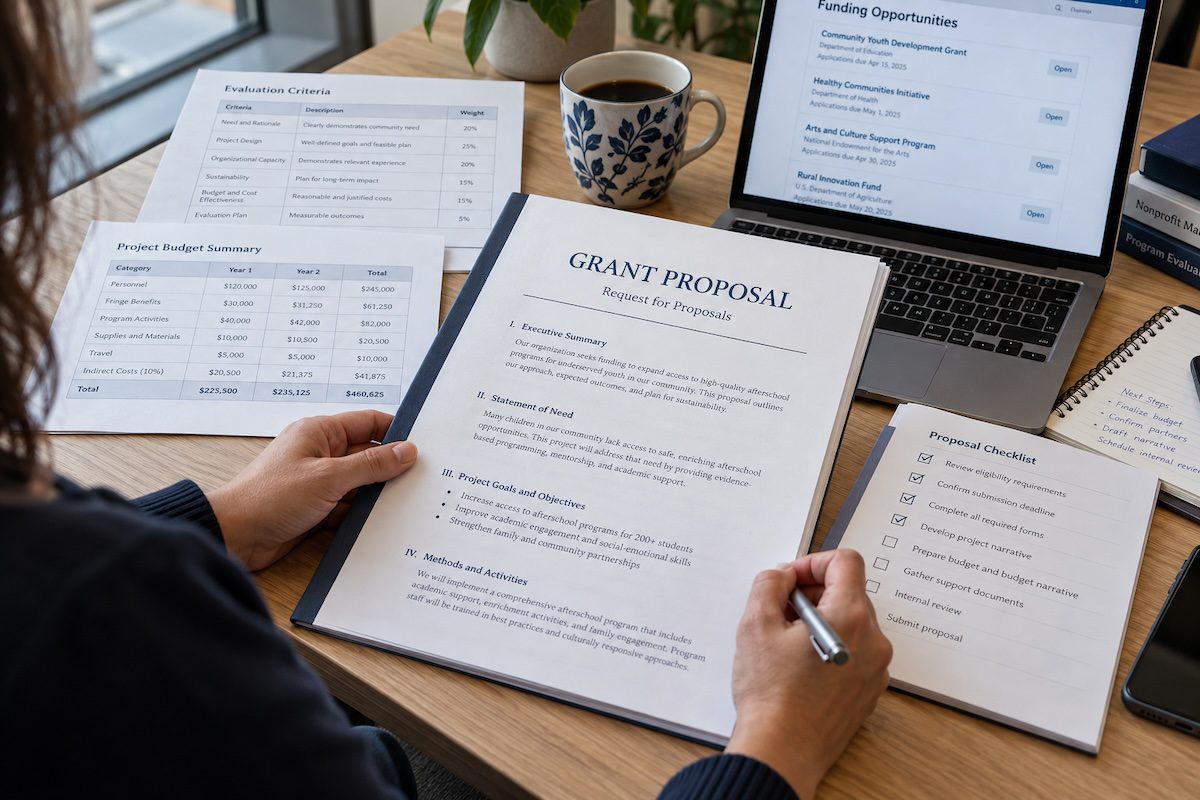
RFP grants are funding opportunities where a foundation, corporation, or government agency publishes a request for proposals and invites eligible organizations to compete for money.
The funder sets the priorities, the award range, the rules, and the deadline. You decide whether to apply and how to make your case.
The hard part starts after you find one. A grant RFP can run dozens of pages, the deadline sits a few weeks out, and your team still has programs to run. This guide shows you where to find RFP grants, how to screen each one before you commit, how to build a response reviewers can score, and when a grant writer pays for itself.
Key Takeaways
- An RFP grant is a funder’s invitation to compete for money tied to the funder’s goals.
- Grant RFPs fund your mission. Procurement RFPs buy services an agency needs. The rules differ, so confirm which one you hold.
- US federal agencies now call grant announcements NOFOs. Canadian federal departments run calls for proposals.
- Run the FUNDS check before you write a word, and pass on RFPs that fail it.
- A compliance matrix built from the RFP keeps reviewers from screening you out on a technicality.
Have a grant RFP open right now? The Write Direction’s grant writers can review it with you and tell you whether it deserves your team’s time. Book a consultation.
What Are RFP Grants?
A grant RFP is a document a funder publishes to announce available money and the rules for competing for it. An RFP targets a defined goal. A health foundation might fund youth mental health programs in two counties. A city health department might fund neighbourhood wellness microgrants.
Four types of funders issue RFP grants:
- Private foundations fund causes tied to their mission.
- Community foundations pool local donations and fund regional needs.
- Corporate giving programs fund causes near their business or customers.
- Government agencies fund programs at the federal, state or provincial, and municipal levels.
Some RFPs accept applications from any eligible organization. Others go to a short list of invited applicants.
Some funders repeat the same RFP each year, so you can plan ahead. Others release a one-time RFP when new money arrives. If you are new to the field, our guide on what grant writing involves covers the basics behind a grant application.
How Grant RFPs Differ From Procurement RFPs
The same three letters cover two kinds of documents. A grant RFP gives you money to carry out work that advances your mission and the funder’s goals.
A procurement RFP pays a vendor to deliver goods or services the agency needs. Government listing pages often mix the two, and some state and city “grant” RFPs end in a service contract.
The difference changes how you write, budget, and report.
| Factor | Grant RFP | Procurement RFP |
| Purpose | Funds your program or project | Buys a service or product for the agency |
| Work design | You propose the approach | The agency defines the scope of work |
| Payment | An award, paid in advance or as reimbursement | Payment for deliverables or hours |
| Scoring focus | Need, impact, capacity, budget fit | Price, technical approach, past performance |
| After the award | Progress and financial reports | Deliverables, invoices, performance reviews |
| US federal rules | Uniform Guidance (2 CFR 200) | Federal Acquisition Regulation (FAR) |
Read the first pages of the document before you plan your response. Words like “contract,” “scope of work,” “vendor,” and “pricing schedule” point to procurement. Words like “award,” “grantee,” “program outcomes,” and “matching funds” point to a grant. If you hold a procurement document, our walkthrough of the government RFP process applies instead.
RFP, RFA, NOFO, and Call for Proposals
Funders use different names for the same kind of document. US federal agencies have moved to Notice of Funding Opportunity (NOFO) as the standard term.
The National Institute of Food and Agriculture, for example, renamed its Request for Applications a NOFO and kept its application process the same. Foundations and many state and city agencies still say RFP.
In Canada, federal departments such as Employment and Social Development Canada (ESDC) run a call for proposals, an open process with fixed start and end dates. For a full breakdown of the terms, see our comparison of RFA vs RFP.
What a Grant RFP Contains
Grant RFPs follow a familiar pattern. Find these parts before you decide anything:
- Funding range and number of awards. These numbers show the size of the prize and your odds.
- Eligibility. Look for legal status, location, years in operation, budget size, and rules about past funding.
- Funding priorities. These are the outcomes the funder wants its money to produce.
- Key dates. Note the letter of intent (LOI) deadline, information session, question deadline, and final due date.
- Required sections. Check narrative headings, page limits, font rules, and attachments.
- Budget rules. Look for matching funds, indirect cost caps, and costs the funder won’t pay.
- Payment type. ESDC separates grants from contributions. A contribution reimburses specific costs, and you must account for the funds and may face an audit.
- Evaluation criteria. This is the scoring rubric, with the weight on each section.
- Submission and reporting. Note the portal, the file rules, and the reports due after the award.
The evaluation criteria deserve the closest read. Reviewers score against them, so they tell you where to spend your words. Our guide to RFP evaluation criteria shows how scoring rubrics work in practice.
Where to Find RFP Grants
United States
Federal grant announcements post on Grants.gov, where you can search by agency, category, and eligibility. State agencies post grant RFPs on department pages, often under “Grants and RFPs” or “Funding Opportunities.” City health, housing, and arts departments do the same. Sign up for each agency’s email alerts so new RFPs reach you the day they post.
Canada
Federal departments post calls for proposals on Canada.ca. Provinces run their own systems. Ontario, for example, uses Transfer Payment Ontario for many provincial grants. Community foundations in most cities also run annual or themed calls.
Databases and Alerts
Subscription databases pull opportunities from many funders into one search. Candid’s Foundation Directory, Instrumentl, and GrantWatch cover US funders. Imagine Canada’s Grant Connect covers Canadian foundations and corporate funders. Pair one database with alerts from the funders you know best.
How to Decide Which RFP Grants to Pursue: The FUNDS Check
Chasing near-miss RFPs burns out small teams. Before you commit hours, run the opportunity through five questions. If it fails two or more, pass on it.
| Check | Question to ask | Red flag |
| Fit | Does the funder’s priority match a program you run or plan to run? | You would need to invent a program to qualify |
| Upfront eligibility | Do you meet the eligibility rules today? | A rule you “almost” meet |
| Numbers | Does the award justify the hours, match, and reporting? | A $10,000 grant that needs 80 hours and a 1:1 match |
| Deadline | Can your team deliver a strong response by the due date? | Under three weeks out, with no draft material on file |
| Scoring | Can you earn high marks on the heaviest-weighted criteria? | The top-weighted criterion is your weakest area |
Not sure an RFP passes the FUNDS check? Send it to The Write Direction, and we’ll walk through it with you before you commit your team’s time. Book a consultation.
How to Respond to a Grant RFP
Build a Compliance Matrix Before You Write
Copy each requirement from the RFP into a spreadsheet: the section, page limit, required content, attachment, and scoring weight.
Give each line an owner and a due date. Reviewers often screen out applications for a missing form or an extra page before anyone reads the narrative. Our RFP compliance checklist gives you a starting template.
Attend the Information Session and Submit Questions
Funders use information sessions to explain priorities the RFP text leaves vague. Join the session, note what the program officer stresses, and send written questions before the question deadline. Many funders publish their answers to all applicants, so read the Q&A file before you finalize.
Mirror the RFP’s Structure
Use the funder’s section headings, in the funder’s order, with the funder’s numbering. Reviewers score with the rubric open beside your application. Matching headings let them find each answer in seconds.
Write the Core Sections
- Need statement: local data that shows the problem and the people it affects.
- Goals and objectives: measurable targets with dates.
- Methods: the activities, staff, and timeline that reach those targets.
- Evaluation plan: how you will measure results and report them.
- Organizational capacity: your track record, partners, and financial controls.
Write each section to the scoring criteria. If the rubric gives 30 points to evaluation, your evaluation plan needs detail to match. Our grant writing tips for nonprofits cover voice and storytelling for these sections.
Match the Budget to the Narrative
Each activity in your methods section needs a budget line, and each budget line needs a reason in the budget narrative. Reviewers spot mismatches fast. Check indirect cost caps and match requirements against the RFP before you lock your numbers.
Register in Funder Portals Ahead of the Deadline
Federal portals take time to set up. The Grants.gov quick start guide tells applicants to allow up to 10 business days for SAM.gov registration and to submit well before the deadline in case a submission error occurs.
Canadian federal programs run through their own portals, such as ESDC’s Grants and Contributions Online Services. Set up your accounts the week you find the RFP.
Mistakes That Get Grant RFP Responses Rejected
- Exceeding page limits or ignoring format rules.
- Leaving out attachments, signatures, or letters of support.
- Pasting boilerplate that ignores the funder’s stated priorities.
- Submitting a budget that doesn’t match the narrative.
- Starting portal registration the week of the deadline.
- Applying when you fail an eligibility rule and hoping for an exception.
Each of these mistakes can cost you the award before a reviewer weighs your program.
When to Bring in a Grant Writer
Your team knows your programs better than any outside writer. A grant writer adds speed, structure, and an outside read on how reviewers will score you. Consider help when:
- The deadline is under four weeks away, and your staff has no time to own the response.
- You are applying for your first federal grant and need to work through NOFO rules and portals.
- The budget involves matching funds, indirect costs, or multi-year projections.
- The funder requires a French-language or bilingual submission.
- The award is large enough that a loss costs more than the writing fee.
A grant writer handles the compliance matrix, drafts and edits the narrative, aligns the budget narrative with your numbers, and runs a final compliance review. Your team supplies program data, financial statements, letters of support, and final sign-off. Our grant writing services page explains how we work.
How Our Team Supports Grant RFP Responses
Our grant writers work with organizations across Canada and the United States. We write for Canadian federal and provincial funders and for US state and municipal programs, in English and French.
We review the RFP with you first, so your team commits to opportunities worth the effort.
Win Your Next Grant RFP
RFP grants reward organizations that pick the right opportunities and follow the funder’s rules to the letter. Find the RFP, run the FUNDS check, build your compliance matrix, and write to the scoring criteria.
At The Write Direction, we help you do all four. Our grant writers screen RFPs with you, build compliant responses, and align your budget with your story, so reviewers can score your program on its merits.
Book a consultation or email us at [email protected] to talk through your next deadline.
Frequently Asked Questions
What are RFP grants?
RFP grants are funding opportunities where a foundation, corporation, or government agency publishes a request for proposals and invites eligible organizations to compete for money.
The RFP sets the funder’s priorities, award range, eligibility rules, required sections, scoring criteria, and deadline. Applicants submit a proposal that shows how their program meets those priorities, and reviewers score each proposal against the published criteria.
Is a grant RFP the same as a government contract?
No. A grant RFP funds work that advances your mission, and you propose the approach.
A procurement RFP pays a vendor to deliver a defined scope of work for the agency. Some state and city RFPs blur the line and end in a service contract, so check the award terms, payment method, and reporting rules before you start writing.
Can a for-profit business apply for grant RFPs?
Yes, in some cases. Most foundation RFPs limit eligibility to registered charities or 501(c)(3) nonprofits.
Government RFPs that accept businesses exist for research, innovation, workforce training, and economic development, in both the US and Canada. Read the eligibility section first, since funders reject ineligible applicants without reviewing the proposal.
How long does it take to respond to a grant RFP?
Plan for three to six weeks for a standard foundation or state grant, and longer for a federal application with a complex budget.
Your time goes to reading the RFP, building the compliance matrix, gathering data and letters, drafting, budgeting, and review. Federal applicants also need SAM.gov registration, which Grants.gov says can take up to 10 business days.
What does a grant writer need from you to respond to an RFP?
A grant writer needs the RFP and any addenda, your program description, outcome data, recent financial statements, your organizational budget, staff bios, letters of support, and your registration details for the funder’s portal.
Share past applications too, since approved language saves drafting time. The sooner you send these, the more time your writer can spend strengthening the narrative.

Related posts


Recent Posts