
What Is an RFP in Real Estate? A Complete Guide to Request for Proposals
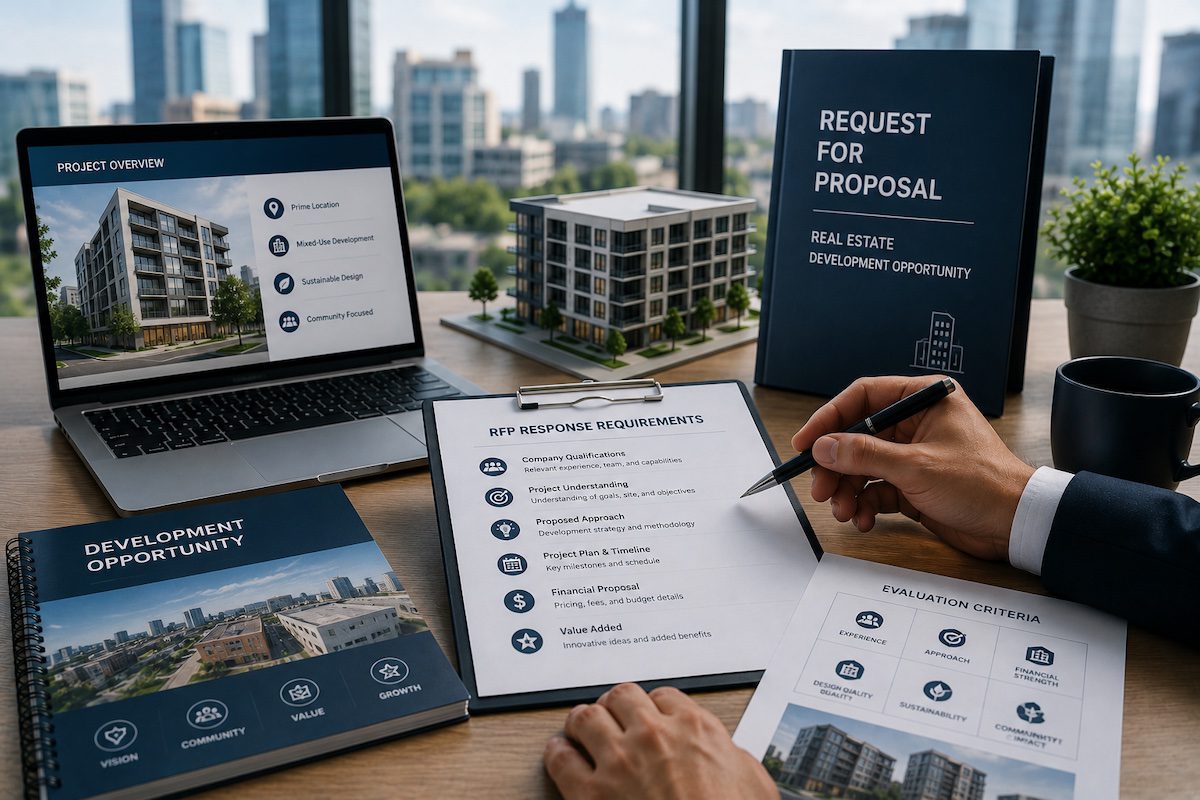
An RFP in real estate is a formal document used to solicit competitive proposals, either from landlords who own space a tenant wants to lease, or from service providers (brokers, property managers, developers) competing for a real estate engagement. Most online definitions focus only on the first scenario, which leaves out half the picture. At The Write Direction, we draft RFPs across all four major real estate categories, so this guide covers the full topic rather than just the tenant leasing use case.
Key Takeaways
- A real estate RFP (Request for Proposal) is a non-binding solicitation document used to gather, compare, and evaluate competitive offers.
- The term covers four distinct document types: tenant lease RFPs, brokerage services RFPs, property management RFPs, and development or public sector RFPs.
- RFPs differ from LOIs, RFIs, and RFQs in purpose, timing, and level of detail.
- A complete real estate RFP includes scope, economic terms, evaluation criteria, timeline, and procedural rules.
- The process typically runs four to twelve weeks from issue to vendor selection.
- Common mistakes include vague scope, missing evaluation criteria, and treating the RFP as a binding contract
What Is an RFP in Real Estate?
A Request for Proposal in real estate is a structured document that one party issues to multiple recipients to gather competitive bids on a defined real estate need. The document spells out the issuer’s requirements, the response format, the evaluation method, and the timeline. Recipients respond with proposals the issuer can score side by side.
Two characteristics define every real estate RFP. First, it is non-binding: neither the issuer nor the respondents commit to a transaction by participating. Second, it is comparative: the document is built to surface differences between competing offers on an apples-to-apples basis.
The issuer can be a tenant looking for office space, a corporate real estate team hiring a national brokerage, a REIT selecting a property management firm, or a municipality choosing a developer for a public-private project. Each scenario produces a different kind of RFP, which is why a single definition rarely captures what the document actually is.
The Four Types of RFPs in Real Estate
We use a Four-Type Real Estate RFP Typology to organize the territory. The type depends on who issues the RFP and what they are soliciting.
Tenant-Issued Lease RFPs
This is the most familiar version. A tenant, usually working through a tenant representation broker, sends an RFP to landlords whose properties match the tenant’s space requirements. The RFP asks each landlord to respond with specific economic terms: base rent, lease term, tenant improvement allowance, free rent period, operating expense structure, renewal options, and similar deal points. The tenant uses the responses to shortlist properties and move toward a letter of intent.
Brokerage Services RFPs
Here the issuer is typically a corporate user, institutional investor, government agency, or non-profit that wants to hire a commercial real estate brokerage firm. The RFP solicits proposals from competing firms for tenant representation, project leasing, investment sales, or portfolio services. Responses cover the firm’s experience, team credentials, market knowledge, fee structure, and proposed marketing or transaction strategy.
Property Management RFPs
Owners, REITs, condominium boards, homeowners associations, and asset managers issue these RFPs to select a third-party property management company. The document covers the portfolio scope, services required (operations, maintenance, accounting, tenant relations, reporting), performance metrics, and fee model. Property management RFPs often run longer than lease RFPs because the relationship is ongoing rather than transactional.
Development and Public Sector Real Estate RFPs
Municipalities, school districts, transit authorities, federal agencies, and large institutions use this category to solicit proposals for development projects, real estate acquisition, disposition of surplus property, or comprehensive real estate consulting services. These RFPs are usually published publicly, follow strict procurement rules, and include detailed evaluation criteria tied to public interest factors. Compliance frameworks such as federal acquisition regulations or state procurement statutes shape both the document and the response process.
What’s Included in a Real Estate RFP
A complete real estate RFP typically contains seven sections:
- Issuer background and project context. A brief introduction to the organization issuing the RFP, the business need driving the project, and any relevant background information.
- Scope of work or space requirements. For a lease RFP, this covers square footage, location preferences, build-out condition, intended use, and occupancy timeline. For a services RFP, this defines the deliverables, geographic coverage, and performance expectations.
- Economic terms. Base rent, escalations, lease term, tenant improvement allowance, free rent or rent abatement, CAM (common area maintenance) charges, operating expense pass-throughs, and options to renew, expand, or terminate. Service RFPs include proposed fees, commission structures, and reimbursable expenses.
- Submission requirements and proposal format. Page limits, required attachments, contact information, and the format respondents must follow so responses can be compared consistently.
- Evaluation criteria and scoring methodology. The factors the issuer will use to score proposals (price, experience, technical approach, references) and the relative weight of each.
- Timeline and key dates. Issue date, Q&A window, proposal deadline, interview dates, anticipated selection date, and target start or occupancy date.
- Legal, procedural, and confidentiality terms. The issuer’s right to reject any proposal, negotiate terms, modify the RFP, treat submissions as confidential, and clarify that the RFP itself creates no obligation.
RFP vs. LOI vs. RFI vs. RFQ in Real Estate
These four documents often get confused. They serve different functions at different stages.
- RFP (Request for Proposal): Solicits detailed, competitive proposals from multiple parties. Used when the issuer knows what they need and wants to compare specific offers.
- LOI (Letter of Intent): A focused, non-binding document that signals serious intent on a single property or counterparty. LOIs come later in the process, often after an RFP has narrowed the field. An LOI typically goes back and forth between two parties before a formal lease or purchase agreement is drafted.
- RFI (Request for Information): A broader, earlier document used to gather general information and qualify potential vendors or properties. The output is a shortlist, not a transaction.
- RFQ (Request for Qualifications): Focuses on a respondent’s credentials, experience, and capacity, with less emphasis on pricing. Often used in public sector real estate procurement as a first-stage filter before issuing a full RFP.
A typical procurement sequence runs RFI to RFQ to RFP to LOI to contract, though many real estate transactions skip one or more stages.
The Real Estate RFP Process Step by Step
- Define requirements and assemble the team. Lock in budget, timeline, decision-makers, and must-have versus nice-to-have criteria.
- Identify and shortlist recipients. Build a list of landlords, brokers, or vendors who can realistically meet the requirements.
- Draft the RFP document. Cover all seven sections above. Make requirements specific enough to be scoreable.
- Issue the RFP and manage the Q&A window. Most real estate RFPs include a defined period during which respondents can submit clarifying questions, with answers shared with all bidders to keep the playing field level.
- Receive and score responses. Apply the evaluation criteria to rank proposals.
- Conduct interviews or site visits. Shortlisted respondents typically present in person or virtually before final selection.
- Select the winner and transition to LOI or contract. The RFP itself does not create the deal. Once a winner is chosen, parties move to an LOI, purchase and sale agreement, lease, or services contract.
Lease RFPs commonly close in four to six weeks. Brokerage and property management RFPs run six to ten weeks. Public sector real estate RFPs often take three months or longer because of procurement rules.
Why Real Estate RFPs Matter
A well-built RFP changes the negotiation. It signals professionalism, creates competitive pressure among respondents, and forces a structured response that is easier to evaluate. For corporate users, it documents a defensible procurement process. For public and non-profit organizations, it satisfies compliance requirements that mandate competitive solicitation above certain thresholds. For any issuer, it produces market intelligence: even unsuccessful proposals reveal what the market is willing to offer.
Common Mistakes to Avoid in a Real Estate RFP
- Vague scope. If respondents have to guess what the issuer wants, proposals will not be comparable.
- Missing evaluation criteria. Without published scoring factors, the selection process looks arbitrary and discourages strong bidders.
- Unrealistic timelines. Two-week response windows produce thin proposals. Two to four weeks is the working minimum for most categories.
- Missing legal and procurement language. Reservation of rights, confidentiality, and non-binding clauses protect the issuer.
- Treating the RFP as a contract. Selection of a winning proposal still requires a separate binding agreement.
- Mis-sized recipient list. Sending to too few limits competition; sending to too many burns goodwill with firms that have no real chance of winning.
Frequently Asked Questions
Is an RFP in real estate legally binding?
No. A Request for Proposal is a non-binding solicitation. Neither the issuer nor the respondents create a contract by participating. The issuer can reject all proposals, modify the RFP, or restart the process. A binding obligation only forms once parties sign a separate document, such as a lease, purchase and sale agreement, or services contract, following the RFP.
Who typically writes an RFP for commercial real estate?
For tenant lease RFPs, the document is usually prepared by the tenant’s representation broker, sometimes with input from the tenant’s legal and real estate teams. For brokerage services and property management RFPs, the issuer’s corporate real estate, procurement, or facilities team typically drafts the RFP, often with outside writing support. Public sector RFPs are prepared by procurement officers, often with template language required by statute.
What is the difference between an RFP and an LOI in real estate?
An RFP is a one-to-many document used to gather competitive proposals from multiple parties before selecting a counterparty. An LOI (Letter of Intent) is a one-to-one document exchanged between two specific parties once the field has narrowed, outlining the key business terms of a likely deal. Both are non-binding, but the RFP is comparison-driven and the LOI is transaction-driven.
How long should a commercial real estate RFP be?
Lease RFPs typically run five to ten pages. Brokerage and property management RFPs run ten to twenty-five pages because they include scoring rubrics, vendor questionnaires, and detailed scope descriptions. Public sector real estate RFPs can exceed fifty pages once compliance attachments, certifications, and reference forms are included. Length should match complexity, not the other way around.
Are RFPs used in residential real estate?
RFPs are rare in single-family residential transactions because individual home sales follow listing-and-offer dynamics rather than competitive solicitation. They do appear in residential portfolio acquisitions, large-scale multifamily transactions, residential property management engagements, and HOA service procurement. Affordable housing developers also issue RFPs when soliciting construction, financing, or operating partners.
How long does the real estate RFP process take from issue to selection?
Most commercial lease RFPs close in four to six weeks: two to three weeks for landlord responses, one to two weeks for evaluation, and one week for shortlisting and final selection. Brokerage and property management RFPs run six to ten weeks. Public sector or institutional real estate RFPs often take three months or longer because of mandatory public notice periods, formal Q&A processes, and committee-based evaluation.
How The Write Direction Can Help
At The Write Direction, we draft and edit real estate RFPs across all four categories covered above. Our team has produced lease RFPs for corporate users relocating regional offices, brokerage selection RFPs for institutional investors, property management RFPs for multi-property owners, and public sector real estate RFPs for municipal and educational clients. We write the scope, structure the evaluation criteria, build the response templates, and align the document with procurement standards when the situation calls for it.
If you are preparing to issue a real estate RFP and want a document that produces serious, comparable proposals, get in touch with our team or book a consultation to discuss the project. We will help you turn a fuzzy real estate need into a clear, defensible, response-ready RFP.

Related posts


Recent Posts