
Capability Statement Template: Sections, Structure, and a Fill-In Format You Can Reuse
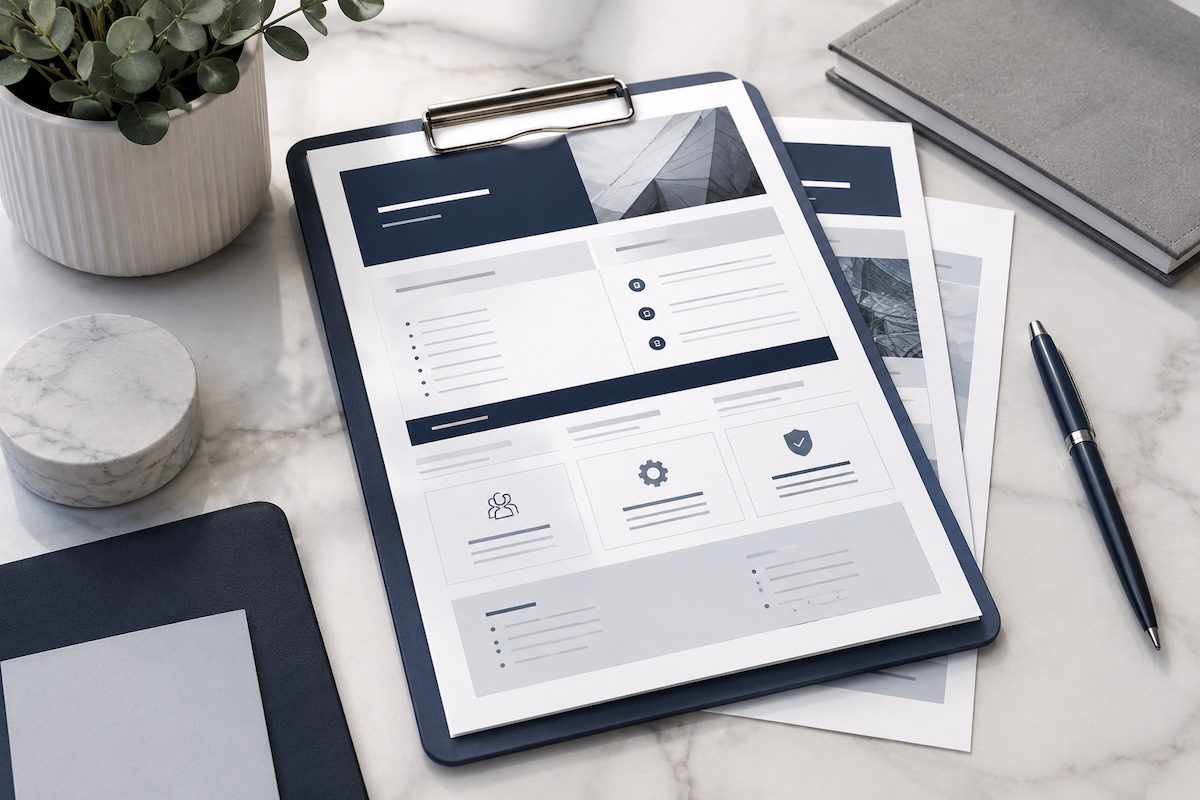
A capability statement template is a one-page layout with six fixed sections: a header block, core competencies, past performance, differentiators, certifications, and company data with contact details.
Government buyers scan those sections in a predictable order, so the template’s job is to put each answer where the reader expects it. The same six-section structure serves federal buyers, state agencies, and prime contractors, with the evidence swapped per pursuit rather than the layout rebuilt.
Key Takeaways
- A capability statement template holds six sections: header block, core competencies, past performance, differentiators, certifications, and company data with contact details.
- Contracting reviewers spend 30 to 60 seconds per document, so the layout must surface competencies and identifiers without hunting.
- Deliver the finished page as a text-searchable PDF with a dated file name, never as a flattened image.
- Industry adaptations change the evidence: construction firms lead with bonding capacity and safety record, IT firms with clearances and compliance frameworks.
- The GRID framework (Gather, Rank, Insert, Design) fills the template with your evidence instead of leftover boilerplate.
What a Capability Statement Template Contains
A working template arranges six sections on a single page: a header block with the company identity, four to six core competencies, verifiable past performance, differentiators, and certifications.
A company data block with a named contact closes the page. The order matters because buyers read top-left to bottom-right and quit early.
For the full definition, the strategy behind general and targeted versions, and where the document fits in a federal pursuit, read our capability statement guide. The sections below cover the build.
The Template, Section by Section
Header Block
The header carries the company logo, legal name, and a one-line positioning statement at the top of the page.
Write the positioning line as a capability claim: “Licensed electrical contractor delivering federal facility upgrades across the Southeast” beats “Powering your success.”
Core Competencies
List four to six competencies as short bullets phrased in the keywords buyers type into the SBA’s Dynamic Small Business Search.
Each bullet names a service and a context: “Network infrastructure design for classified environments” rather than “IT services.” This block sits under the header because it decides whether the reader continues.
Past Performance
Give each engagement one line: client or agency, contract number or scope, dollar value, and a measurable outcome. “GSA Region 4, HVAC modernization, $1.2M, delivered 6 weeks early” tells a reviewer more than a paragraph. Firms without federal contracts list commercial, state, or subcontract work in the same format.
Differentiators
Write two to four claims a competitor could not paste onto their own page: proprietary methods, clearance levels, response-time guarantees, niche equipment, or geographic coverage. Test each line by asking whether a rival could sign it without lying, and cut the ones that pass.
Certifications
List SBA designations first (8(a), WOSB, SDVOSB, HUBZone), then industry credentials such as ISO 9001, CMMI, or state licenses.
The SBA’s contracting assistance programs page explains each designation; on the template, the acronym and certification number suffice.
Company Data and Contact
The data block anchors the bottom of the page: UEI, CAGE code, primary and secondary NAICS codes, and DUNS legacy reference where a prime requests it.
Add purchase card acceptance and one named contact with direct phone and email. Buyers copy these identifiers into SAM.gov entity registration lookups, so accuracy here decides whether verification succeeds on the first try.
Copy-Paste Text Template
Paste the skeleton below into Word or Google Docs and replace every bracket before the document leaves your machine.
[COMPANY LOGO] [LEGAL COMPANY NAME]
[One-line positioning statement: what you deliver, for whom, where]
Core Competencies
[Competency 1: service + context] | [Competency 2] | [Competency 3] | [Competency 4]
Past Performance
[Client/Agency] | [Contract # or scope] | [$ value] | [Outcome]
[Client/Agency] | [Contract # or scope] | [$ value] | [Outcome]
Differentiators
[Claim a competitor could not copy] | [Claim 2] | [Claim 3]
Certifications
[SBA designation + number] | [Industry credential] | [State license]
Company Data
UEI: [number] | CAGE: [code] | NAICS: [primary, secondary] | Accepts GPC: [Yes/No]
Contact: [Name, Title] | [Direct phone] | [Email] | [Website]
The GRID Framework for Filling the Template Without Boilerplate
The Write Direction developed the GRID framework because the fastest way to get skipped is submitting a template with generic language still in it.
- Gather the identifiers first. Pull the UEI, CAGE code, NAICS codes, and certification numbers from your registrations before writing a word. A page built around verified data never ships with a placeholder in the data block.
- Rank the competencies against buyer searches. Draft eight candidate competencies, search each phrasing in DSBS, and keep the four to six that match how buyers look for your codes.
- Insert the evidence, not the adjectives. Replace every descriptive claim with a number, a contract, or a credential. “Responsive support” becomes “4-hour on-site response, guaranteed in writing.”
- Design for the scan. Lay the finished content into blocks a reviewer can read in under a minute, with competencies at the top and identifiers findable in one glance.
Design and File Rules
Keep the document to one page in a column or block layout, with brand colours that survive black-and-white printing.
Export a text-searchable PDF rather than a flattened image, because buyers and primes run keyword searches across saved statements and a flattened file returns nothing.
Name the file with the company and date, in the pattern CompanyName-Capability-Statement-2026.pdf, and refresh the date with each revision so a reviewer never questions whether the page is current.
The same plain-language rules that govern proposals apply here at higher compression. Firms that follow our RFP examples and annotated templates will recognize the discipline: short lines, concrete nouns, zero filler.
Adapting the Template by Industry
Construction
Construction buyers verify risk before capability. Lead the differentiators with bonding capacity (single and aggregate), state licenses, safety record with EMR, and self-performed trade percentages. Past performance lines should carry project size and completion against schedule.
IT and Professional Services
Technology and consulting buyers scan for clearances, compliance frameworks (FedRAMP, CMMC level, SOC 2), and contract vehicles (GSA MAS, CIO-SP, state IDIQs). A vehicle listed on the page saves the buyer a procurement step, which makes it a differentiator in its own right.
Products and Manufacturing
Product firms lead with production capacity, quality systems (ISO 9001, AS9100), delivery terms, and country-of-origin compliance. Buyers sourcing goods verify supply reliability, so a line on inventory or turnaround time outworks a paragraph on company history.
Customizing the Template Per Opportunity
A targeted rebuild takes minutes when the general version is sound. Run this checklist against each notice:
- Reorder the competencies so the first bullet answers the notice’s first requirement.
- Swap the past performance lines for the three engagements closest to the scope.
- Mirror the agency’s vocabulary from the notice or its mission page.
- Update the header positioning line to name the agency’s domain.
- Refresh the file date and the version in the file name.
State and local pursuits swap federal identifiers for their local equivalents: UNSPSC codes and state small business certifications replace NAICS codes and SBA designations where the jurisdiction requires them.
Contractors moving from the introduction stage into a live pursuit should study the government RFP process and what an RFP is in government contracting.
The targeted statement’s vocabulary should match the solicitation that follows. Once the introduction earns a request for a full submission, our guide on how to write a business proposal covers that next document.
Template Mistakes That Get You Skipped
- Brackets left in. A shipped placeholder tells the buyer the firm cannot proofread its own marketing.
- Two-page spillover. Page two goes unread and signals unfamiliarity with government norms.
- Flattened PDFs. An export saved as an image fails the keyword searches buyers run.
- Stale dates. A file named 2023 invites the question of what else is out of date.
- Decorative design. Heavy graphics that bury the data block cost the reader the identifiers they came for.
The Write Direction rebuilds client templates against these failure points, then pressure-tests the structure the same way we build our RFQ template: every block earns its position or loses it.
Frequently Asked Questions
What should a capability statement template include?
A capability statement template should include six sections: a header block with a positioning line, four to six core competencies, past performance with values and outcomes, differentiators, and certifications. A company data block completes it, carrying the UEI, CAGE code, NAICS codes, and a named contact.
Is there a standard format for a capability statement?
No agency mandates a format, but a de facto standard exists: one page, competencies at the top, identifiers in a fixed data block, and a scannable column or block layout. Buyers review hundreds of these documents, so a page that follows the expected structure reads faster and survives the first cut.
Should a capability statement template be in Word or PDF?
Build the template in Word or Google Docs so you can edit it per opportunity, then export the finished version as a text-searchable PDF. The PDF preserves the layout across devices, and the searchable text layer lets buyers and prime contractors find the firm by keyword in saved files.
Can I use the same capability statement template for every agency?
The layout stays constant; the content should not. Keep one general version for SAM.gov profiles and events, then rebuild the competency order, past performance lines, and vocabulary for each targeted agency or prime. State pursuits may also need UNSPSC codes and state certifications in place of federal identifiers.
Where can I get a free capability statement template?
The copy-paste skeleton on this page covers the standard six-section structure at no cost. APEX Accelerators and SBA district offices also provide free editable templates and one-on-one reviews for small businesses. Whatever the source, replace every placeholder with verified data before the document reaches a buyer.
Build the Page Once, Win Meetings With It for Years
A sound template turns each new opportunity into a fifteen-minute customization instead of a blank-page rewrite. The six sections, the searchable PDF, and the per-notice checklist give the firm a document buyers can verify in one pass.
At The Write Direction, we build capability statement templates, targeted rebuilds, and the proposal documents that follow when the introduction lands.
Our writers phrase your competencies in the keywords your buyers search and back every claim with evidence they can check. Book a consultation to discuss your template, or email us at [email protected] to get started.

Related posts

Recent Posts