
RFQ vs RFP: Key Differences, When to Use Each, and How They Fit in Procurement

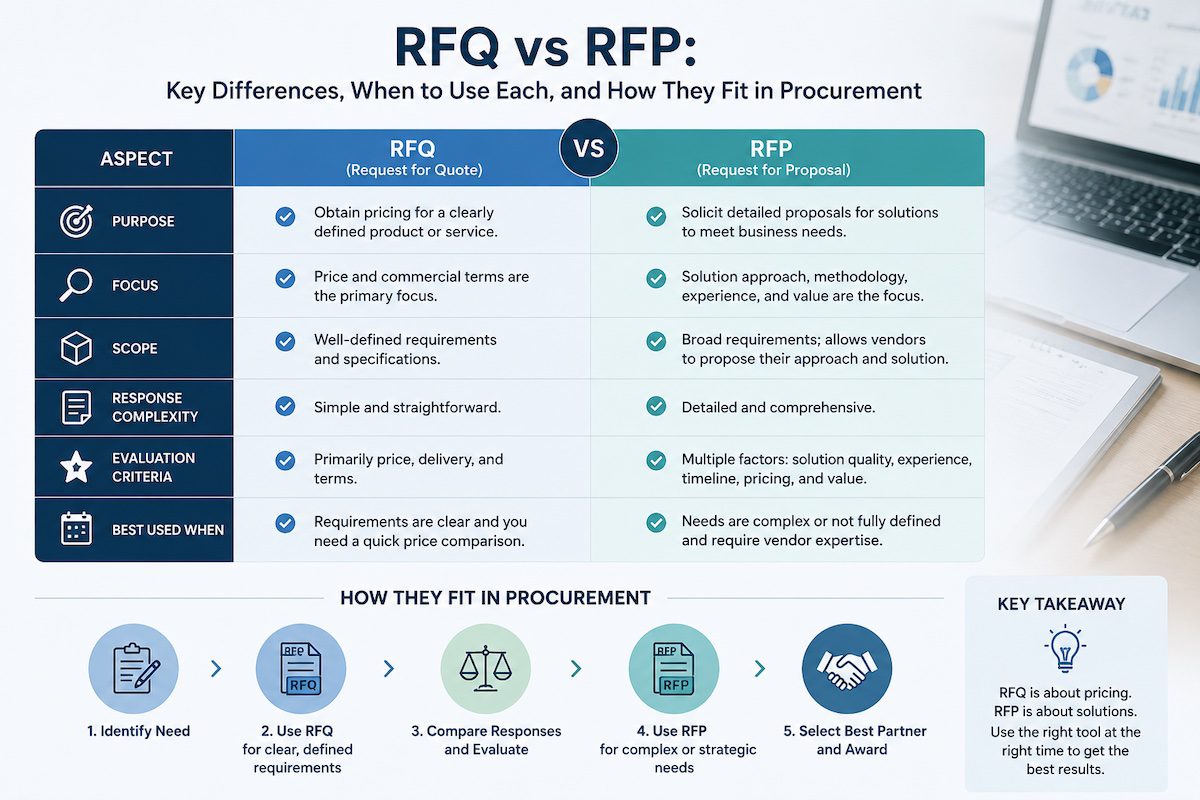
The RFQ vs RFP question trips up procurement teams, vendors, and bid writers every day, and getting it wrong has real costs. An RFQ (Request for Quote) is a price-focused document used when specifications are clear, and the buyer just wants competitive pricing.
An RFP (Request for Proposal) is a solution-focused document used when the buyer needs the vendor to propose how the work will be done, not just what it costs. Most articles stop there. At The Write Direction, we write both documents across multiple industries, so this guide goes deeper: seven specific differences, a decision matrix, real cross-industry examples, and where the rest of the procurement document family fits.
Key Takeaways
- An RFQ solicits pricing on clearly defined goods or services; an RFP solicits a complete solution to a defined problem.
- The two documents differ across seven dimensions: purpose, specification clarity, evaluation focus, complexity, vendor flexibility, time required, and outcome type.
- Use an RFQ for standardized purchases where price is the deciding factor; use an RFP for complex projects where approach, capability, and partnership matter.
- The two can be combined: an RFP to select the partner, followed by an RFQ to lock final pricing.
- RFI, RFT, RFO, IFB, EOI, ITT, ITQ, and LOI fill out the broader procurement document family.
- Misapplying the wrong document wastes vendor time, burns goodwill, and either inflates cost or hides value.
RFQ vs RFP at a Glance
| Dimension | RFQ | RFP |
| Primary purpose | Get competitive pricing | Solicit a complete solution |
| Buyer knows the spec | Yes, fully | Partially or not at all |
| Evaluation driver | Price | Total value (price + approach + capability) |
| Document length | 1–5 pages | 10–50+ pages |
| Vendor flexibility | None (price only) | High (vendors propose the approach) |
| Typical timeline | Days to two weeks | Four to twelve weeks |
| Outcome | One-time purchase or short-term contract | Strategic partnership or complex engagement |
If the buyer can write the full specification down on a single page and the only question left is price, they want an RFQ. If the buyer can describe the problem but needs the vendor to figure out the solution, they want an RFP. Both documents typically follow upstream spend analysis and category strategy work led by the Chief Procurement Officer (CPO) or category manager.
What Is an RFQ (Request for Quote)?
A Request for Quote is a formal document a buyer sends to potential suppliers asking for pricing on a specific, well-defined product or service. The buyer already knows what they want, and the only variable is cost.
A typical RFQ contains:
- A clear description of the item or service (specifications, dimensions, technical standards, quantity)
- Delivery requirements (location, lead time, freight terms, Incoterms for international orders)
- Payment terms (Net 30, Net 60, milestone payments)
- Quote format (unit price, total price, taxes, fees, surcharges, validity period)
- Submission deadline and contact details
- Any required certifications or supplier diversity status
RFQs are short, structured, and easy to compare side by side. They favor straightforward competitive bidding where every supplier is quoting on the same scope. Some categories also use the three-bids-and-a-buy approach, where the buyer secures three quotes against the same RFQ before awarding. Procurement teams often run RFQs through an e-sourcing platform such as SAP Ariba, Coupa, JAGGAER, or GEP for automated bid collection, reverse-auction support, and integration with the broader procure-to-pay (P2P) workflow.
What Is an RFP (Request for Proposal)?
A Request for Proposal is a formal document that a buyer sends to potential vendors asking for a full solution to a defined business problem. The buyer describes the need, the constraints, and the evaluation criteria, then asks vendors to propose how they would solve it.
A typical RFP contains:
- Background and business context
- Statement of Work (SOW) and detailed requirements
- Technical, functional, or operational specifications
- Evaluation criteria and scoring methodology
- Vendor qualifications, references, and capability statement
- Proposed approach, methodology, or work plan
- Pricing structure (often fixed price, time and materials, or hybrid)
- Service level agreements (SLAs) and key performance indicators (KPIs)
- Timeline, key dates, and submission instructions
- Legal, compliance, ESG, and contractual terms
RFPs are evaluated on total value rather than price alone. Procurement teams typically apply a scoring rubric that weighs technical approach, vendor capability, references, security and compliance, supplier diversity commitments, and pricing. The lowest bid does not always win, and many RFP processes include a best and final offer (BAFO) round before contract award.
RFQ vs RFP: The Seven Key Differences
1. Purpose: Transactional vs. Strategic
An RFQ exists to compare prices on something the buyer already knows how to specify. An RFP exists to compare solutions, capabilities, and strategic fit on something the buyer needs help designing.
2. Specification Clarity: Defined vs. Open-Ended
An RFQ assumes the buyer can describe the deliverable down to the part number, SKU, or service-level specification. An RFP assumes the buyer can describe the outcome but expects vendors to fill in the approach. Where the scope is highly uncertain, EU public buyers sometimes use competitive dialogue instead of a standard RFP, which permits multiple rounds of discussion with shortlisted vendors before final proposals.
3. Evaluation Focus: Price vs. Total Value
RFQ evaluation is overwhelmingly price-driven, sometimes filtered by minimum qualification thresholds (insurance, certifications, delivery capability). RFP evaluation is multi-criteria: technical approach, experience, references, methodology, risk, total cost of ownership (TCO), and pricing. Public sector RFPs often use best-value procurement or lowest price technically acceptable (LPTA) frameworks rather than lowest-bid-wins.
4. Document Complexity and Length
RFQs are short (one to five pages) because the buyer is asking one question: what’s your price? RFPs are long (ten to fifty pages, sometimes more) because the buyer is asking dozens of questions about how the work will be done.
5. Vendor Flexibility
In an RFQ, vendors have no room to propose alternatives. They quote against the specification or disqualify themselves. In an RFP, vendors have significant room to propose different approaches, technologies, or methodologies. That flexibility is the entire point of issuing an RFP rather than an RFQ.
6. Time and Effort Required
RFQ cycles run days to two weeks. RFP cycles run four to twelve weeks (and longer for public-sector or capital-project RFPs). Both buyer and vendor effort scale accordingly: an RFQ might take a few hours to draft and respond to, while an RFP often consumes weeks of cross-functional work on both sides, including dedicated bid management resources on the supplier side.
7. Outcome: One-Time Purchase vs. Ongoing Partnership
RFQs typically result in a purchase order (PO) or short-term contract. RFPs typically result in a multi-year contract, master services agreement (MSA), or strategic partnership backed by supplier relationship management (SRM) and ongoing contract lifecycle management (CLM). The relationship implications shape how each document should be written.
When to Use an RFQ vs an RFP
Use an RFQ when:
- The goods or services are standardized and have clear specifications
- The purchase is a repeat buy or commodity acquisition
- Price is the dominant or only decision factor
- A fast turnaround is needed
- Suppliers are pre-qualified through an earlier pre-qualification questionnaire (PQQ) or RFI, so capability is not in question
- The scope can be defined on a single page
Use an RFP when:
- The project is complex or the solution is not predefined
- Multiple evaluation factors matter (approach, experience, security, support, technology, sustainability)
- The buyer wants strategic input or creative options from vendors
- The contract is long-term or high-value
- The buyer is selecting a partner, not just buying a part
- Regulatory or compliance requirements demand a competitive, documented process
- Single-source procurement is not justified, and a sole-source justification has been ruled out
Use both together when:
- A complex sourcing event needs both strategic evaluation and tight pricing
- The buyer issues an RFP to shortlist and select the partner, then issues a follow-up RFQ to finalize unit pricing on specific deliverables
- A long-term framework agreement is awarded by RFP, with ongoing transactional purchases priced through RFQs
RFQ vs RFP Examples Across Industries
IT and software. Buying off-the-shelf software licenses for 500 users with known SKUs = RFQ. Building a custom enterprise platform integrating CRM, ERP, and data analytics = RFP.
Construction. Ordering 50,000 square feet of standard-grade drywall = RFQ. Procuring a design-build contractor for a new hospital wing = RFP.
Healthcare. Stocking gloves, syringes, and basic medical supplies through a group purchasing organization (GPO) = RFQ. Selecting an electronic health record (EHR) system that requires integration, training, HIPAA compliance, and ongoing support = RFP.
Professional services. Printing 10,000 branded brochures = RFQ. Hiring a consulting firm to lead a strategic transformation = RFP.
Manufacturing. Sourcing 100,000 units of a standard fastener at a defined spec = RFQ. Engaging a contract manufacturer to engineer and produce a new product = RFP.
Government and public sector. Purchasing commodity office supplies under Federal Acquisition Regulation (FAR) thresholds = RFQ or sealed IFB. Procuring a multi-year IT modernization project under FAR Part 15 = RFP. International public buyers may use an open tender, restricted tender, ITT (Invitation to Tender), or ITQ (Invitation to Quote), depending on jurisdiction.
Where RFI Fits: The Complete Procurement Document Family
RFQ and RFP are part of a broader procurement document family. Each serves a different stage of strategic sourcing, source-to-pay (S2P) workflow design, and supplier selection.
- RFI (Request for Information): Early-stage discovery. The buyer asks the market what’s possible, who the players are, and what general approaches exist. Often paired with a pre-qualification questionnaire (PQQ) to filter the long list down to qualified bidders. Output is a shortlist, not pricing.
- RFQ (Request for Quote): Pricing solicitation on defined goods or services.
- RFP (Request for Proposal): Solution solicitation on a defined problem.
- RFT (Request for Tender): Formal public-sector procurement, often used in Commonwealth and European countries.
- RFO (Request for Offer): Open-ended creative solutions, similar to RFP but with even more vendor flexibility.
- IFB (Invitation for Bid): Sealed competitive bidding, common in US public contracting, where the lowest responsive bid wins.
- ITT (Invitation to Tender): International equivalent of IFB used in the UK, EU, and Commonwealth procurement.
- ITQ (Invitation to Quote): Smaller-scale equivalent of an RFQ used in some public-sector frameworks.
- EOI (Expression of Interest): A pre-qualification document used to gauge supplier interest before issuing an RFP or RFT.
- LOI (Letter of Intent): Non-binding signal of intent toward a contract, typically issued after the winning bid is selected.
A common sourcing sequence is RFI → PQQ → RFP → BAFO → LOI → contract award → CLM, though many procurement events skip stages depending on category complexity and supplier maturity.
Common Mistakes When Choosing Between RFQ and RFP
- Issuing an RFP when an RFQ would have done the job. Forces suppliers to write twenty-page proposals for a simple commodity purchase, wastes time on both sides, and burns goodwill.
- Issuing an RFQ when an RFP was needed. Locks the buyer into the lowest price on the wrong solution. Common in complex IT or professional services purchases, where the buyer assumed the scope was clearer than it was.
- Vague specifications in an RFQ. Produces non-comparable quotes because every supplier interpreted the scope differently.
- Treating the two documents as interchangeable. Procurement teams that copy-paste between templates lose the structural differences that make each document work.
- Skipping RFI or PQQ in unfamiliar markets. Buyers who go straight to RFP without market discovery often write requirements that don’t reflect what suppliers can actually deliver.
- Choosing on price alone in an RFP scenario. Defeats the purpose of issuing an RFP. If the buyer is just going to pick the cheapest bid, an RFQ would have saved everyone weeks of effort.
- Forcing a competitive process when a single-source is justified. Some categories (proprietary technology, IP-locked services, regulated sole-source suppliers) call for a documented sole-source justification, not a competitive RFP or RFQ.
Frequently Asked Questions
Is an RFQ the same as a quote?
Not quite. An RFQ is the request the buyer sends; the quote is the response the supplier provides. The RFQ defines what the buyer needs priced and how the supplier should structure the response. The quote is the supplier’s pricing answer, often with terms, validity period, and conditions attached. The two work together but are distinct documents in the procurement workflow.
Can you use an RFQ and an RFP together?
Yes, and many procurement teams do. A common pattern is to issue an RFP first to select a strategic partner based on capability, approach, and value, then issue an RFQ to that partner (or a shortlist) to lock in pricing on specific deliverables. Another pattern is to use an RFP to award a master services agreement, then run ongoing RFQs against that framework for transactional purchases. The two documents serve different decisions and can be sequenced or layered as the procurement event requires.
Which is more formal, an RFQ or an RFP?
Both are formal procurement documents, but RFPs are generally more formal because they involve more comprehensive evaluation, multi-stakeholder review, and longer contracts. RFPs typically include legal, compliance, and confidentiality terms; structured scoring rubrics; BAFO rounds; and detailed submission requirements. RFQs are formal in the sense that they create a structured competitive bidding process, but they are shorter and less procedurally heavy than RFPs.
Is an RFQ legally binding?
Neither an RFQ nor an RFP is binding by itself. Both are solicitations: the buyer is asking for information (a quote or a proposal) and is not committing to purchase. The supplier’s response is also generally non-binding unless the response explicitly states otherwise or unless local law treats accepted quotes as offers. Binding obligations arise only when a purchase order, contract, or signed agreement is executed.
How long should an RFQ be compared to an RFP?
RFQs are typically one to five pages because they cover a single question (price) and a tightly defined scope. RFPs typically run ten to fifty pages, and sometimes longer for public-sector or capital-project procurements, because they cover scope, approach, evaluation criteria, vendor qualifications, references, compliance, and pricing. Length should match the complexity of the decision, not the other way around: a short RFP on a complex project is just an incomplete RFP.
What is the difference between an RFP, RFQ, and RFI?
An RFI (Request for Information) is the earliest-stage document, used to gather general information about suppliers and what the market can deliver. An RFQ (Request for Quote) is the latest-stage document, used to lock in pricing once the specifications are clear. An RFP (Request for Proposal) sits between the two and is used when the buyer knows the problem but needs vendors to propose the solution. A common sequence is RFI to RFP to RFQ, though many procurement events skip stages based on the category and the buyer’s familiarity with the supplier landscape.
How The Write Direction Can Help
At The Write Direction, we draft and edit both RFPs and RFQs across procurement, technology, healthcare, construction, manufacturing, professional services, and public sector contexts. Our team has produced concise commodity RFQs for repeat purchasing programs, comprehensive multi-year RFPs for IT and consulting engagements, and hybrid sourcing documents that combine an RFP for partner selection with a follow-up RFQ for pricing. We write the scope of work, structure the evaluation criteria, build the response templates, and align each document with the procurement standards that apply to your category.
If you are preparing a procurement event and want to make sure the right document goes out the door, get in touch with our team or book a consultation to discuss your project. We will help you choose between an RFQ and an RFP, then write the document that produces serious, comparable responses from the right suppliers.

Related posts


Recent Posts