
What Is an RFP in the Hotel Industry? A Complete Guide to Hotel Requests for Proposal
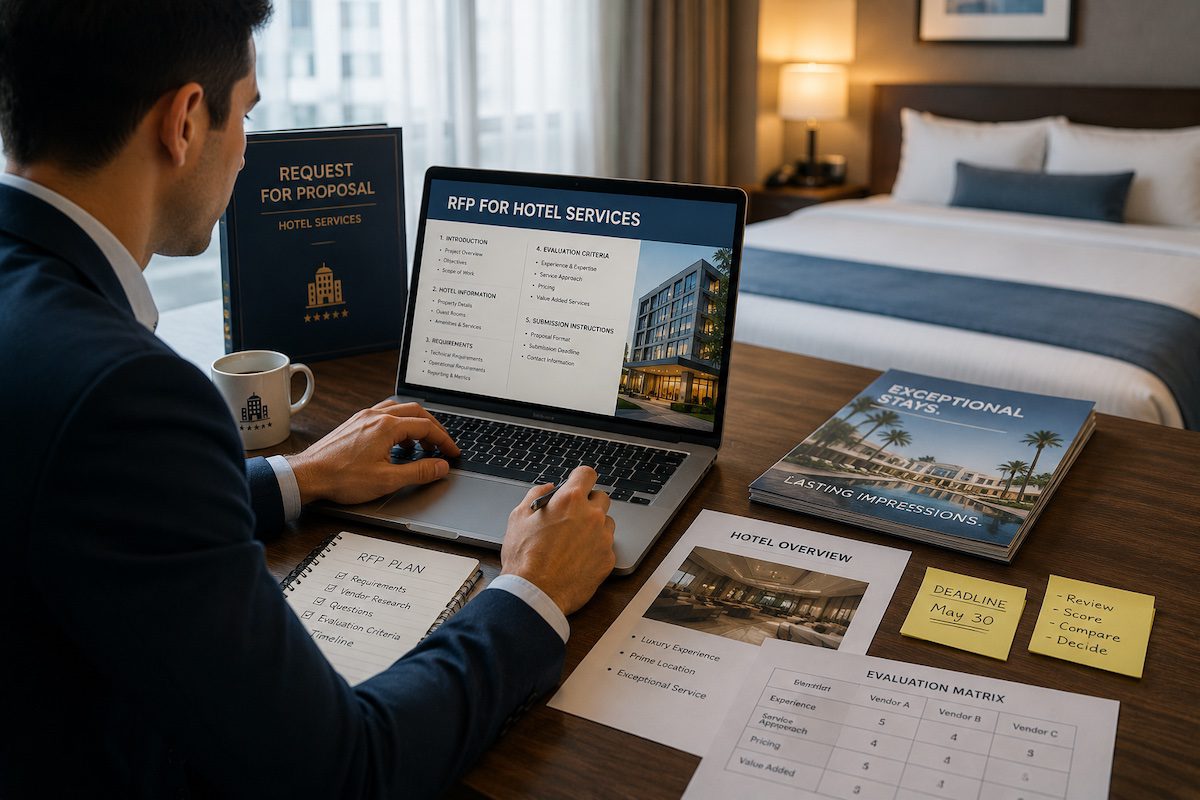
An RFP in the hotel industry is a structured document used to solicit competitive proposals from hotels (or, less commonly, from vendors that serve hotels). Most online definitions only describe one slice of this picture, usually the corporate travel angle or the meeting planner angle. At The Write Direction, we draft hotel RFPs across all three major categories, so this guide covers the full landscape rather than just the use case that fits one software vendor’s marketing.
Key Takeaways
- A hotel RFP (Request for Proposal) is a non-binding request for competitive proposals, used to negotiate rates, source venues, or procure services for hotel operations.
- The term covers three distinct document types: corporate transient RFPs, group and meeting RFPs, and hotel-issued vendor RFPs.
- Most corporate transient RFPs follow an annual Q3–Q4 cycle that aligns with fiscal planning, though continuous procurement is gaining ground.
- A complete hotel RFP includes volume data, requirements, rate or pricing structure, amenities, contractual terms, evaluation criteria, and response format.
- GBTA standardized templates are widely accepted and improve response rates for transient RFPs.
- Both buyers and hotels benefit from RFP software, but the document itself, not the tool, decides quality of outcome.
What Is an RFP in the Hotel Industry?
A Request for Proposal in the hotel industry is a formal document that one party issues to multiple recipients to gather competitive bids on a defined hospitality need. The document spells out requirements, response format, evaluation method, and timeline. Recipients respond with proposals the issuer can compare side by side. Related procurement documents include the RFI (Request for Information), used earlier to qualify potential suppliers, and the RFQ (Request for Quotation), used when pricing is the only variable.
Two characteristics define every hotel RFP. First, it is non-binding: neither side commits to a contract by participating. Second, it is comparative: the document is built to surface meaningful differences between competing offers.
The hotel industry is unusual in that the RFP flows in two directions. A corporation issuing a travel program RFP sends it to hotels. An event planner issuing a meeting RFP sends it to hotels. But a hotel issuing a construction or technology RFP sends it to vendors. The format, contents, and stakes shift with each scenario, which is why one definition rarely captures what the document actually is.
The Three Types of RFPs in the Hotel Industry
We use a Three-Type Hotel RFP Framework to organize the territory. The type depends on who issues the RFP and what they are sourcing.
Corporate Transient RFPs
This is the most common use of the term inside corporate travel programs. A company, often working with a travel management company (TMC) such as American Express GBT, BCD Travel, or CWT, sends an RFP to hotels in the cities where employees travel. The RFP asks each hotel to bid on negotiated room rates, amenities, cancellation policies, and loyalty terms for the upcoming program year. Pricing is requested for the transient segment specifically, separate from group business.
Volume can range from fifty room nights at a single property to millions of room nights across a global portfolio. Government contractors typically request per diem compliant rates aligned to GSA per diem ceilings. The outcome is a preferred hotel program: a curated list of properties offering contracted rates and inclusions to traveling employees, often accessed through a corporate code or chain code at the time of booking.
Consortia and TMC-driven negotiations fall into this category, aggregating volume across multiple companies to secure deeper discounts and IATA-numbered commissions. Brand-level programs such as Marriott Global Sales, Hilton for Business, Hyatt Leverage, and IHG Business Edge offer parallel options for companies that prefer to negotiate at the chain level.
Group, Meeting and Event RFPs
Here the issuer is an event planner, association, sports federation, corporate meetings team, or wedding planner. The RFP is event-specific rather than annual. It defines the dates, attendee count, room block size, meeting space requirements, food and beverage (F&B) needs, audiovisual (AV) setup, and any concessions the planner expects (comp rooms, complimentary upgrades, reduced parking, attrition flexibility).
Hotels respond with availability, pricing per room night, meeting space rental, banquet menus, and contract terms specific to group business. Group RFPs typically resolve faster than transient RFPs because the event date creates a fixed deadline. Tools like Cvent, Amadeus Hospitality MeetingBroker, and Knowland are widely used to distribute group RFPs and route them to the right property sales contacts.
Hotel-Issued Vendor RFPs
This category is often overlooked. Hotels themselves issue RFPs when they need to procure significant services or capital goods. Common examples include construction and renovation contracts, online travel agency (OTA) distribution agreements, property management system (PMS) selection, booking engine licensing, payment processing, F&B suppliers, laundry services, security, and brand-standard compliance vendors. These RFPs follow standard B2B procurement structure with hospitality-specific terms layered on top.
What’s Included in a Hotel RFP
A complete hotel RFP, regardless of type, typically contains seven sections:
- Issuer profile and volume data. Background on the company, planner, or hotel issuing the RFP, plus historical or projected volume (room nights per market for transient programs, attendee count and peak nights for group RFPs). Strong volume narratives often include ADR (average daily rate) and RevPAR (revenue per available room) context for the issuer’s existing program.
- Property and service requirements. Location parameters, star rating, room types, meeting space configuration, accessibility, brand restrictions, and any duty-of-care requirements.
- Rate or pricing structure. Static negotiated rates, dynamic discounts off best available rate (BAR), last room availability (LRA) terms, package pricing, group rates, or commission structures. Transient RFPs often request both LRA and non-LRA pricing, plus a per diem option for government-facing programs.
- Amenities, inclusions, and concessions. Wi-Fi, breakfast, parking, fitness center access, loyalty point eligibility, complimentary upgrades, comp rooms per paid block, late checkout, and similar value adds.
- Cancellation, attrition, and contractual terms. Cancellation windows, attrition allowances on group blocks, force majeure language, and rebooking clauses.
- Compliance and sustainability requirements. Insurance levels, data security, ESG certifications, emissions reporting, GSA per diem compliance for government contractors, and traveler wellness standards.
- Evaluation criteria, timeline, and response format. Scoring factors, weighting, response deadline (typically two to four weeks), interview or site visit schedule, and award notification date.
The Annual Hotel RFP Cycle
Corporate transient RFPs follow a predictable calendar that mirrors corporate fiscal planning.
- Q1–Q2 (January through June): Spend analysis, program strategy, and hotel shortlisting. Travel managers pull historical data on room nights, ADR, RevPAR, and traveler compliance, often benchmarking against STR (Smith Travel Research) market data.
- Q3 (July through September): RFP launch. Most programs distribute their RFPs to hotels in this window so responses arrive before the holiday slowdown.
- Q4 (October through December): Negotiation rounds, award decisions, contract signing, and rate loading into the GDS (Sabre, Amadeus, Galileo, Worldspan) and online booking tools such as Concur, SAP Concur Travel, or Egencia.
- Q1 of program year (January onward): Program goes live. Travel managers run rate audits throughout the year to catch loading errors and ensure negotiated discounts actually appear at booking under the correct corporate code.
Group RFPs follow the event date, not the calendar. A meeting taking place next June might have its RFP issued this October, with award decisions by December.
A growing number of mature programs are moving toward continuous procurement: a hybrid model that blends annual negotiated rates with dynamic pricing and real-time rate monitoring. Continuous procurement responds to rate fluctuations and supply changes throughout the year rather than locking in twelve months of pricing in one window.
Who Sends and Receives Hotel RFPs
Buyers include corporate travel managers, procurement teams, TMCs, event planners, association meeting professionals, sports federations, government agencies, non-profit organizations, and wedding planners. On the hotel-issued side, buyers are property general managers, owners, asset managers, and brand procurement teams.
Sellers include hotel sales teams, brand-level national and global sales offices (NSOs and GSOs), revenue managers, general managers, consortia such as American Express GBT or BCD Travel partner networks, and third-party hotel representation companies. For hotel-issued RFPs, sellers are construction firms, technology vendors, F&B suppliers, and service providers.
Internal stakeholders on both sides typically include finance, legal, IT, and (on the buyer side) duty-of-care or risk management.
Hotel RFP Best Practices for Buyers
- Use GBTA (Global Business Travel Association) standardized templates. Hotels recognize the format and respond faster.
- Keep questionnaires focused. Longer RFPs receive fewer responses; only ask what you will actually score.
- Provide accurate historical volume. Hotels price based on the room nights you can credibly deliver.
- Benchmark against STR data and prior-year ADR before opening negotiations.
- Set realistic deadlines. Two to four weeks is the working minimum; one-week windows produce thin responses.
- Use a sourcing platform (Cvent, ReadyBid, Lanyon, Amadeus Hospitality) for distribution, scoring, and rate auditing.
- Audit loaded rates throughout the program year. Negotiated discounts are worthless if they never reach the booking screen.
Hotel RFP Best Practices for Hotels (Suppliers)
- Respond fast. Studies of group RFP platforms have shown that first responders win a disproportionate share of business.
- Personalize beyond the consumer website. Buyers have already seen the public marketing; the response should add information they cannot find elsewhere.
- Highlight differentiators that map to the RFP’s stated criteria. Generic responses get filtered out.
- Use RFP response software to pre-populate property data and respond consistently across multiple inbound RFPs.
- Track win/loss by segment (transient versus group) and refine the response playbook based on what actually closes.
Common Mistakes to Avoid in a Hotel RFP
- Overly long questionnaires. Anything that takes a hotel more than ninety minutes to complete will get fewer or weaker responses.
- Missing volume data. Without credible room nights, hotels cannot price a real discount.
- No rate-loading verification. A negotiated rate that does not load to the right corporate code in the GDS does not exist.
- Treating the RFP as administrative. The document drives a significant share of annual travel spend; thin RFPs produce thin savings.
- No communication back to bidders. Hotels that lose without explanation are less likely to bid aggressively next year.
Frequently Asked Questions
What does RFP stand for in the hotel industry?
RFP stands for Request for Proposal. In the hotel industry, the term refers to a structured bidding document used to solicit competitive proposals, most often for corporate transient travel rates, group event sourcing, or hotel-side vendor procurement. The acronym is the same as in any other industry; the contents are tailored to hospitality requirements such as room rates, meeting space, F&B, attrition, and amenity concessions.
When is hotel RFP season?
Corporate transient RFP season runs from Q3 through Q4 each year, usually July through December, with rates going live the following January. This timing aligns with corporate fiscal planning and gives hotels time to load negotiated rates into the GDS and into branded chain codes before the new program year starts. Group and meeting RFPs follow the event date rather than the calendar, so they can be issued at any time. Some mature programs have moved to continuous procurement and source year-round.
What is the difference between a hotel RFP and an LOI?
A hotel RFP is a one-to-many document used to gather competitive proposals from multiple hotels before selecting a partner. A Letter of Intent (LOI) is a one-to-one document exchanged with a specific hotel once the field has narrowed, outlining the key terms of a likely deal. RFPs lead to LOIs, and LOIs lead to signed contracts. Both are non-binding, but the RFP is comparison-driven and the LOI is transaction-driven.
Who pays for the hotel RFP process?
The issuing party absorbs internal labor costs of preparing, distributing, and evaluating the RFP. Some legacy sourcing platforms charge per-RFP fees, while newer platforms offer unlimited RFPs on subscription. Consortia programs sometimes require hotels to pay participation fees, though many representation companies cover this on a pay-on-performance basis tied to commissions and IATA-numbered bookings. Hotels responding to an RFP absorb the labor cost of their proposal.
What is a GBTA RFP template?
A GBTA RFP template is a standardized request format published by the Global Business Travel Association. It comes in several versions, including a full template and a short form for smaller programs. Hotels recognize the GBTA structure, which speeds up response and improves accuracy. Travel managers who use a streamlined GBTA short form often see meaningful improvements in response rates compared to long-form custom templates.
How long does the hotel RFP process take from launch to rate loading?
A typical corporate transient RFP cycle runs ten to sixteen weeks: two to four weeks for hotel responses, two to four weeks for evaluation and negotiation, two weeks for award decisions and contract signing, and another two to four weeks for rates to load into the GDS and online booking tools. Group RFPs close faster, usually four to eight weeks, because the event date forces a tighter schedule. Public sector and government RFPs run longer because of mandatory procurement procedures.
How The Write Direction Can Help
At The Write Direction, we draft and edit hotel RFPs across all three categories covered above.
Our team has produced corporate transient RFPs for travel managers preparing for the Q3 launch window, group and meeting RFPs for associations and corporate event teams, and hotel-issued vendor RFPs for property owners sourcing construction, PMS, OTA, and F&B partners. We write the volume narratives, structure the rate request, build the scoring rubric, and align the document with GBTA standards when the program calls for it.
If you are preparing to issue a hotel RFP and want a document that produces serious, comparable proposals from the right properties, get in touch with our team or book a consultation to discuss your project. We will help you turn a complex sourcing requirement into a clear, defensible, response-ready RFP.

Related posts


Recent Posts