
RFP Analysis: How to Break Down an RFP and Decide Whether to Bid
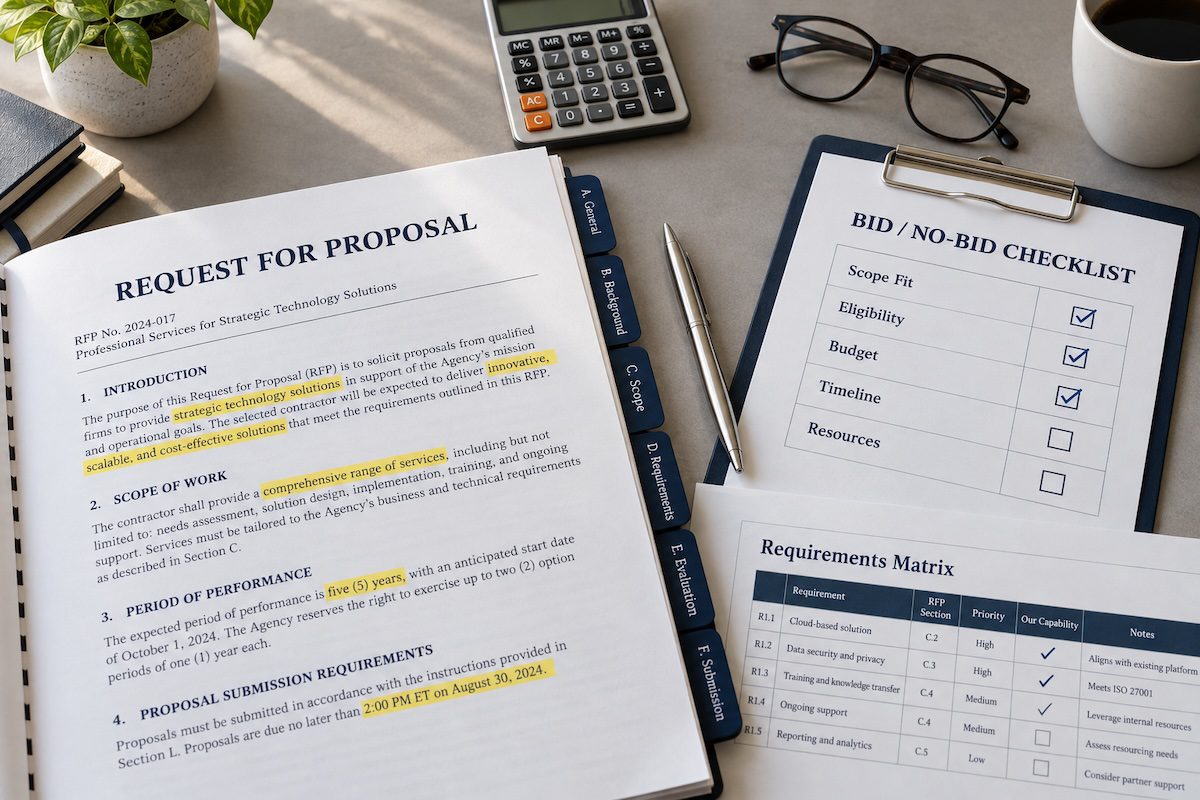
RFP analysis is the work of reading a request for proposals, breaking it into requirements, risks, and scoring rules, and deciding whether to bid before anyone writes a word.
Done well, it tells you where the points sit, which rules can disqualify you, and what the contract will cost you after you win.
Teams that skip it pay later. They miss a mandatory form, answer the questions they wish the buyer had asked, or spend three weeks on a bid they had no chance of winning.
This guide gives you a repeatable method for analyzing an RFP, the signals extraction software misses, and a sample one-page verdict you can adapt. If you are new to responding, start with our overview of what an RFP response is.
Key Takeaways
- RFP analysis happens between the RFP’s release and your kickoff meeting. Its output is a bid or no-bid decision and a plan.
- Pass/fail requirements decide more bids than writing quality. Find them first.
- Read the sample contract. Payment terms, liability, and insurance minimums can turn a win into a loss.
- The evaluation weights tell you where to spend your words and your best people.
- Software extracts requirements fast, but judgment about fit, risk, and the competition still needs a person.
Have an RFP on your desk right now? The Write Direction can analyze it with you and give you a clear bid or no-bid recommendation before your team commits its time. Book a consultation.
What Is RFP Analysis?
RFP analysis is a structured review of a solicitation from the responder’s side. You collect the full package, extract each requirement, weigh the risks, and judge your odds.
The result is a short decision document and, if you bid, the inputs for your compliance matrix and response plan.
It sits at the front of the response process. A buyer releases the RFP, you analyze it, you decide, and drafting begins after that decision.
RFP Analysis vs Proposal Evaluation
Buyers use the phrase too. On the buyer’s side, “RFP analysis” can mean reviewing and scoring the proposals that came in.
That work follows published criteria and a scoring method. For that side of the process, see our guide to evaluation criteria for RFPs. The rest of this article covers the responder’s side.
Why RFP Analysis Decides Bids Before Writing Starts
Public buyers treat mandatory requirements as pass/fail. Canada’s Office of the Procurement Ombud reviewed a 2022 defence training contract where the evaluators rejected a bid because it left out a copy of the course curriculum that a mandatory criterion required.
The bidder had asked a clarifying question about the French translation and assumed the answer covered the whole criterion. The Ombud upheld the rejection and noted that bidders carry the duty to seek clarification on unclear requirements.
That bidder could write. The bid failed on a requirement a careful analysis would have flagged in the first hour.
Analysis also protects your capacity. Each bid you pass on frees your subject matter experts for a bid you can win. And the buyer’s stated priorities, pulled out during analysis, become the win themes your response repeats.
Gather the Full Solicitation Package First
Analyze the whole package. The scope section tells you half the story. Collect:
- The main RFP document.
- Each addendum, numbered and dated.
- Pricing forms and cost templates.
- The sample or draft contract.
- Mandatory forms, declarations, and certifications.
- The question-and-answer log, if the buyer has started one.
- Portal instructions, including file size and naming rules.
US federal solicitations follow a set layout. The FAR’s uniform contract format places the statement of work in Section C, contract clauses in Section I, instructions to offerors in Section L, and evaluation factors in Section M. Most state, provincial, and municipal RFPs use their own structure, so map where each of those four pieces lives before you start.
The sample contract gets skipped most often. Read it now, while you can still ask questions about it.
The SCOPE Method for Analyzing an RFP
Run each RFP through five lenses. Record what you find in one working document.
| Lens | What to find | Questions to answer |
| Submission rules | Deadline and time zone, portal, page limits, formatting, file rules, required forms | Can we submit a compliant package by the deadline? |
| Criteria and weights | Evaluation factors, point values, minimum scores, price weighting | Where do the points sit, and can we score high there? |
| Obligations | Contract terms, insurance minimums, liability, payment terms, security and privacy rules, key personnel | Can we live with this contract if we win? |
| Pricing signals | Posted budget, past award values, pricing structure, how price gets scored | Can we compete on price and still make money? |
| Eligibility and knockouts | Mandatory certifications, experience thresholds, location or residency rules, pass/fail forms | Do we meet each mandatory requirement today? |
Submission Rules
Note the deadline with its time zone, the portal, and each formatting rule. A 10-page limit on a technical approach changes how you staff the writing. A portal that needs registration may take days to set up.
Criteria and Weights
The weights show you the buyer’s priorities. If methodology carries 40 points and price carries 20, the buyer cares more about how you work than what you charge. Look for minimum scores on rated sections, since falling short on one can eliminate you. Our breakdown of RFP scoring criteria and weights shows common scorecard designs.
Obligations
Read the contract clauses.
Flag unlimited liability, insurance limits above what you carry, payment terms longer than 60 days, intellectual property transfers, and named key personnel you would need to commit for the full term. Any of these can make a winning bid unprofitable.
Pricing Signals
Look for a posted budget or a not-to-exceed figure. Search public award records for what the buyer paid last time.
Check whether price uses a formula, such as lowest price earns full points, or a judgment score. A formula rewards the lowest bidder. A judgment score leaves room for value.
Eligibility and Knockouts
List each mandatory requirement on its own line and mark it met, not met, or unclear. Mandatory items include certifications, years of experience, past contract values, local presence, and signed forms. One “not met” ends most analyses. Each “unclear” becomes a question for the buyer.
Read Between the Lines: Signals Software Misses
Extraction tools find each “shall” and “must.” They don’t tell you what the pattern of requirements means. Watch for:
- Requirements written around one product or firm. A brand name, a niche certification, or a narrow experience rule can point to a favoured incumbent.
- Timelines that don’t fit the scope. A large scope with a short delivery window can signal a rushed project or a buyer who already has a vendor in mind.
- Vague scope with fixed pricing. You carry the risk of each undefined task.
- Thin evaluation criteria. A buyer that says little about scoring leaves more room for judgment calls you can’t predict.
- Unanswered questions. Anything unclear goes to the buyer during the question period. Those answers often become addenda that apply to all bidders.
Our team ran this analysis on a provincial agency’s list of qualified grant writers. The SCOPE review surfaced three conditions. The roster excluded US suppliers, so any bid had to go through a Canadian entity.
The rated criteria asked for consultant-level evidence of grant writing in the agency’s sector. And the contract required next-business-day availability in the agency’s home city. Our verdict was a conditional go: bid, provided the team could document that sector experience and commit to the availability terms in writing.
Turn the Analysis Into a Bid or No-Bid Verdict
Summarize the analysis on one page. Decision-makers will read one page. Here is a format you can adapt:
| Field | What to record |
| Opportunity | Buyer, title, value, deadline |
| Fit | How the scope matches your services and recent work |
| Knockouts | Each mandatory item marked met, not met, or unclear |
| Contract risk | Clauses you would need to accept or negotiate |
| Effort | Estimated hours and the people you would need |
| Competition | Incumbent, expected bidders, any signs of a favoured vendor |
| Win probability | Your honest estimate, with the reasons |
| Verdict | Bid, no-bid, or conditional bid with named conditions |
Give one person the final call, with input from sales, delivery, and finance. Set a deadline for the decision within a few days of release, so a “bid” leaves enough time to write.
After a “bid” verdict, your knockout list and SCOPE notes feed the next step. Our guide to building a compliance matrix shows how to turn them into a line-by-line tracker.
Want a second opinion on a go/no-go call? Send the RFP to The Write Direction, and we’ll work through the SCOPE analysis with you. Book a consultation.
Common RFP Analysis Mistakes
- Reading the scope of work and skipping the instructions and evaluation sections.
- Ignoring addenda released after your first read.
- Starting analysis after the kickoff meeting, when the team has already begun drafting.
- Treating “should” requirements as optional when the buyer scores them.
- Assuming a clarification answer covers more than the question asked.
- Skipping the sample contract until after the award.
Our RFP compliance checklist covers the matching checks at the end of the process, before you submit.
Manual Analysis vs AI Shredding Tools
“Shredding” means breaking an RFP into individual requirements. Software now does this in minutes. Here is a fair split of the work:
| Task | Software | Person |
| Extracting each requirement and its section reference | Fast and thorough | Slow on long RFPs |
| Building a first-draft compliance matrix | Strong | Needed to check it |
| Spotting knockouts across appendices | Good, if the files are machine-readable | Needed for scanned forms |
| Judging contract risk | Weak | Required |
| Reading competitive signals | Weak | Required |
| Making the bid or no-bid call | Not suited | Required |
Use software for extraction, then put your best people on judgment. Our overview of RFP tools and where the software stops covers the categories in more detail.
Make Your Next Bid Decision With Confidence
RFP analysis is the cheapest hour in the response process and the one that saves the most money. Gather the full package, run the SCOPE lenses, read the contract, and put your verdict on one page before anyone drafts.
At The Write Direction, we analyze RFPs for our own bids and for clients across Canada and the US, and we turn each analysis into a clear recommendation your team can act on.
If the verdict is bid, our RFP and bid writing services take it from there. Book a consultation or email [email protected] with the RFP and your deadline.
Frequently Asked Questions
What is RFP analysis?
RFP analysis is the process of reviewing a request for proposals before you respond.
You gather the full solicitation package, extract each requirement, check pass/fail rules, review contract terms, study the evaluation weights, and judge your odds of winning. The result is a bid or no-bid decision and, if you bid, a plan for the response.
How long should it take to analyze an RFP?
For a typical services RFP, plan on half a day to two days, depending on length and the number of attachments.
Complex public tenders with long contracts can take longer. Finish the analysis within the first few days after release, so a decision to bid still leaves your team most of the response window for writing and review.
Is analyzing an RFP the same as shredding it?
No. Shredding breaks an RFP into individual requirements, most often in a spreadsheet or compliance matrix. Analysis includes shredding but goes further.
It weighs contract risk, pricing signals, competition, and fit, then produces a bid or no-bid verdict. Software can shred an RFP in minutes. Analysis still needs people who know your business.
Who should be involved in analyzing an RFP?
A proposal or bid manager leads the analysis. Bring in a delivery lead to judge the scope, someone from finance to review pricing and payment terms, and legal or contracts staff for the sample contract.
A senior decision-maker signs off on the final bid or no-bid call. Small firms often cover all of these roles with two or three people.
What should a bid or no-bid summary include?
Include the opportunity basics, a fit summary, each mandatory requirement marked met or not met, contract risks, the estimated effort, expected competitors, your win probability, and a clear verdict.
Keep it to one page. A conditional bid verdict should name each condition, such as a teaming partner or a contract term you need to negotiate.

Related posts


Recent Posts