
Home Care Agency Policy and Procedure Manual: What It Must Include and How to Build One
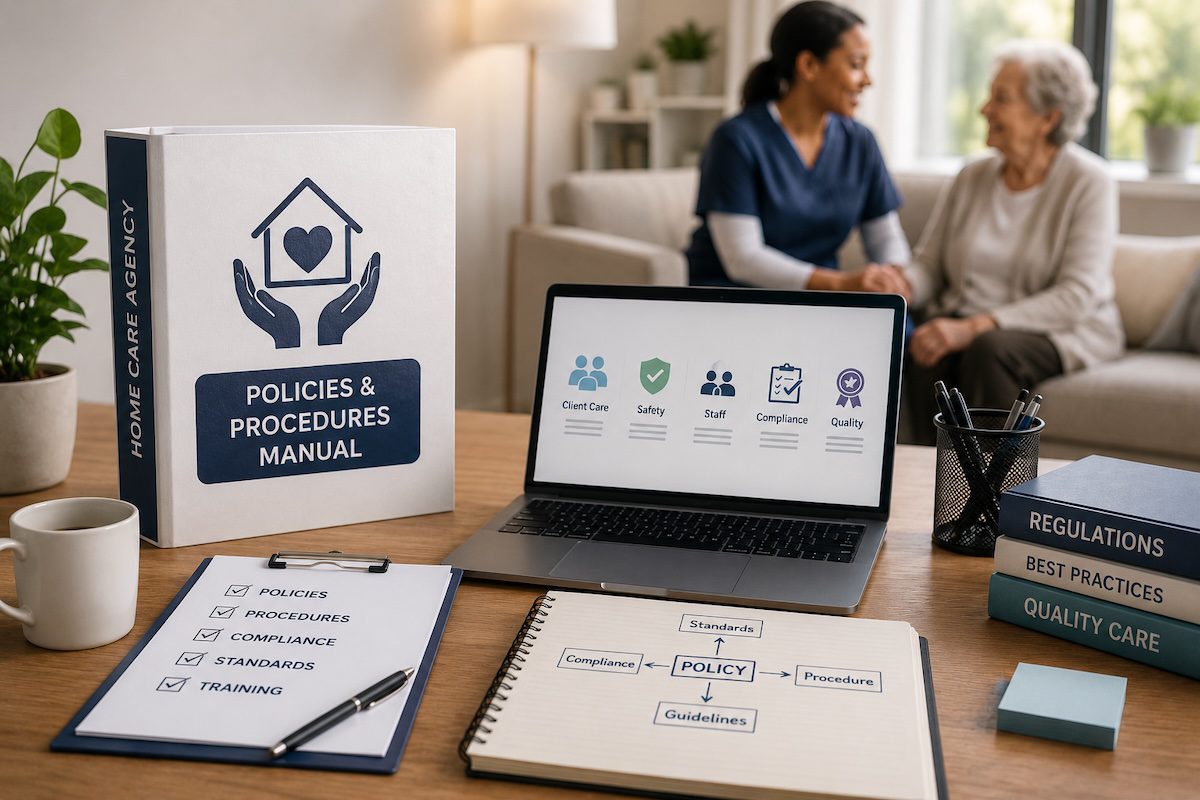
A home care agency policy and procedure manual is the document that tells your staff how your agency runs, how clients are protected, and how you stay compliant with state and federal rules. Without one that is clear, current, and complete, an agency risks failed surveys, denied reimbursement, and avoidable liability. With one, caregivers know exactly what to do, surveyors find the proof they need, and the business runs the same way on every shift.
This guide explains what the manual is, what sections it must contain, how accreditation and licensure shape it, and how to keep it survey-ready year after year.
Key Takeaways
✓ A policy and procedure manual sets the rules (policies) and the step-by-step methods (procedures) that govern every part of a home care agency.
✓ Non-medical home care and skilled home health follow different standards, so the manual must match your service model.
✓ State licensure, accreditation bodies like CHAP and ACHC, and Medicare Conditions of Participation all shape what the manual must include.
✓ A complete manual covers administration, client care, personnel, training, quality improvement, safety, records, and finances.
✓ Treat the manual as a living document: review it at least once a year and after any major regulatory change or incident.
What Is a Home Care Agency Policy and Procedure Manual?
A policy and procedure manual brings two related things together in one place. A policy is the rule: a clear statement of what your agency does and the standard it holds. A procedure is the method: the specific steps staff follow to carry that policy out. A policy might state that every client receives a written care plan before services begin. The matching procedure then lists who creates the plan, what it must contain, who signs it, and where it is filed.
The manual governs everyone connected to care delivery. Caregivers and personal care aides rely on it for daily tasks and client safety. Administrative staff use it for intake, scheduling, billing, and recordkeeping. Clients and their families gain a clear account of their rights, the services they will receive, and how to raise a concern.
A strong manual exists for four reasons: it keeps you compliant with licensing and accreditation rules, it makes you ready for a survey at any time, it lowers legal and operational risk, and it keeps care consistent no matter who is on shift. At The Write Direction, we often describe a good policy and procedure manual as the single source of truth for how an agency operates, because that is exactly the role it should play.
Home Care vs. Home Health: Why the Distinction Changes Your Manual
The phrase “home care” covers more than one kind of business, and the difference matters for your manual. Non-medical home care (also called private duty or personal care) provides help with daily living: bathing, dressing, meal preparation, companionship, and homemaking. Skilled home health provides clinical care ordered by a physician, such as nursing, wound care, and physical or occupational therapy, and is often Medicare-certified.
Your service model decides which rules apply. A non-medical agency answers mainly to state licensure requirements and, when it chooses, to private duty accreditation. A Medicare-certified home health agency must also meet the federal Conditions of Participation. Because the standards differ, a manual built for one model will leave dangerous gaps if you apply it to the other. Match the manual to the services you actually deliver, and update it the moment you add a new line of service.
The Regulatory and Accreditation Landscape
Several layers of oversight shape a home care manual, and your policies should map to each layer that applies to you.
State licensure comes first. Most agencies undergo a licensing survey, sometimes scheduled and sometimes unannounced, and surveyors review the manual for compliance. Requirements vary by state, so a generic template rarely satisfies them on its own.
Accreditation is the next layer. Bodies such as the Community Health Accreditation Partner (CHAP), the Accreditation Commission for Health Care (ACHC), and The Joint Commission set standards that many agencies adopt to demonstrate quality and, in some cases, to qualify for reimbursement. CHAP, for example, is an independent non-profit accreditor for home and community-based care and holds deeming authority from CMS, which means its survey can substitute for a federal or state inspection.
Federal rules apply to Medicare-certified agencies. The Conditions of Participation in 42 CFR Part 484 spell out what a home health agency must do to take part in the Medicare and Medicaid programs.
Finally, cross-cutting laws touch every agency: HIPAA protects client information, OSHA and bloodborne pathogen rules protect workers, and mandated reporting laws require staff to report suspected abuse, neglect, or exploitation. The Write Direction’s labor compliance support helps agencies line their documentation up against the specific boards and standards that govern them.
Core Sections Every Manual Should Contain
A complete home care policy and procedure manual is organized into clear sections so staff and surveyors can find what they need fast. The sections below appear in most well-built manuals.
Administration and Governance
This section sets the foundation: mission, vision, values, and statement of purpose, along with the governing body and administrator roles. It also defines document control, the system of version numbers, approval dates, and signatures that proves your policies are current and authorized.
Client Care
This is the heart of the manual. It covers admission and discharge criteria, client rights and responsibilities, the plan of care, coordination of care, advance directives, medication assistance or management, and supervision of services. Clear admission and discharge policies prevent disputes and protect both the client and the agency.
Personnel and Human Resources
This section governs your workforce: hiring, background checks, job descriptions, competency requirements, and supervision. Strong personnel policies keep unqualified staff out of clients’ homes and create a record that surveyors can verify.
Education and Training
Here you define onboarding, ongoing in-service training, and competency for specialty care such as dementia support or fall prevention. Training policies show that your caregivers are prepared for the clients they serve.
Performance Improvement (QAPI)
A quality assurance and performance improvement program describes how you monitor care, track complaints and incidents, and act on what you learn. This section turns problems into measurable improvements rather than repeated mistakes.
Safety Management
Safety policies cover emergency preparedness, infection control, and incident reporting. They explain what staff do during a disaster, how they prevent the spread of infection, and how they document accidents and near misses.
Information Management and Records
This section protects client information and sets rules for confidentiality, record content, and record retention. It connects directly to HIPAA and to your state’s retention timelines.
Financial
Financial policies address fees, billing methods, client notification of charges, and, where required, electronic visit verification. Clear financial policies reduce billing errors and build client trust.
How to Build a Survey-Ready Manual: The MAPPED Test
Writing policies is the easy part. Writing policies that survive a survey is harder. At The Write Direction, we use a simple check we call the MAPPED Test to confirm that each policy is complete and defensible before it goes into a manual. Run every policy through these six questions:
Mapped to a standard. Does the policy cite the specific regulation, Condition of Participation, or accreditation standard it satisfies? A policy that maps to a standard is easy to defend.
Assigned owner. Is a named role responsible for following and maintaining it? Ownership keeps policies from drifting out of date.
Procedure included. Is the policy paired with concrete, numbered steps? A principle without a procedure leaves staff guessing.
Proof defined. Does the policy name the form, log, or record that proves the work happened? Surveyors look for evidence, not intentions.
Effective version control. Does the policy show an approval date, version number, and signature? Version control demonstrates that leadership authorized it.
Due for review. Is a review date scheduled? A review cadence keeps the manual current between surveys.
A policy that passes all six is survey-ready. A policy that fails even one needs work before it earns a place in your manual.
Common Mistakes Agencies Make
A few avoidable errors cause most manual-related deficiencies.
The first is the generic template. An off-the-shelf manual that ignores your state and your services almost always contains gaps a surveyor will spot. The second is the orphaned policy: a policy with no matching procedure, or a procedure with no governing policy. The third is the static binder. Agencies that write a manual once and never touch it fall out of compliance as soon as regulations change. The fourth is the missing crosswalk, the simple map that links each policy to the standard it satisfies. Without it, both internal review and survey preparation take far longer than they should.
Keeping the Manual Current
A policy and procedure manual is a living document, not a one-time project. Review the full manual at least once a year as a baseline. Beyond that annual review, certain rules carry their own timelines: Medicare-certified agencies, for example, must review and update their emergency preparedness program on a set schedule under the Conditions of Participation.
Update individual policies sooner whenever a trigger occurs: a new or amended regulation, a change in leadership or services, or an incident that reveals a gap. Agencies that adopt new technology, such as AI-assisted scheduling or documentation tools, should also add policies that govern those tools. Each update should pass back through the MAPPED Test, and each new version should carry a fresh approval date and signature so your document control stays intact.
We Build Manuals That Hold Up
At The Write Direction, we have spent years building and refreshing policy and procedure manuals for agencies across North America, and we know that a manual is only as strong as the writing behind it. Our diverse team of writers, industry experts, and compliance specialists works closely with home care agencies to produce tailored manuals that match your state, your services, and the standards you answer to, whether you are launching a new agency or updating documentation that no longer keeps pace with the rules. We do not hand you a template. We collaborate with you to create documentation that reads clearly, holds up under a survey, and gives your caregivers a reliable guide for every shift.
If your home care agency needs a new manual, a thorough revision, or a compliance review of what you already have, we would be glad to help. Reach out through our contact page for a quote, or email us directly at [email protected] to start the conversation.
Frequently Asked Questions
What is the difference between a policy and a procedure?
A policy is the rule, and a procedure is the method. The policy states what your agency does and the standard it sets, such as requiring a written care plan for every client. The procedure lists the exact steps that carry the policy out: who acts, in what order, and which form or record they complete. A complete manual always pairs the two, because a policy without a procedure leaves staff unsure how to comply.
What is the difference between home care and home health policies and procedures?
Home care (non-medical or private duty) policies cover personal care, companionship, and homemaking, and answer mainly to state licensure. Home health policies cover skilled clinical services like nursing and therapy, and Medicare-certified agencies must also meet the federal Conditions of Participation. The two follow different standards, so each needs a manual built for its specific service model.
What should a home care policy and procedure manual include?
A complete home care policy and procedure manual includes sections on administration and governance, client care, personnel and human resources, education and training, quality assurance and performance improvement, safety management, information management and records, and finances. Each section pairs clear policies with step-by-step procedures and names the records that prove compliance during a state or accreditation survey.
What is a crosswalk in a policy and procedure manual?
A crosswalk is a reference table that links each policy to the specific regulation or accreditation standard it satisfies. It lets you, a surveyor, or an accreditor confirm coverage at a glance, instead of reading the whole manual to find a single requirement. A clear crosswalk speeds up survey preparation, makes annual reviews easier, and quickly reveals any standard your manual does not yet address.
Do home care agencies need CHAP or ACHC accreditation?
Not always. State licensure lets an agency operate, but accreditation through CHAP, ACHC, or another approved body is sometimes required, often to qualify for Medicare or Medicaid reimbursement or to satisfy certain states. Many agencies also pursue accreditation voluntarily to signal quality. Check your state’s rules and your payer requirements to decide whether accreditation applies to you.
How often should you update a home care policy and procedure manual?
Review the full manual at least once a year. Update individual policies sooner whenever regulations change, leadership or services change, or an incident reveals a gap. Some rules carry their own timelines: Medicare-certified agencies must review their emergency preparedness program on a set schedule. Treating the manual as a living document keeps it survey-ready all year.
Can I use a template for my home care policy and procedure manual?
A template can be a starting point, but it should never be your finished manual. Generic templates rarely match your state’s licensing rules, your accreditation standards, or the exact services you deliver, and surveyors notice the gaps. The stronger approach is to tailor every policy to your agency, then verify it against the standards that govern you.
How long does it take to create a home care policy and procedure manual?
The timeline depends on the size of your agency, your services, and the standards you must meet. A focused manual can take a few weeks, while a comprehensive one mapped to state licensure and accreditation standards takes longer. Working with experienced writers shortens the process, because they know which policies and procedures surveyors expect and how to map each one to the right standard from the start.
What happens if my manual fails a state survey?
If a surveyor finds that your policies or procedures fall short, your agency receives deficiencies and must submit a plan of correction explaining how and when you will fix each one. Serious or unresolved deficiencies can lead to sanctions, suspended payments, or loss of licensure. Clear, current, well-mapped documentation is the simplest way to avoid that outcome.

Related posts


Recent Posts