
SOP vs Work Instructions: Key Differences, Examples, and How to Choose
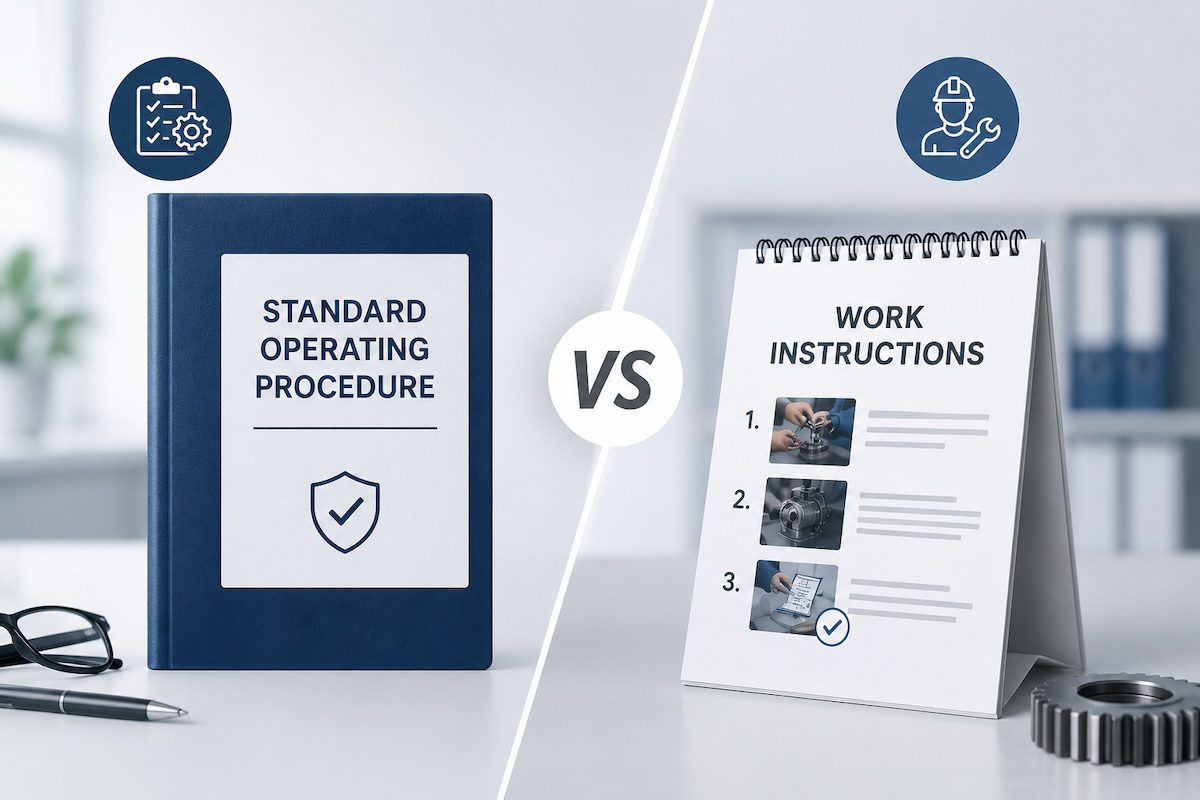
Teams across manufacturing, healthcare, and professional services frequently treat Standard Operating Procedures (SOPs) and work instructions as the same thing. They are not. Understanding the difference between SOP vs work instructions decides whether your documentation passes audits, trains new hires quickly, and actually gets used on the floor. This guide breaks down what each document does, when to write one over the other, and how the two work together inside a complete quality management system.
Key Takeaways
- An SOP defines what a process is, why it exists, and who is responsible. A work instruction defines how one specific task gets done.
- SOPs sit higher in the documentation hierarchy. Work instructions sit at the operator level, closest to the actual work.
- ISO 9001:2015 recognises both, though only certain documented information is strictly mandatory.
- Choose an SOP when you need cross-functional alignment. Choose a work instruction when an individual must execute a precise, repeatable task.
- The two documents are complementary, not competitive. Most mature organisations need both.
What Is a Standard Operating Procedure (SOP)?
A Standard Operating Procedure is a formal document that describes a routine business process from start to finish. It identifies the purpose, scope, roles, sequence of major steps, and references to supporting documents. SOPs answer the questions what needs to happen, why it matters, and who owns each part.
Under ISO 9001:2015, SOPs satisfy the standard’s “procedure” requirement inside a Quality Management System (QMS). Regulated industries such as pharmaceuticals, medical devices, food safety, and clinical research rely on SOPs to demonstrate compliance with bodies including the FDA, OSHA, GMP guidelines, and HIPAA.
A typical SOP includes:
- Purpose and scope
- Roles and responsibilities
- Required inputs, resources, and tools
- A sequence of major process steps
- Escalation paths and exceptions
- References to related policies, forms, and work instructions
- Revision history and document control information
SOPs are written for managers, supervisors, auditors, and cross-functional staff who need to understand the whole process, not just one step inside it.
What Are Work Instructions?
A work instruction is a granular, task-level document that tells one person exactly how to complete one job. Where an SOP says “calibrate the equipment,” a work instruction breaks that into numbered steps: wipe the sensor, zero the scale, place the reference weight, record the reading, and so on.
Work instructions answer the question how do I do this, correctly and safely, right now. They live closest to the work itself, often printed at workstations, embedded in tablets on the shop floor, or built into digital adoption platforms.
A strong work instruction usually contains:
- One clearly defined task
- Sequenced steps in plain language
- Tools, materials, and personal protective equipment required
- Visual aids: photos, screenshots, diagrams, or short videos
- Acceptance criteria so the operator knows when the task is complete
- Safety callouts and quality checks
- Document ID, version, and date
Visual work instructions and digital work instructions have replaced static PDFs in many modern factories and labs. They reduce training time, cut human error, and make updates faster to roll out.
SOP vs Work Instructions: Side-by-Side Comparison
| Attribute | Standard Operating Procedure | Work Instruction |
| Purpose | Defines the overall process | Defines how one task is performed |
| Scope | Broad, cross-functional | Narrow, single task |
| Level of detail | Medium, high-level steps | High, step by step |
| Primary audience | Managers, auditors, teams | Individual operators |
| Question answered | What, why, who, when | How |
| Format | Mostly text, structured sections | Text plus visuals, often digital |
| Update frequency | Lower, formal change control | Higher, faster revisions |
| ISO 9001:2015 role | Procedure layer | Detailed implementation layer |
A paired worked example
Consider a Quality Control SOP for a beverage manufacturer. The SOP describes the QC team’s responsibilities, sampling frequency, batch release criteria, and escalation rules. Sitting beneath that SOP are three separate work instructions:
- WI-QC-01: How to calibrate the digital scale before each shift
- WI-QC-02: How to draw and label a product sample from the filling line
- WI-QC-03: How to log results in the lab information management system (LIMS)
The SOP provides the framework. The work instructions get the work done. New employees can read the SOP to understand the whole QC operation, then follow each work instruction to execute their actual tasks.
How SOPs and Work Instructions Fit Into a Document Hierarchy
Inside a mature QMS, documentation follows a four-tier pyramid:
- Policies at the top: the organisation’s intent and principles
- Processes next: end-to-end workflows that transform inputs into outputs
- Procedures and SOPs in the middle: how each process is executed
- Work instructions and records at the base: task-level detail and proof of execution
This structure matters because ISO 9001:2015, FDA 21 CFR Part 820, and similar frameworks expect documentation to be traceable from policy down to the actual action on the floor. Auditors look for that line of sight. When work instructions cannot be traced back to an SOP, or when SOPs reference work instructions that no longer exist, organisations fail audits and lose certification.
When to Write an SOP vs a Work Instruction
Use this decision framework before drafting either document:
- Granularity test. Does the task have enough complexity, risk, or repetition to deserve its own document? If yes, it likely needs a work instruction. If the step is one of many in a wider workflow, it belongs inside an SOP.
- Audience test. Will the reader be a manager or auditor who needs the whole picture? Write an SOP. Will the reader be an operator performing one specific task? Write a work instruction.
- Frequency-of-change test. Stable, policy-level guidance that rarely changes fits an SOP. Detail that updates whenever equipment, software, or methods change fits a work instruction.
- Risk and compliance test. Safety-critical, regulated, or audit-sensitive work usually needs both: an SOP to define the process and work instructions to control each high-risk step.
If you can answer yes to “an individual needs to perform this exact task the same way every time,” you need a work instruction. If you can answer yes to “we need shared understanding of how this whole process runs,” you need an SOP.
Industry Examples Beyond Manufacturing
The SOP and work instruction model is not limited to factory floors. At The Write Direction, we have written documentation across the sectors below.
- Manufacturing. An assembly SOP defines the build sequence. Work instructions detail torque settings, fastener placement, and inspection points.
- Healthcare. A patient intake SOP defines triage roles and timing. Work instructions cover blood draw technique, vitals capture, and EHR entry.
- Pharmaceuticals. A batch production SOP covers material flow and release criteria. Work instructions handle weighing, granulation, and tablet compression at each station.
- SaaS and IT operations. An incident response SOP defines severity tiers and communication paths. Runbooks function as work instructions for restoring a specific service.
- Professional services. A client onboarding SOP outlines the engagement lifecycle. Work instructions guide CRM data entry, kickoff agenda templates, and document collection.
The pattern is consistent: the SOP gives the team a shared mental model. The work instruction gives the individual a reliable script.
Common Mistakes to Avoid
- Using the two terms interchangeably. This produces bloated SOPs that operators ignore and orphan work instructions no one can trace.
- Overloading SOPs with task-level detail. SOPs become unreadable, and any small tooling change forces a full SOP revision.
- Writing work instructions without an anchoring SOP. Detail without context creates inconsistency and audit findings.
- Skipping version control and ownership. Documents drift, contradict each other, and lose credibility.
- Forgetting to update after process changes. Outdated documentation is worse than no documentation because it actively misleads new staff.
Best Practices for Writing SOPs and Work Instructions
For SOPs, lead with purpose and scope, name the process owner, list roles clearly, sequence the major steps, and link to supporting documents. Keep sentences short. Avoid jargon when a plain word will do.
For work instructions, keep one task per document, use numbered steps, embed visuals near each action, state acceptance criteria, and flag safety risks where they appear in the sequence. Write at the reading level of the actual operator, not the procedure author.
Through our policy manual writing services, we help organizations develop clear SOPs, work instructions, and related documentation that support consistency, training, and compliance.
Frequently Asked Questions
Is a work instruction the same as an SOP?
No. An SOP describes a full process and explains what needs to happen and why. A work instruction describes one specific task inside that process and explains exactly how to perform it. Some organisations use the terms loosely, but in any regulated environment or ISO 9001:2015 quality system the two documents serve different roles and audiences.
Does ISO 9001 require both SOPs and work instructions?
ISO 9001:2015 mandates certain documented information, including the quality policy, scope, and specific records. It does not strictly require either SOPs or work instructions by those names. However, most ISO 9001-certified organisations maintain both because together they prove that processes are controlled and tasks are executed consistently across the workforce.
Which comes first, the SOP or the work instruction?
The SOP comes first. You define the process, its purpose, and its owners before drilling into task-level detail. Once the SOP exists, individual steps that need granular guidance get their own work instructions. Writing work instructions before SOPs often produces conflicting documents and orphaned procedures.
Can a work instruction exist without an SOP?
Technically yes, but it is rarely a good idea. Without an anchoring SOP, the work instruction lacks context, ownership, and traceability. Auditors flag standalone work instructions because there is no documented process they support. The only common exception is very small organisations where one informal procedure covers the entire operation.
How detailed should work instructions be?
Detailed enough that a competent new employee can complete the task correctly without asking for help. That usually means numbered steps, visuals for any action that benefits from one, tools and materials listed at the top, safety notes inline, and acceptance criteria at the end. Avoid padding. Every sentence should drive the next action.
How often should SOPs and work instructions be reviewed?
Most quality systems require an annual review at minimum. Trigger an earlier review whenever the process changes, equipment is replaced, regulations are updated, or an incident reveals a gap. Work instructions typically need revisions more often than SOPs because they sit closer to changing tools and methods on the ground.
Final Thoughts
At The Write Direction, we have spent years helping operations, quality, and compliance teams stop confusing SOPs with work instructions and start writing both well. Clear documentation is not paperwork. It is how your team scales, how your audits go smoothly, and how your new hires get productive in weeks instead of months.
If your SOPs are bloated, your work instructions are missing, or your team cannot tell which document to write next, we can help. Book a consultation or email us at [email protected] to talk through what your documentation actually needs.

Related posts


Recent Posts