
RFA vs RFP: Key Differences, When to Use Each, and How to Respond
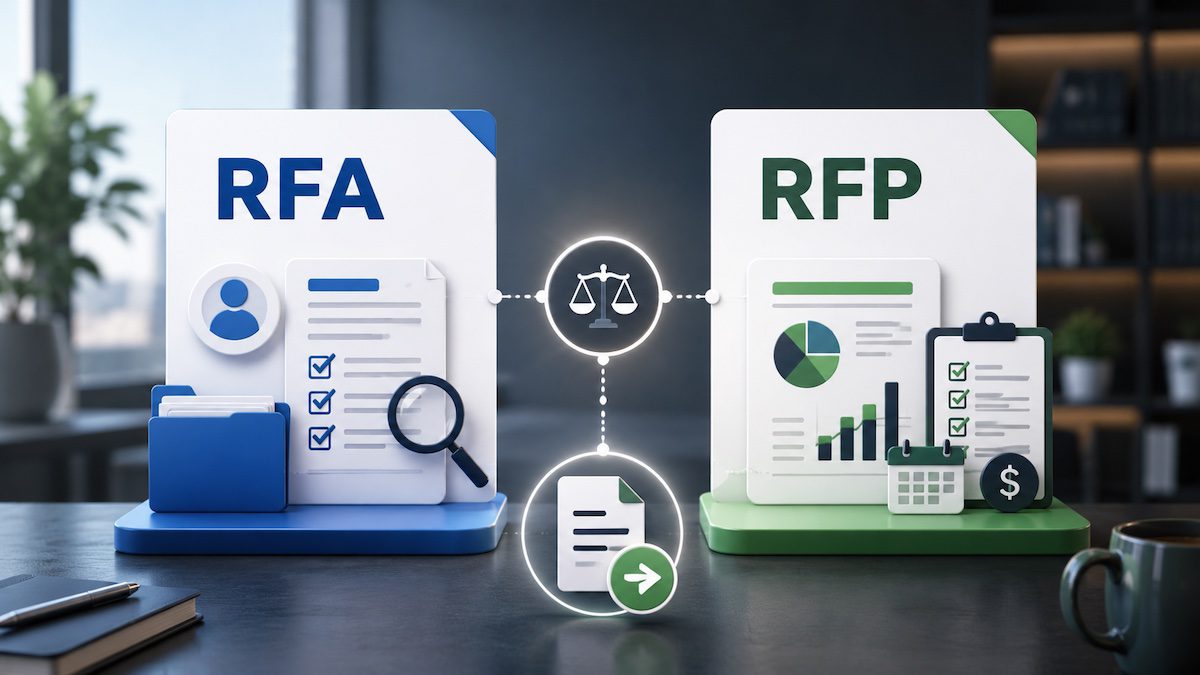
The RFA vs RFP question trips up first-time applicants, seasoned grant writers, and procurement teams alike. The two acronyms look almost identical, and people use them interchangeably all the time. That confusion has a real cost. Submitting a grant-style application to a procurement RFP can get your response thrown out for non-compliance. Pitching a vendor sales narrative into a grant RFA can sink your evaluation score. The two documents serve different purposes, follow different regulations, and reward different writing approaches.
This guide breaks down the RFA vs RFP distinction from every angle that matters: definitions, a side-by-side comparison, regulatory framework, response strategy, post-award implications, and a practical test for figuring out which document you are actually looking at.
Key Takeaways
- RFA stands for Request for Application; RFP stands for Request for Proposal.
- RFAs solicit grant applications. RFPs solicit contract proposals or, in foundation contexts, grant proposals.
- The federal distinction maps to two different regulatory frameworks: Uniform Guidance (2 CFR Part 200) for grants and the FAR for contracts.
- Private foundations use the terms interchangeably, so always read the document rather than relying on the title.
- RFAs reward mission alignment and methodological creativity. RFPs reward technical capability, past performance, and competitive pricing.
- Post-award obligations differ significantly, including reporting cadence, audit risk, allowable costs, and indirect cost treatment.
- When the label is ambiguous, ask: assistance or purchase, mission or deliverable, 2 CFR or FAR, advance a goal or execute a scope.
What Is a Request for Application (RFA)?
A Request for Application is a formal solicitation issued by a government agency or foundation that invites eligible organizations to apply for grant funding or a cooperative agreement. The Federal Grant and Cooperative Agreement Act of 1977 (31 U.S.C. §§ 6301 to 6308) sets the legal foundation for federal RFAs, and most federal grant awards then fall under the Uniform Guidance at 2 CFR Part 200.
RFAs come from agencies like the National Institutes of Health (NIH), the National Institute of Allergy and Infectious Diseases (NIAID), the Environmental Protection Agency (EPA), the Substance Abuse and Mental Health Services Administration (SAMHSA), the Department of Health and Human Services (HHS), and the United States Department of Agriculture (USDA). State agencies and many private foundations also use the format.
Eligible applicants usually include nonprofit organizations, universities, research institutions, community-based groups, and (for some opportunities) for-profit entities pursuing research and development. RFAs are typically published on Grants.gov, in the Federal Register, on the NIH Guide, and on the issuing agency’s own portal.
What Is a Request for Proposal (RFP)?
A Request for Proposal is a formal solicitation issued by a buyer (a government agency, private company, nonprofit, or foundation) that invites vendors to submit a detailed proposal for a specific product, service, or project. In the federal context, RFPs fall under Federal Acquisition Regulation (FAR) Part 15, which governs negotiated procurements.
RFPs can also be issued by private foundations soliciting grant proposals, which is where the terminology overlap creates real confusion. The label on the cover page does not always tell you the funding mechanism underneath. Most procurement RFPs appear on SAM.gov, agency procurement portals, state and municipal procurement sites, and private bid databases. Typical respondents include for-profit vendors, consulting firms, contractors, and (for some scopes) nonprofits providing services.
RFA vs RFP: Side-by-Side Comparison
| Dimension | RFA (Request for Application) | RFP (Request for Proposal) |
|---|---|---|
| Primary purpose | Award grant funding to advance the funder’s mission | Acquire goods or services to meet the buyer’s needs |
| Funding mechanism | Grant or cooperative agreement | Contract |
| Relationship | Partner or benefactor | Customer and vendor |
| Governing framework (federal) | Uniform Guidance (2 CFR Part 200); Federal Grant and Cooperative Agreement Act of 1977 | Federal Acquisition Regulation (FAR) Part 15 |
| Typical issuer | NIH, NIAID, EPA, SAMHSA, HHS, USDA, state agencies, foundations | Federal procurement offices, companies, foundations, nonprofits |
| Typical respondent | Nonprofits, universities, research institutions, and sometimes for-profits | For-profit vendors, contractors, consulting firms |
| Evaluation focus | Scientific or programmatic merit, mission alignment, and feasibility | Technical approach, past performance, price, and compliance |
| Scope flexibility | Applicants propose a methodology and approach | Buyer specifies scope; vendor proposes execution |
| Award document | Notice of grant award; grant agreement | Contract or task order |
| Payment structure | Cost reimbursement or a fixed amount tied to milestones | Firm fixed price, cost reimbursement, or time and materials |
| Reporting requirements | Programmatic and financial reports; Single Audit threshold applies above $750,000 in federal awards | Deliverable acceptance, invoices, contract-specific reports |
| Indirect cost treatment | Federally negotiated indirect cost rate, or 10% de minimis | Contract-specific overhead and G&A rates |
| Where to find opportunities | Grants.gov, Federal Register, NIH Guide, agency portals | SAM.gov, agency procurement portals, bid databases |
Key Differences Explained
Purpose and Intent
An RFA advances the funder’s mission. The funder wants to see public health improve, research advance, or a community problem solved. An RFP buys what the buyer needs. The buyer has a specified outcome and wants a vendor to deliver it.
The Funding Relationship
In an RFA, you become a partner. The funder shares your goal and provides resources so you can pursue it. In an RFP, you become a vendor. The buyer is your customer, the relationship is contractual, and your job is to deliver against a specification.
Scope Flexibility
RFAs reward methodological creativity. The funder usually states a goal (reduce opioid mortality, improve STEM outcomes, advance cancer research) and lets applicants propose how to get there. RFPs lock the scope. The buyer has already decided what they want, and vendors compete on how well they can execute that defined scope.
Regulatory Framework
The federal version of this distinction is sharp. Grants flow under the Uniform Guidance at 2 CFR Part 200, which sets allowable costs, audit thresholds, and procurement standards for award recipients. Contracts flow under the FAR, which sets bidding rules, cost principles, and inspection clauses for vendors. Mixing the two compliance frameworks in your response is one of the fastest ways to get disqualified.
Evaluation Criteria
RFA reviewers score on scientific or programmatic merit, alignment with funding priorities, organizational capacity, and project feasibility. RFP evaluators score on technical capability, past performance, price, and compliance with stated requirements. The same writer cannot reuse the same response. The audience and the rubric are different.
A Worked Example: Same Project, Two Funding Routes
Picture a community health initiative focused on opioid prevention in a single county. The two routes look like this.
Routed as an RFA (grant): Your organization proposes a program design grounded in evidence-based prevention research. You include a logic model, named partners, a sustainability plan, and a project narrative explaining how your work advances the funder’s public health priorities. The budget includes salaries, supplies, an indirect cost rate, and modest evaluation costs. Deliverables are flexible. Reporting is programmatic.
Routed as an RFP (contract): A county health department has already designed the program. They issue an RFP for a vendor to deliver specified services: a defined number of training sessions, a fixed deliverable schedule, performance metrics, and a not-to-exceed budget. Your response demonstrates capability, past performance on similar contracts, and competitive pricing. The county owns the design. You execute.
Same problem. Two completely different documents and two completely different writing approaches. At The Write Direction, we routinely help clients identify which route applies and prepare the response that fits.
When Are RFA and RFP Used Interchangeably?
The clean federal distinction breaks down in the foundation and private sector world. Many private foundations call their grant solicitations “RFPs” even though they are functionally requests for grant applications. Some federal agencies prefer the term Notice of Funding Opportunity (NOFO) or Notice of Funding Availability (NOFA) instead of either RFA or RFP. State and local governments mix the terminology constantly.
The legal distinction still matters. Whether you are dealing with a grant or a contract determines the regulations, the writing approach, and the post-award obligations. The practical rule is simple: read the document, not the title. If it talks about the scope of work, deliverables, vendors, and contract terms, treat it as procurement. If it talks about program goals, project narratives, eligibility, and grant terms, treat it as assistance.
Where RFA and RFP Fit Within the Broader RFx Family
RFA and RFP sit inside a wider family of solicitation documents collectively known as RFx. Knowing where each one falls helps you read any solicitation faster.
- RFI (Request for Information): Early-stage market research. Non-binding. Buyers use it to learn what is available before defining requirements.
- RFQ (Request for Quotation): Price-focused. Specs are locked. Buyer wants competing prices from prequalified vendors.
- RFP (Request for Proposal): Buyer wants vendors to propose how they will solve a defined problem.
- RFA (Request for Application): Funder wants eligible organizations to apply for grant funding to advance the funder’s mission.
- RFT (Request for Tender): The most formal, legally binding solicitation. Common in government infrastructure and construction.
- RFEI (Request for Expression of Interest): Gauges interest from potential respondents before issuing a formal solicitation.
- NOFA / NOFO (Notice of Funding Availability / Opportunity): Government announcement that grant funds are available. Often used in place of “RFA.”
RFAs and RFPs anchor opposite ends of the assistance versus procurement spectrum. Everything else clusters around them.
How to Respond to an RFA vs an RFP
Responding to an RFA
Lead with mission alignment. Reviewers want to see that your project advances the funder’s stated priorities. A strong RFA response includes:
- A project narrative that frames the need, the proposed approach, and the expected outcomes
- A logic model linking activities to outputs to outcomes
- A budget and budget justification tied directly to project activities
- Demonstrated organizational capacity, including key personnel CVs and prior performance
- Letters of support from named partners
- A sustainability plan
Common rejection reasons: applicant ineligibility, weak mission fit, vague outcomes, unrealistic budgets, and missing required attachments.
Responding to an RFP
Lead with a demonstrated understanding of the buyer’s problem. Evaluators want to see that you can deliver what they have specified. A strong RFP response includes:
- An executive summary with clear win themes
- A technical approach that maps directly to the stated scope of work
- Past performance citations relevant to the scope
- A pricing volume that is competitive and compliant with cost instructions
- A compliance matrix confirming every requirement is addressed
- Credentials, certifications, and financial stability documentation
Common rejection reasons: non-compliance with the solicitation format, weak differentiation, uncompetitive pricing, missing past performance, and scoring shortfalls on technical evaluation factors.
Post-Award: How the Two Diverge After You Win
Most guides stop at “you win the money.” What happens next is where RFAs and RFPs separate most dramatically.
Reporting cadence. Grant recipients submit programmatic reports tied to project milestones and financial reports tied to expenditures. Contract holders submit deliverable acceptance documentation, invoices, and any contract-specific reporting clauses.
Audit risk. Federal grant recipients that expend $750,000 or more in federal awards in a year trigger a Single Audit under the Uniform Guidance. Contracts have their own audit clauses governed by the FAR, with audit triggers tied to contract value and type.
Allowable costs. Grant costs must meet Uniform Guidance standards: necessary, reasonable, allocable, and consistently treated. Contract costs follow the cost principles in FAR Part 31 for federal procurement. The two frameworks overlap but are not identical.
Indirect costs. Grant recipients typically apply a federally negotiated indirect cost rate or the 10% de minimis. Contract overhead and G&A rates are negotiated contract by contract under the FAR.
Scope change. Modifying a grant scope requires prior approval from the awarding agency. Modifying a contract scope requires a formal contract modification, which often involves contracting officer approval and price renegotiation.
The Write Direction team helps clients understand these post-award obligations before they submit, so winning the work does not become a compliance burden later.
How to Tell Which Document You Are Looking At: A Four-Question Test
When the cover page is ambiguous, run through these four questions.
- Is the money flowing as assistance or as a purchase? Assistance points to RFA. Purchase points to RFP.
- Is the issuer trying to advance a mission or acquire a deliverable? Mission advancement points to RFA. Deliverable acquisition points to RFP.
- Does the document reference 2 CFR Part 200 or the FAR? 2 CFR Part 200 means grant. FAR means contract.
- Are you proposing how to advance a goal or how to deliver a specified scope? Advancing a goal points to RFA. Delivering a specified scope point to the RFP.
If three of four answers point in the same direction, you have your answer.
Common Mistakes Organizations Make
- Treating an RFA like a sales pitch. Grant reviewers want mission alignment and feasibility, not marketing language.
- Treating an RFP like a mission statement. Procurement evaluators want technical capability and competitive pricing, not your origin story.
- Missing compliance requirements. Both document types have hard requirements (page limits, font sizes, required attachments, file naming). Missing them is the fastest way to get disqualified.
- Underestimating the budget narrative. Both RFAs and RFPs reward budgets clearly tied to scope. Vague budgets get scored down.
- Ignoring evaluation weights. Most solicitations publish scoring weights. Allocating your response effort to match those weights is the single highest-leverage thing you can do.
Frequently Asked Questions
Is an RFA the same as a grant?
No. An RFA is the solicitation document that invites applications. The grant is the award you receive if your application is selected. The two terms get mixed up because they are part of the same funding cycle, but they refer to different stages: solicitation versus award.
Can the same project be funded through both an RFA and an RFP?
Rarely, and not simultaneously for the same scope. The choice depends on the funder’s intent. If the funder wants to support your work in advancing a shared mission, expect an RFA. If the funder has already designed the project and wants a vendor to execute, expect an RFP. Some organizations pursue both funding routes for related but distinct projects.
What is the difference between an RFA, RFP, and NOFA/NOFO?
NOFA (Notice of Funding Availability) and NOFO (Notice of Funding Opportunity) are federal government terms for grant funding announcements. RFA (Request for Application) is most common at NIH and HHS. RFP (Request for Proposal) is more common in procurement contexts and in foundation grant-making. The funding mechanism (grant or contract) matters far more than which label the issuer chose.
Who can respond to an RFA versus an RFP?
RFAs are typically open to nonprofit organizations, universities, research institutions, and (for some opportunities) for-profit entities pursuing research and development. RFPs open to any qualified vendor, contractor, or service provider that meets the stated eligibility. Some federal RFPs restrict bidding to small businesses, women-owned businesses, service-disabled veteran-owned businesses, or other set-aside categories.
Does Canada use RFA and RFP the same way as the United States?
Canadian practice overlaps but uses different terminology. Federal procurement runs through Public Services and Procurement Canada and follows Treasury Board rules rather than the FAR. Grant solicitations may be labeled “call for proposals” or “call for applications” by federal departments and provincial agencies. The Competition Bureau Canada enforces fair-bidding rules that influence how RFPs are written and evaluated. The grant-versus-contract distinction holds; the labels vary by jurisdiction.
Do I need a professional writer to respond to an RFA or RFP?
Not legally, but it changes your win rate. Federal RFAs and high-value RFPs reward precise technical writing, compliance discipline, and a structured budget narrative. At The Write Direction, our team brings both grant writing and RFP response experience, so we can match the response style to the document type and improve your odds of an award.
Conclusion
The RFA vs RFP question is not really about acronyms. It is about whether money is flowing as assistance or as a purchase, and that single distinction shapes everything else: the regulations, the writing style, the evaluation criteria, and the post-award obligations.
At The Write Direction, we work both sides of this divide every day. Our team has helped nonprofits win federal RFA grants, supported research institutions through complex cooperative agreement applications, and written winning RFP responses for vendors competing in municipal, provincial, and federal procurement. If you are staring at a solicitation and are not sure whether you are looking at a grant or a contract, or if you know which one it is and want a sharper response, get in touch with The Write Direction. We will help you read the document right and write the response that wins.